



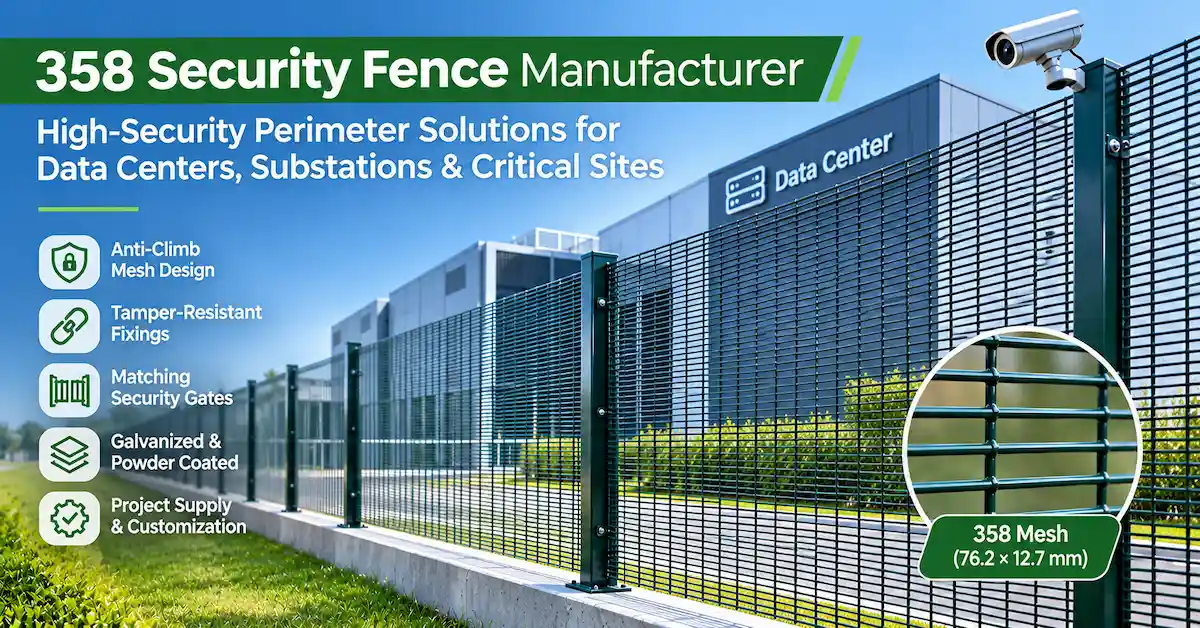
TL;DR: A reliable 358 security fence manufacturer should supply more than close-mesh panels. For data centers, substations, and other critical facilities, buyers must specify the complete perimeter system: 76.2 × 12.7 mm mesh, appropriate wire diameter, engineered posts, secure fixings, compatible gates, corrosion protection, and documented inspection requirements. The 358 mesh pattern improves climb resistance, but it does not automatically provide a certified intrusion-resistance rating.
High-value infrastructure requires a different approach to perimeter fencing.
A standard industrial fence may be adequate for boundary separation. A data center or electrical substation may also require restricted access, surveillance visibility, intrusion deterrence, and coordinated physical security measures.
This makes supplier selection more complicated.
Two quotations may offer the same 358 mesh dimensions but differ significantly in post construction, panel overlap, connection security, gates, coating systems, and testing documentation.
For international EPC contractors, security integrators, and procurement managers, these differences can affect installation, acceptance, and future maintenance.
This guide explains how to evaluate a 358 security fence manufacturer using technical specifications, system-level design requirements, manufacturing controls, and a practical RFQ checklist.
Key Takeaways
-
358 identifies a mesh configuration: The conventional specification uses approximately 76.2 × 12.7 mm welded mesh and 4 mm wire.
-
Security depends on the complete system: Panels, posts, clamps, foundations, and gates all contribute to perimeter performance.
-
Anti-climb does not mean intrusion-proof: Narrow mesh openings restrict footholds and handholds but cannot guarantee prevention of every attack.
-
Security ratings require evidence: A 358 mesh designation is not equivalent to an LPS 1175 certification.
-
Infrastructure sites require coordination: CCTV, access control, electrical safety, site grading, and maintenance access should be considered during specification.
-
Manufacturing quality matters: Wire diameter, welded intersections, coating condition, dimensional tolerances, and connection compatibility require inspection.
-
The RFQ must be complete: Ask for an itemized panel, post, fixing, gate, coating, packaging, and documentation schedule.
What Is a 358 Security Fence?
A 358 security fence is a welded steel mesh perimeter fencing system designed to make unauthorized climbing more difficult while preserving visibility through the fence.
It is also commonly called 358 anti-climb fencing, prison mesh fencing, or high-security welded mesh fencing.
The name originates from an imperial measurement convention:
-
3 inches: approximately 76.2 mm.
-
0.5 inch: approximately 12.7 mm.
-
8 gauge: conventionally associated with approximately 4 mm wire in this application.
The narrow mesh arrangement reduces the space available for conventional handholds and footholds.
However, its effectiveness depends on the wire material, welding, panel construction, connection details, and the complete installed system.
Typical 358 Security Fence Specifications
| Component | Common Industry Reference | What Buyers Must Confirm |
|---|---|---|
| Mesh configuration | 76.2 × 12.7 mm | Measurement convention and tolerance |
| Wire diameter | Approximately 4.0 mm | Steel-core diameter, grade, tolerance |
| Panel construction | Resistance-welded steel wires | Weld integrity and panel geometry |
| Panel height | Project-dependent, commonly around 2–3 m | Finished security height |
| Panel width | Often around 2.4–2.5 m | Actual width and post center spacing |
| Steel posts | Square or rectangular hollow sections | Section, wall thickness, foundation |
| Connections | Clamp bars, plates or security clips | Fixing pattern and tamper resistance |
| Surface finish | Zinc coating and/or compatible organic coating | Specified coating process and inspection |
| Access gates | Pedestrian, swing or sliding systems | Security, operation and perimeter continuity |
| Additional features | Approved security toppings or sensor interfaces | Project authorization and compatibility |
These are reference specifications, not a guarantee that every configuration is available from one manufacturer.
Always use the supplier's approved product drawing for the final order.
Who Should Choose a 358 Security Fence Manufacturer?
358 fencing is relevant to buyers whose projects place greater emphasis on restricted access and perimeter security than conventional boundary definition.
| Buyer Type | Application | Main Procurement Priority |
|---|---|---|
| Data center developer | Server campus perimeter | Controlled access and monitoring |
| Power utility contractor | Electrical substation boundary | Security and site-specific safety |
| Security systems integrator | Integrated perimeter protection | Fence and detection-system interfaces |
| Airport infrastructure contractor | Restricted facility boundaries | Access coordination and durability |
| Industrial EPC contractor | Critical machinery and storage areas | Engineering and installation compatibility |
| Government project supplier | Protected public infrastructure | Documented specification and acceptance |
When Might 358 Fencing Be Unnecessary?
A conventional 2D or 3D welded mesh fence may be sufficient for a low-risk site requiring only boundary separation.
If the project's primary requirement is visual privacy, open 358 mesh may not provide the desired screening.
Where certified forced-entry resistance, vehicle-impact resistance, or specialized containment is required, a conventional 358 system should not be selected without verifying the relevant tested performance.
The correct solution follows the project's security risk assessment, not the product name alone.
For general perimeter selection, review Giant Fence's security fence comparison guide.
How Does 358 Fencing Support Perimeter Security?
The practical advantages of 358 welded mesh come from its geometry and integration with a complete fence structure.
1. Restricted Climbing Opportunities
The narrow mesh pattern makes it difficult to obtain conventional handholds and footholds.
However, adjacent buildings, equipment, landscape features, and poorly designed gates can undermine the intended anti-climb effect.
2. Resistance to Casual Interference
Welded steel wire intersections and closely spaced openings can make certain interference methods more difficult.
Actual resistance to cutting or forced entry depends on the tools, attack method, wire properties, connections, and overall assembly.
3. Visibility for Surveillance
Open welded mesh allows visibility through the boundary.
This may support CCTV coverage and security patrols, but camera position, lighting, vegetation, and site obstacles still determine actual surveillance effectiveness.
4. Integration with Perimeter Detection
Suitable fence systems can be coordinated with alarm or detection equipment.
Mounting methods, cable routing, sensor performance, and maintenance access should be designed by the responsible security-system specialist.
A physical fence is one component of perimeter security—not a replacement for access control, monitoring, and response procedures.
Which 358 Security Fence Configuration Is Right for Your Project?
Buyers should compare complete system configurations rather than assuming all 358 fencing offers identical performance.
Configuration Comparison
| Configuration | Main Components | Suitable Project Need | Important Verification |
|---|---|---|---|
| Standard 358 Boundary | Close-mesh panels, posts, approved clamps | Controlled industrial perimeter | Geometry, posts, coating |
| 358 With Coordinated Access | Panels, secure pedestrian and vehicle gates | Data centers and utility facilities | Gate security and interfaces |
| Project-Engineered 358 System | Site-specific panels, supports, fixings and approved enhancements | Higher-risk or exposed locations | Structural and security evidence |
| Certified Security System | Exact tested fence and gate configuration | Projects requiring an intrusion-resistance rating | Valid independent certification |
These are procurement configurations, not separate GIANT MESH product model names.
Why the Certified System Is Different
A product can use 358 mesh without having a tested forced-entry rating.
A certified system must be supported by documentation identifying the actual tested configuration.
Changing the posts, fasteners, height, or gates can affect whether that certification remains applicable.
Therefore, buyers should never substitute an untested configuration for a specified certified system without approval.
Why Are Anti-Tamper Fixings and Panel Connections Important?
The panel itself is only one part of the security boundary.
Posts and connections transfer loads and keep adjoining panels securely attached.
Panel-to-Post Connections
Depending on the approved system, 358 panels may use steel clamp bars, plates, or compatible security clips.
The drawings should define the fixing arrangement, materials, spacing, and connection details.
Tamper-Resistant Fasteners
Security fasteners are intended to reduce unauthorized removal using ordinary methods.
They are not automatically tamper-proof.
Buyers should verify whether replacement tools, spare fasteners, and maintenance procedures are available to authorized personnel.
Panel Overlaps
Some 358 systems use overlapping panel edges at posts.
Where this arrangement is specified, panel width and post center spacing may differ.
For large projects, using nominal panel width as installed bay spacing can create quantity errors.
Post and Foundation Design
A larger or thicker post is not automatically sufficient.
Structural selection depends on fence height, wind action, terrain, connection forces, foundations, and ground conditions.
A qualified designer should confirm the appropriate configuration.
How Should Security Gates Match a 358 Fence?
Gates should be included in the security fence specification from the beginning of the project.
A perimeter with closely spaced mesh panels may still have vulnerabilities if its entrances use incompatible frames, connections, or access hardware.
Pedestrian Security Gates
Consider the clear opening, frame rigidity, hinges, locking method, operating requirements, and compatibility with nearby fence panels.
Vehicle Access Gates
Swing and sliding gates may serve different layouts and operating conditions.
The choice depends on available space, traffic, foundations, gate weight, operational safety, and access-control requirements.
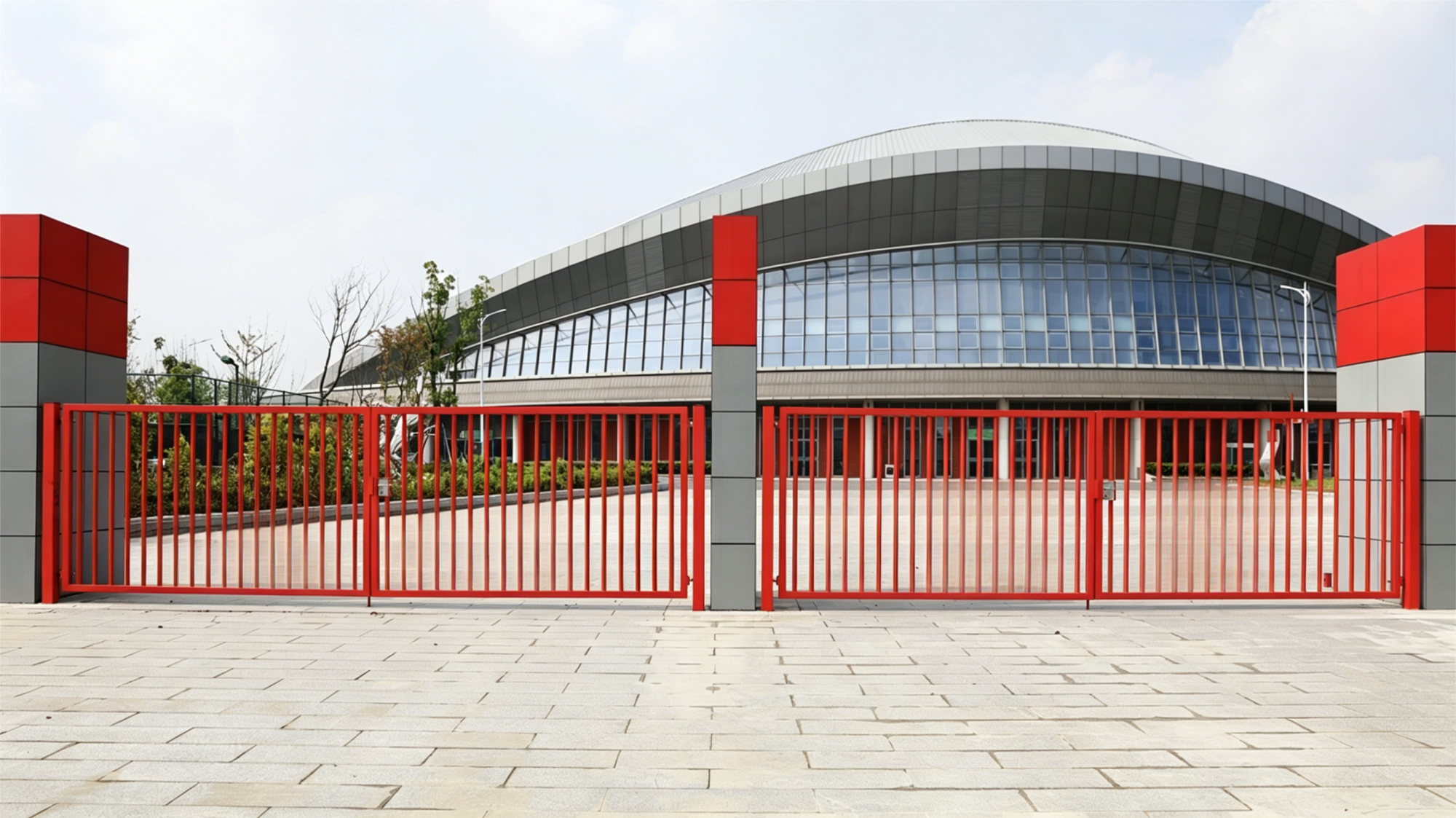
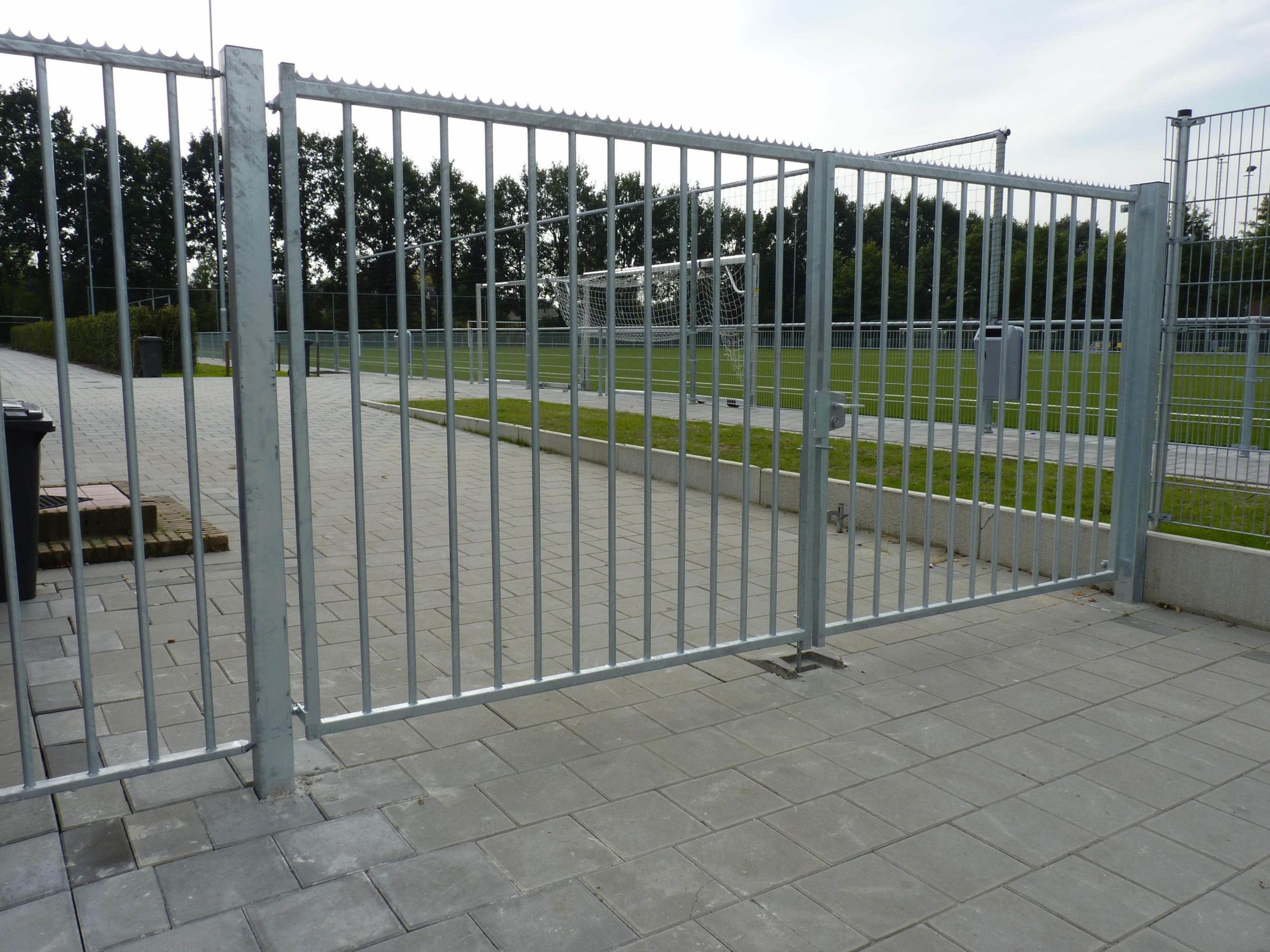
Giant Fence's double gate product illustrates a related entrance product category. Its suitability for a particular 358 security project must be confirmed; a conventional double gate is not automatically a certified high-security gate.
Security System Interfaces
Where electronic access control is specified, coordinate the gate supplier with the access-control and safety specialists.
A gate's structural performance and its electronic control functions require separate evaluation.
Manufacturing Quality Control for 358 Security Fence Panels
A reliable 358 security fence manufacturer should be able to explain how its manufacturing and inspection processes control finished product quality.
Giant Fence, operated by Hebei Giant Metal Technology Co., Ltd., is based in Anping County, Hebei Province, China.
Its published manufacturing background includes wire mesh production, welding, post fabrication, surface treatment, and fencing system supply.
Review the company's manufacturing background when assessing supplier capabilities.
Important Manufacturing Stages
Wire Preparation: Confirm material specification and wire diameter before production.
Mesh Welding: Inspect intersection quality and consistent mesh geometry.
Panel Fabrication: Verify dimensions, squareness, and any approved forming operations.
Post Manufacturing: Check post sections, connection positions, and fabrication quality.
Surface Treatment: Inspect the applicable galvanizing or coating requirements.
Trial Assembly: Confirm that panels, posts, and approved fixings fit correctly.
358 Security Fence Inspection Checklist
| Inspection Item | Required Evidence |
|---|---|
| Wire diameter | Measured results against approved drawings |
| Mesh opening | Defined aperture measurement and tolerances |
| Weld intersections | Agreed visual or mechanical checks |
| Panel geometry | Height, width, squareness, flatness |
| Posts | Section dimensions and connection locations |
| Security fasteners | Type, quantity and compatibility |
| Coating | Process specification and inspection results |
| Gate interfaces | Approved drawings and trial assembly |
| Packaging | Protected panels and identified components |
For high-security projects, inspections should be linked to documented acceptance criteria rather than informal claims such as "100% secure" or "zero defects."
What Standards Should Buyers Check?
Industry standards address different parts of fence performance.
They should not be treated as interchangeable certifications.
EN 10223-7: Welded Mesh Panel Requirements
BS EN 10223-7:2012 addresses welded steel wire panels for fencing, including applicable properties, tolerances, and coatings.
It provides a useful basis for specifying manufactured mesh panels.
BS 1722-14: Open-Mesh Steel Panel Fencing
BS 1722-14:2017 addresses design, installation, testing, and performance requirements for open-mesh steel panel fences within its scope.
Its categories cover general-purpose through higher-security applications.
LPS 1175: Tested Intrusion Resistance
LPS 1175 Issue 8 provides a framework for evaluating resistance to forced entry.
Ratings are associated with defined attack tool sets and minimum resistance times.
A manufacturer cannot legitimately claim that a standard 358 panel automatically achieves an LPS 1175 rating.
For projects requiring certification, request the certificate and verify that the supplied fence, posts, connections, gates, and installation conditions match its approved scope.
Corrosion and Site Requirements
ISO 9223:2012 provides a framework for classifying atmospheric corrosivity.
It helps inform coating selection but does not certify the service life of a completed fence.
Other applicable requirements may cover wind actions, electrical safety, foundation design, access systems, or local security standards.
Procurement rule: Ask the supplier to provide evidence for each claimed performance requirement, and distinguish company management-system certification from product-specific testing.
Corrosion Protection for Data Centers and Substations
Infrastructure fences may operate for extended periods in outdoor environments.
The required coating system depends on humidity, airborne contaminants, salt exposure, installation damage, and maintenance arrangements.
| Environment | Key Concern | Buyer Requirement |
|---|---|---|
| Inland data center | General weather exposure | Suitable specified zinc or coating system |
| Coastal substation | Salt-related corrosion | Exposure-specific corrosion protection |
| Industrial energy site | Atmospheric contaminants | Coating compatibility and inspection |
| High-wind location | Structural loading | Engineered posts, connections and foundations |
| Sloped or uneven site | Ground clearance and continuity | Approved installation details |
A zinc-coated steel substrate with compatible additional coating may be appropriate for some projects.
However, the exact process and acceptance criteria must be established in the contract.
Avoid selecting a coating solely from an advertised number of years of service life.
Real Project Reference: GIANT MESH Airport Perimeter Supply
Giant Fence has published a case study describing a high-security airport perimeter project in Congo.
According to the company's project report, the supply involved:
-
7,018 sets of 358 fencing.
-
10 sets of double gates.
-
2.5 m high × 2.9 m wide fence panels.
-
76.2 × 12.7 mm mesh.
-
4.1 mm wire specification.
-
Additional specified security and corrosion-protection components.
The project demonstrates the importance of coordinating security fence panels with gates and other components at significant scale.
This is a manufacturer-published project reference, not independent evidence of a particular certified security rating.
Read the Giant Fence airport security fencing case study.
What Drives the Cost of a 358 Security Fence System?
The lowest panel quotation does not necessarily represent the lowest project cost.
Main Cost Factors
| Cost Item | Procurement Impact |
|---|---|
| Steel wire and mesh | Material quantity and construction |
| Panel dimensions | Production, handling and shipment |
| Post system | Steel consumption and structural requirements |
| Fixings | Security and connection specifications |
| Coating | Materials, processing and inspection |
| Gates | Frames, hardware and interfaces |
| Custom engineering | Drawings and project-specific changes |
| Testing | Required inspections and certification evidence |
| Export logistics | Packaging, shipping and customs |
| Site installation | Foundations, labor and access arrangements |
Total Installed Perimeter Cost = Fence Supply + Gates + Shipping + Civil Works + Installation + Required Security Interfaces
The calculation should also consider maintenance and replacement components.
A price comparison is only meaningful when all supplier quotations use the same approved scope.
Project Planning Example: 600-Meter Critical-Site Boundary
Consider a hypothetical critical-infrastructure facility with a 600-meter closed perimeter.
For an initial quantity estimate, assume a nominal 2.5-meter installation module.
600 ÷ 2.5 = 240 nominal fence modules
For a simple closed boundary, this would suggest approximately 240 regular support positions before accounting for entrances and special conditions.
However, a final bill of materials must consider:
-
Actual panel overlaps and approved post centers.
-
Vehicle and pedestrian gate openings.
-
Corner and terminal supports.
-
Changes in ground level.
-
Special security zones.
-
Structural requirements.
The figure is a preliminary planning estimate, not a final supply quantity or actual customer project.
Why Accurate Layouts Matter
If a 358 panel is manufactured with an overlapping connection arrangement, the effective installed spacing may be smaller than its overall physical width.
Over hundreds of meters, even a small difference affects the number of panels and posts required.
The manufacturer should therefore base final quantities on a coordinated installation drawing.
Customization and Export Supply Requirements
Data centers, substations, and other critical sites may require configurations that differ from standard catalog products.
A suitable manufacturing enquiry can cover:
-
Project-specific fence height and panel dimensions.
-
Compatible post profiles and foundations.
-
Approved security fixing arrangements.
-
Matching access gates.
-
Coating type and color.
-
Ground-clearance and sloping-site details.
-
Export packaging and component labeling.
-
Inspection and documentation requirements.
For repeat procurement, all approved changes should be recorded against the relevant drawing revision.
What About MOQ, Capacity and Lead Time?
These vary with product construction, order quantity, finishing requirements, custom components, and factory scheduling.
Rather than assuming fixed delivery promises, ask the manufacturer for a production plan covering drawing approval, materials, manufacturing, inspection, and shipment.
For procurement of security-related components, confirm any applicable site-access or technical information confidentiality requirements before sharing detailed drawings.
358 Security Fence Manufacturer RFQ Checklist
Send the following information when requesting a project quotation.
| RFQ Category | Information to Provide |
|---|---|
| Project type | Data center, substation, airport, industrial facility |
| Destination | Country, port and installation location |
| Layout | Perimeter length, corners, slopes and entrances |
| Security requirements | Site specification and required performance evidence |
| Mesh specification | Aperture dimensions, wire diameter, tolerance |
| Panel dimensions | Height, width and top-edge details |
| Posts | Profile, wall thickness, spacing, foundation interfaces |
| Fixings | Clamp arrangement, fasteners and security requirements |
| Gates | Type, dimensions, security and operational requirements |
| Coating | Process, color and corrosion exposure |
| QC documentation | Inspection plan, testing requirements and sample approval |
| Quantities | Panels, posts, gates and spare components |
| Packaging | Export protection and labeling |
| Commercial terms | Incoterm, milestones and destination |
Need a 358 security fence manufacturer for an infrastructure project?
Share the relevant non-sensitive technical specifications, approximate quantities, and project requirements with Giant Fence to discuss compatible manufacturing options and an itemized RFQ.
Frequently Asked Questions
1. What is the standard mesh size for a 358 security fence?
The conventional 358 mesh configuration uses approximately 76.2 × 12.7 mm welded mesh with 4 mm wire. Confirm measurement conventions and tolerances in the approved drawing.
2. Is a 358 security fence completely impossible to climb?
No fence can be described as impossible to climb in every circumstance. The narrow 358 mesh restricts normal handholds and footholds, but actual security depends on the complete perimeter and surrounding conditions.
3. Can 358 fencing be used around data centers?
Yes, where it meets the project's physical security and engineering requirements. Data centers may also require coordinated gates, CCTV, access control and perimeter detection.
4. Is 358 security fencing suitable for power substations?
It may be suitable for perimeter security. The site designer must also address electrical safety, grounding or bonding requirements where applicable, access restrictions and structural conditions.
5. Does every 358 security fence have an LPS 1175 rating?
No. LPS 1175 ratings apply to tested and appropriately certified configurations. A 358 mesh pattern alone does not establish a security rating.
6. What is the difference between 358 fencing and 2D double-wire fencing?
358 fencing uses narrow mesh openings intended to restrict climbing opportunities. Conventional 2D double-wire fencing has a different mesh structure and is often selected for general industrial or commercial boundaries. Compare complete systems against project requirements.
7. Can 358 security fences include vehicle gates?
Yes. Swing or sliding entrance systems may be coordinated with the perimeter. Their security, structure, operating mechanisms and required approvals should be evaluated separately.
8. What surface treatment is best for coastal security fencing?
The protective coating should match the actual corrosive environment and project requirements. Suitable galvanizing and compatible additional coatings may be considered, subject to the approved specification.
9. What documents should a 358 security fence supplier provide?
Depending on the contract, buyers may request approved drawings, material and coating specifications, inspection records, assembly details, packing lists, and relevant test or certification evidence.
10. How do I request a reliable bulk quotation from a 358 security fence manufacturer?
Provide the project layout, required security performance, mesh and panel specifications, post and fixing requirements, gate schedule, coating requirements, quantities, inspection scope and delivery destination. Complete technical information reduces quotation differences and procurement risks.
Conclusion
Choosing a professional 358 security fence manufacturer for data centers, substations, and other critical infrastructure requires evaluating the entire perimeter security system.
The 358 welded mesh configuration provides a useful combination of restricted climbing opportunities, steel-panel construction, and visibility for surveillance.
However, mesh geometry alone does not establish a certified security rating or guarantee resistance to every intrusion attempt.
For international EPC contractors, security integrators, and infrastructure procurement teams, the most important factors are compatible posts, secure connections, coordinated gates, appropriate corrosion protection, engineering design, and documented quality control.
A detailed RFQ supported by approved drawings and measurable acceptance criteria helps buyers compare manufacturers and reduce installation risks.
Giant Fence, operated by Hebei Giant Metal Technology Co., Ltd., supplies welded mesh fencing and high-security perimeter solutions for international projects.
Planning a high-security perimeter project? Contact the Giant Fence team with your project specifications, required documentation, estimated quantities, and shipping destination to discuss a coordinated 358 fencing solution.