



Introduction
Airport perimeters belong to the highest-level security zones. Unauthorized entry, climbing, cutting or vandalism may cause severe risks to aircraft operation, passenger safety and national public security. Unlike ordinary residential or industrial fencing, airport fences are engineered with strict specifications, anti-climb structures, impact resistance and long-term weatherproof performance to form a reliable physical barrier around airfields, runways, taxiways, cargo zones and restricted operational areas.
Many airport construction contractors and airport management teams face challenges: standard fences fail anti-climb tests, coatings degrade rapidly in coastal airport environments, weak joints get cut easily, or fence systems cannot integrate with detection sensors, CCTV and alarm systems. Choosing qualified airport fences is not just installing perimeter barriers, but building a complete layered security system.
Giant Fence manufactures certified high-security airport fences for civil aviation, military airbases and cargo airport projects globally. Our airport fence systems comply with international aviation security standards, with reinforced anti-climb mesh or tubular steel panels, hot-dip galvanizing and high weather-resistant powder coating. Products can work independently or be combined with barbed wire, razor wire, vibration sensors and lighting systems to deliver all-round perimeter protection for airport restricted zones.
This complete guide covers core functions, main types, technical specifications, material requirements, installation standards and maintenance tips of airport fences. It helps airport project investors, contractors and facility managers select compliant, durable and cost-effective perimeter fencing solutions.
Core Functions of Airport Fences
Airport fences serve multiple critical purposes beyond simple boundary marking.
- Prevent unauthorized intrusion: Block people, animals and vehicles from entering runway, apron and aircraft operating zones, avoiding bird strike risks, runway trespass incidents and flight disruptions.
- Anti-climb & anti-cut protection: Special structural design eliminates footholds and makes manual cutting extremely difficult, resisting deliberate trespass and sabotage.
- Asset & cargo security: Protect airport cargo storage areas, fuel depots, maintenance workshops and sensitive equipment from theft and vandalism.
- Support intelligent security integration: Reserved mounting points for razor wire, vibration fiber sensors, microwave detectors and camera brackets to build an active warning perimeter system.
- Long-term site durability: Resist strong winds, coastal salt spray, UV radiation and temperature changes to maintain stable performance in all-weather airport environments.
Main Types of Airport Fences
Different airport zones require different airport fences. The most widely used categories are listed below:
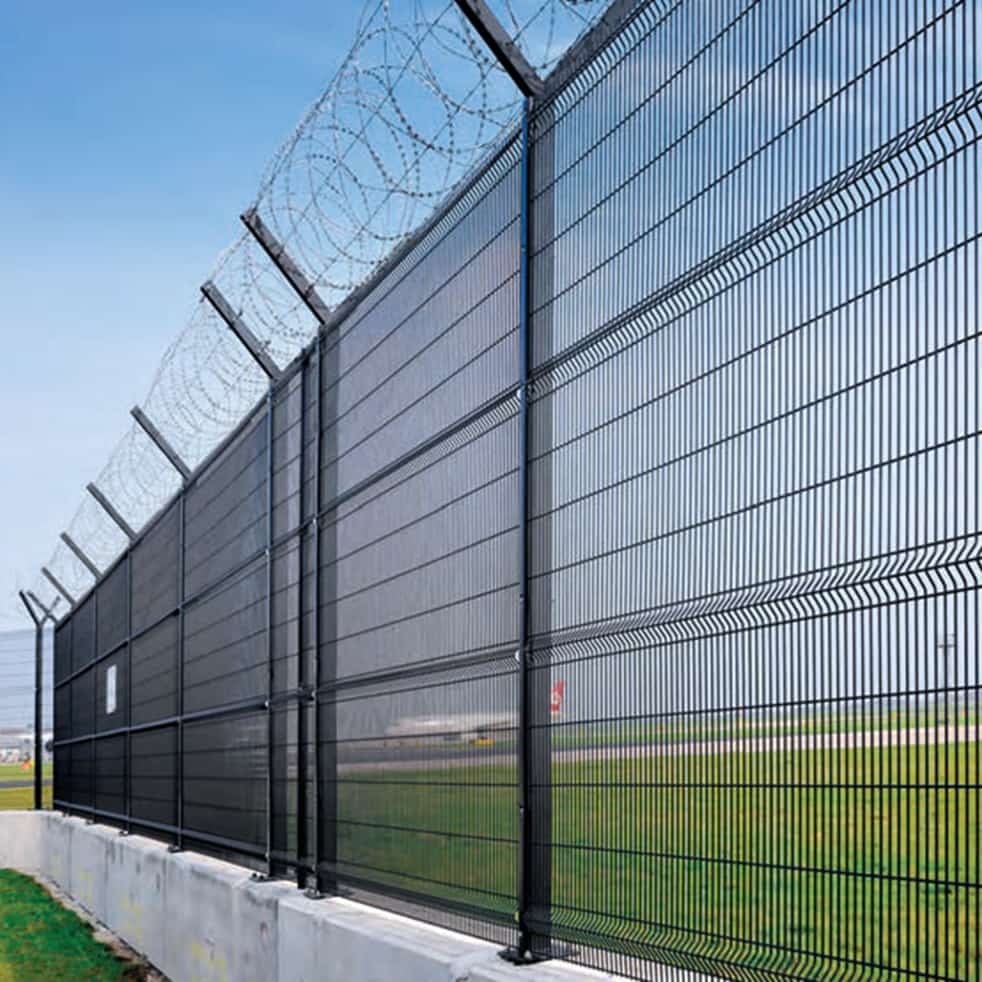
1. Anti-Climb 358 Security Fence (Most Popular Airport Fence)
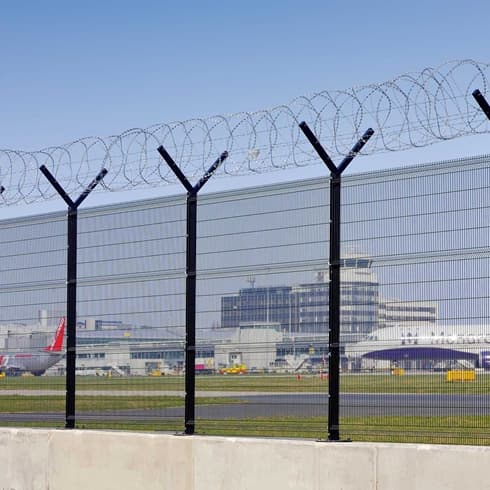
358 anti-climb fence, also known as prison mesh fence, is the primary choice for airport restricted perimeters. Its small mesh opening prevents fingers and tools from gripping for climbing; thick wire makes cutting hard. Usually paired with Y-shaped posts and topped with razor wire or barbed tape. Ideal for runways, aprons and aircraft maneuvering zones.
2. Steel Tubular Airport Fence
Constructed with heavy-duty square and rectangular steel tubes, full welded panel structure. Tall height, spear top anti-climb design, strong impact resistance. Widely used for airport administrative boundaries, cargo yard perimeters and airport internal partition zones. It matches well with steel tubular security gates for vehicle and pedestrian access points.
3. Chain Link Airport Fence with Barbed Wire
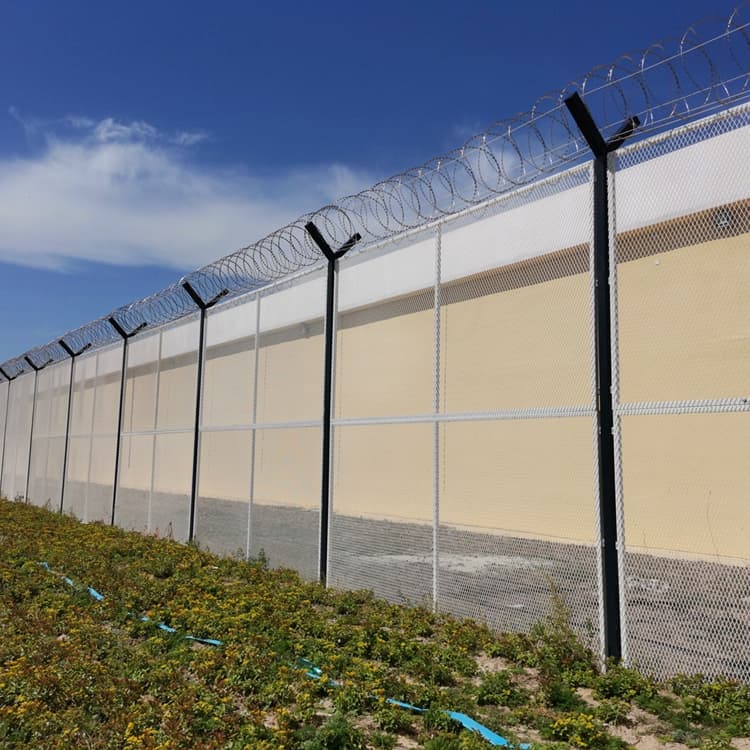
Cost-effective option for secondary airport boundaries and buffer zones. Galvanized chain link mesh fitted with top barbed wire. It is normally applied in outer buffer zones rather than core runway restricted areas due to relatively lower anti-cut performance compared with 358 fence.
4. Welded Mesh Anti-Climb Fence
Large panel welded mesh fence with reinforced wire diameter. Can be customized in height and equipped with anti-climb toppings. Suitable for airport service roads, staff area separation and low-risk perimeter segments.
Key Technical Specifications & Height Standards for Airport Fences
Airport fences must meet strict height and structural requirements defined by aviation security regulations. Height varies by security zone:
- Core restricted zones (runway, apron, aircraft movement area): 2.4m to 3.0m high, plus additional razor wire/barbed tape on Y posts, total height can reach 3.5m or higher.
- Cargo area & maintenance zone: 2.2m – 2.5m high anti-climb fence.
- Outer buffer boundary: 1.8m – 2.0m fence, usually with barbed wire topping.
- Internal partition for office and staff areas: 1.5m – 1.8m tubular fence for zoning.
Key structural requirements:
- Thick wire / heavy steel tube structure to resist cutting and impact.
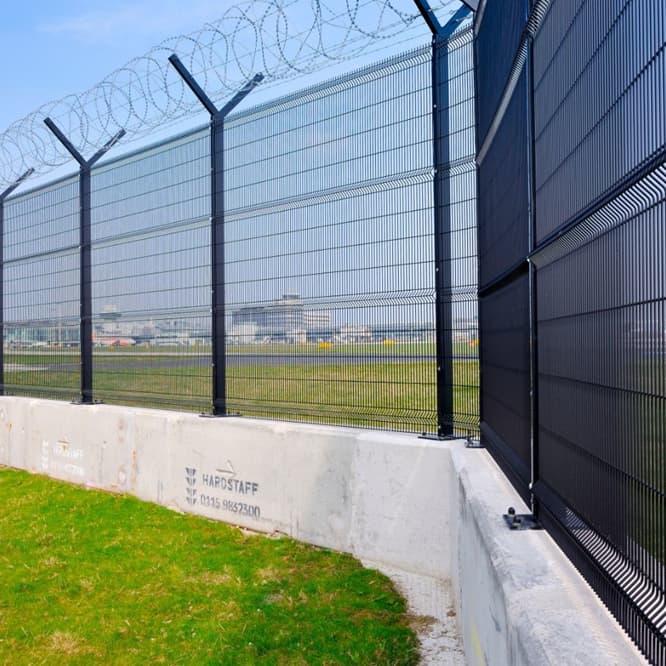
- Reinforced posts (Y-post, heavy square post) with deep concrete foundation.
- Anti-climb top accessories: razor wire, barbed tape, spear points.
- No continuous footholds on the fence surface to block climbing attempts.
Material & Anti-Corrosion Requirements for Airport Fences
Airports are often built in open coastal or windy regions. Rust, peeling coating and material aging can create security weak points. High-quality airport fences adopt dual anti-corrosion protection:
Outdoor polyester powder coating. For coastal airports with high salt spray, high weather-resistance powder coating are mandatory, to fight salt corrosion, strong UV radiation and wind-blown sand abrasion.
Raw material must be low carbon high tensile steel. Welding spots should be smooth and fully sealed to avoid corrosion starting from weld joints. RAL colors commonly selected: black, dark grey and dark green, which fit airport landscape and reduce visual distraction for pilots.
Supporting Accessories & Integrated Security System
A complete airport perimeter system includes not only fence panels, but also matched accessories and security integration components:
- Y-shaped posts, heavy-duty square posts, base plates and anchor bolts
- Razor wire, barbed tape, barbed wire brackets
- High security airport gates: pedestrian security gates and heavy vehicle swing / sliding gates
- Vibration sensors, fiber optic alarm cables, microwave intrusion detectors
- CCTV mounting brackets, warning sign plates, perimeter lighting fixtures
Security gates at airport entry points must use heavy anti-pry locks, reinforced hinges and access control systems. All access gates should match the fence’s anti-climb and anti-cut grade to prevent security gaps at gate openings.
Installation Standards for Airport Fences
1. Site survey & terrain handling: Survey land slope, soil condition and underground obstacles. Fill or level uneven ground before construction to keep fence panels vertical.
2. Deep reinforced foundation: Airport fence posts require deep concrete embedment. Soft soil needs larger concrete footings to resist strong wind and impact, preventing post tilting.
3. Eliminate climbing aids: Keep trees, bushes, stacked materials away from the fence line. No objects near fences that can be used as climbing ladders.
4. Continuous alignment & gap control: Minimize gaps between panels, posts and gates. Small gaps prevent hands or tools from breaking through.
5. Mount topping security devices correctly: Install razor wire on brackets above the fence, with consistent tension and no loose sections.
6. Calibrate detection sensors After fence installation, test all intrusion alarm devices to ensure normal trigger response.
Regular Inspection & Maintenance of Airport Fences
Airport fences are critical safety infrastructure and require routine inspection plans:
- Daily visual patrol: check bent panels, damaged mesh, loose posts, cut wires or damaged coating.
- Quarterly structural inspection: test post stability, tightening bolts and gate hinge condition.
- Annual anti-corrosion check: inspect rust spots and coating peeling, especially for coastal airport fences.
- Alarm system testing: regularly test sensors and alarm linkage to guarantee detection performance.
- Clear vegetation: trim overgrown plants along fence lines to avoid creating climbing footholds.
FAQ
Q1: What type of airport fence offers the highest security level?
A1: 358 anti-climb fence with Y posts and razor wire topping delivers the highest anti-climb and anti-cut performance. It is the primary choice for airport runway and apron restricted zones.
Q2: Can airport fences resist strong wind and coastal salt spray?
A2: Yes. With heavy posts, deep concrete foundations and thick hot-dip galvanized plus high weather-resistant powder coating, qualified airport fences adapt to coastal, windy and high-temperature environments.
Q3: Are airport fences compatible with intrusion detection systems?
A3: Absolutely. We design reserved brackets and mounting positions for fiber vibration sensors, microwave detectors and cameras, realizing physical barrier + intelligent alarm integrated perimeter security.
Q4: What security gates match airport fences?
A4: Heavy-duty anti-climb pedestrian gates and sliding / swing vehicle gates. The gates share the same material, coating and anti-climb standard with airport fences to avoid weak points at access openings.
Conclusion
Airport fences are not simple boundary fences, but core physical defense infrastructure for aviation safety. They must satisfy strict anti-climb, anti-cut, impact-resistant and weatherproof requirements, and can integrate with intelligent detection systems to build multi-layer perimeter protection.
Different airport zones need matched fence types and heights. Core operational areas require top-grade 358 anti-climb fences, while buffer zones and internal partitions can adopt welded mesh or tubular fencing. Material selection, anti-corrosion treatment, foundation construction and regular maintenance directly determine long-term reliability of airport perimeter security.
Giant Fence supplies full sets of certified airport fences, anti-climb panels, security posts, razor wire and matching high-security gates for global airport projects. Our products can be customized according to local aviation security standards, terrain conditions and intelligent system integration needs. Contact us to get technical drawings, compliance documents and bulk project quotations.