



Introduction
Crowd control barriers (also known as crowd control barricades, metal crowd barriers) are widely used for pedestrian separation, queue management and temporary perimeter isolation at concerts, sports events, airports, train stations, shopping malls and construction sites. The stability of the whole barrier system largely depends on its base. Flat feet and bridge feet are the two most mainstream base types for metal crowd control barriers. Many distributors and event contractors are confused about how to choose between them.
There is no absolute “better” option. Flat feet and bridge feet each have unique advantages, applicable ground conditions and usage scenarios. Giant Fence manufactures both types of bases for crowd control barriers. This article compares their structure, stability, installation, mobility, cost and adaptability, helping you select the right base according to project terrain, crowd density and reuse frequency.
What Are Flat Feet for Crowd Control Barriers?
Flat feet are solid flat metal bases directly welded or bolted to the bottom frame of crowd control barriers. They are usually flat rectangular steel plates that fully contact the ground. Some flat feet are integrated heavy steel bases, while others are detachable flat base plates.
The flat contact surface spreads weight evenly on smooth hard ground. Flat-foot crowd control barriers are simple in structure, easy to stack and transport, and are very popular for indoor events with flat concrete or tile floors.
What Are Bridge Feet for Crowd Control Barriers?
Bridge feet, also called arch feet or U-shaped bridge bases, feature an arched, elevated bridge-style design. The two ends touch the ground, while the middle part is raised and suspended above the ground. This special arch structure is the biggest difference from flat feet.
Bridge feet were originally designed for uneven ground and pavement with gaps. They are compatible with road joints, paving stones, slight slopes and grassy compacted ground. One well-known advantage of bridge feet is that they allow forklift forks or pallet jacks to pass underneath for easy repositioning on site.
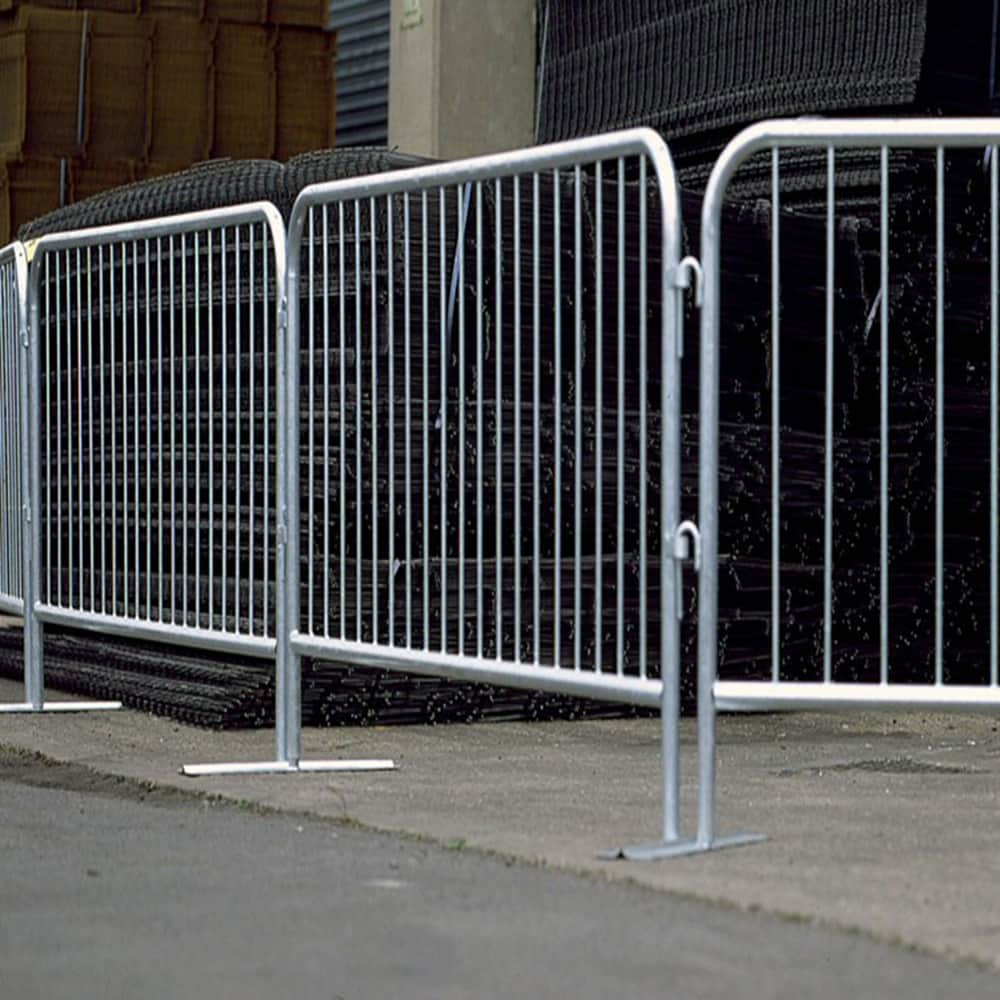
Side-by-Side Comparison: Flat Feet vs Bridge Feet Crowd Control Barriers
- Ground Contact & Stability
Flat feet: Large full contact area. Great stability on perfectly flat, hard, smooth ground. Risk of tipping increases significantly on uneven ground, cracks or bumpy surfaces.
Bridge feet: Only two contact points touch the ground. More tolerant of minor unevenness, pavement joints and small bumps. Better adaptability outdoors, but slightly lower stability than flat feet on perfectly smooth flat ground under heavy crowd pressure.
- Mobility & Handling
Flat feet: Solid plate blocks the bottom. Cannot pass forklift forks underneath. Workers need to lift or drag the barriers for relocation; dragging may scratch finished floors.
Bridge feet: Hollow space under the arch allows forklifts and pallet jacks to go through. Fast bulk moving on construction sites and large outdoor venues without lifting every barrier.
- Floor Protection
Flat feet: The whole base slides easily when dragged, which can scratch tiles, epoxy floors and polished concrete. Rubber pads are usually required.
Bridge feet: Less contact area with the ground. With rubber end caps, they reduce scratch risks; they are also less likely to catch on pavement gaps.
- Stacking & Storage
Flat feet: Thin flat plates stack neatly, saving warehouse space and container loading volume.
Bridge feet: The arched profile takes extra vertical space. They occupy more space during stacking and shipping, which pushes up logistics cost.
- Applicable Surfaces
Flat feet: Indoor venues, exhibition halls, shopping malls, airport terminals, smooth concrete floors.
Bridge feet: Outdoor roads, construction sites, stadium plazas, cobblestone pavement, slightly sloped ground, event fields.
- Cost
Flat feet: Simple structure, lower raw material cost, economical for bulk indoor event orders.
Bridge feet: Special bending or welding arch structure, higher production cost than flat feet crowd control barriers.
Core Advantages of Flat Feet Crowd Control Barriers
- Excellent anti-tip performance on flat hard ground
- Compact stacking design to cut shipping and storage costs
- Lower unit price, cost-effective for recurring indoor events
- Suitable for high-density crowd queuing indoors
Core Advantages of Bridge Feet Crowd Control Barriers
- Adaptable to uneven outdoor pavement, cracks and road joints
- Forklift accessible for fast bulk handling on site
- Not easy to get stuck on paving gaps or small debris
- Ideal choice for construction, festivals and outdoor sports events

How to Choose the Right Base for Your Crowd Control Barrier Project
- Choose flat feet if your projects are mainly indoor: exhibitions, shopping mall promotions, airport queue lines, indoor sports halls with smooth floors, and you value stability and low logistics cost.
- Choose bridge feet if most deployments are outdoors: construction site isolation, street parades, outdoor concerts, stadium plazas with uneven pavement, and you need frequent bulk relocation with forklifts.
- Mixed procurement suggestion: Many event rental companies buy both types of crowd control barriers to cover indoor and outdoor projects at the same time. Add rubber feet pads for both versions to improve anti-slip and floor protection.
Supporting Accessories for Crowd Control Barriers
Giant Fence supplies complete accessories for both flat-foot and bridge-foot crowd control barriers:
- Connecting pins, hooks and locking clips
- Reinforced cross braces for extra stability
- Reflective strips and warning signs

FAQ
Q1: Which base is more stable, flat feet or bridge feet crowd control barriers?
A1: Flat feet are more stable on perfectly smooth flat ground. Bridge feet perform better on uneven ground but have slightly lower stability under strong horizontal pushing on flat surfaces.
Q2: Can bridge feet crowd control barriers be used indoors?
A2: Yes, they can be used indoors. However, they take more stacking space and are usually less economical for pure indoor rental businesses.
Q3: Do flat feet crowd control barriers scratch floors?
A3: They may scratch polished floors if dragged directly. Install rubber foot pads to avoid scratches and increase friction.
Q4: Are crowd control barriers with bridge feet forkliftable?
A4: Yes. The arch gap under bridge feet allows forklift forks and pallet jacks to pass through for fast moving large batches of barriers.
Conclusion
Flat feet and bridge feet are two classic base solutions for crowd control barriers. Flat feet win in indoor stability, stacking performance and cost. Bridge feet stand out in outdoor terrain adaptability and convenient forklift handling.
Giant Fence manufactures both flat-foot and bridge-foot crowd control barriers in hot-dip galvanized or powder coated finish. We provide detachable bases, rubber pads and full connection accessories. Custom colours and sizes are available for event rental companies, construction contractors and government tender projects.
If you are not sure which base fits your main application, tell us your common venues and handling method, and we will recommend the most suitablecrowd control barriers solution and quotation.