



TL;DR: Flexible PVC privacy tape and rigid privacy slats can both transform an open metal mesh fence into a visually screened boundary, but they differ in installation, retention, appearance, and material behavior. The best choice depends on mesh compatibility, privacy requirements, wind exposure, post design, and total installed cost. Before selecting a metal privacy fence manufacturer, verify the complete panel-and-screening system rather than purchasing the cheapest inserts.
Residential developers, fencing contractors, and international distributors frequently face an important specification decision: should a housing project use flexible PVC privacy tape or rigid privacy slats?
The difference is more significant than appearance.
Adding screening changes the behavior of an otherwise open welded mesh fence. It can increase wind forces, introduce new connection requirements, and affect the installation process.
For projects involving hundreds of meters of fencing, small differences in materials, assembly time, and maintenance can become substantial procurement costs.
This guide compares privacy screening systems through practical engineering criteria and explains how to evaluate suppliers, verify product quality, and prepare an accurate bulk-order RFQ.
 Key Takeaways
-
Screening selection: Flexible PVC tape is useful for compatible woven-through mesh applications, while rigid slats provide an alternative with defined profiles and retention details.
-
Wind loading: Increased visual coverage can change aerodynamic behavior. Structural adequacy must be assessed for the completed fence.
-
System compatibility: Mesh openings, V-bends, posts, fixings, and screening components must be verified together.
-
Material durability: Steel corrosion protection and polymer weathering require separate specifications.
-
Procurement economics: Compare total supplied and installed costs, including installation labor and replacement components.
-
Manufacturer evaluation: Approved drawings, assembled samples, inspection records, and complete accessory schedules provide better evidence than general marketing claims.
Quick Comparison: PVC Privacy Tape vs. Rigid Privacy Slats
The following matrix summarizes the main technical differences. It is a qualitative selection guide, not a record of comparative laboratory testing.
| Decision Factor | Flexible PVC Tape | Rigid PVC Slats | Selection Guidance |
|---|---|---|---|
| Construction | Flexible woven-through strips | Formed, relatively rigid profiles | Match the approved mesh system |
| Appearance | Continuous woven pattern | Defined linear profile | Compare assembled samples |
| Installation | Weaving and end fixation | Profile insertion and retention | Test installation time on-site |
| Visual screening | Depends on strip coverage and gaps | Depends on profile overlap and gaps | Specify required viewing conditions |
| Wind behavior | Depends on porosity, gaps, and fixing | Depends on profile geometry and fixing | Engineering assessment required |
| Retention | Clips or suitable end restraints | Rails, caps, clips, or compatible restraints | Verify the complete fixing method |
| Replacement | May allow individual strip replacement | May allow individual profile replacement | Check dismantling requirements |
| Weathering | PVC formulation and exposure dependent | PVC formulation and exposure dependent | Request applicable material evidence |
| Cost | Material and weaving labor | Profile and insertion labor | Compare complete installed cost |
Initial recommendation: Evaluate PVC tape for projects requiring flexible screening through compatible mesh panels. Evaluate rigid slats where defined profile geometry and a particular architectural appearance are important.
Neither option should be selected solely on an assumption that it is universally stronger, cheaper, or better suited to high winds.
Technical Basis: What Can Buyers Verify?
This comparison draws on welded mesh fence construction, polymer screening behavior, environmental exposure principles, and the published product information of Giant Fence, operated by Hebei Giant Metal Technology Co., Ltd.
Giant Fence manufactures metal fencing systems in Anping County, Hebei Province, China. Its published range includes welded mesh fencing, privacy fence configurations, posts, and related entrance systems.
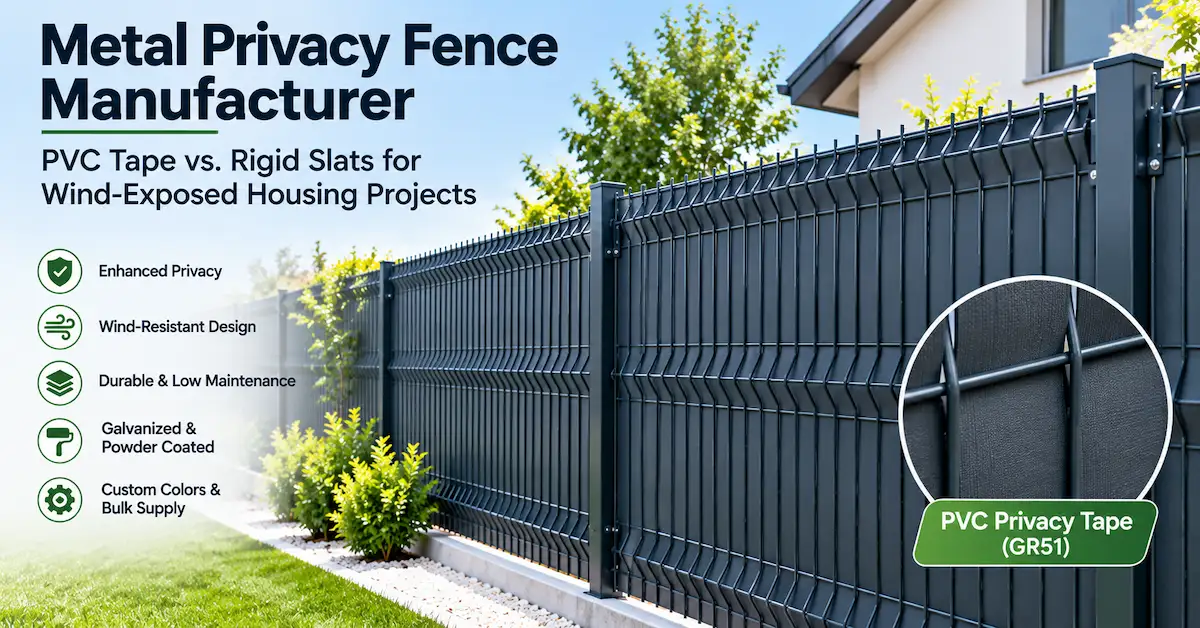
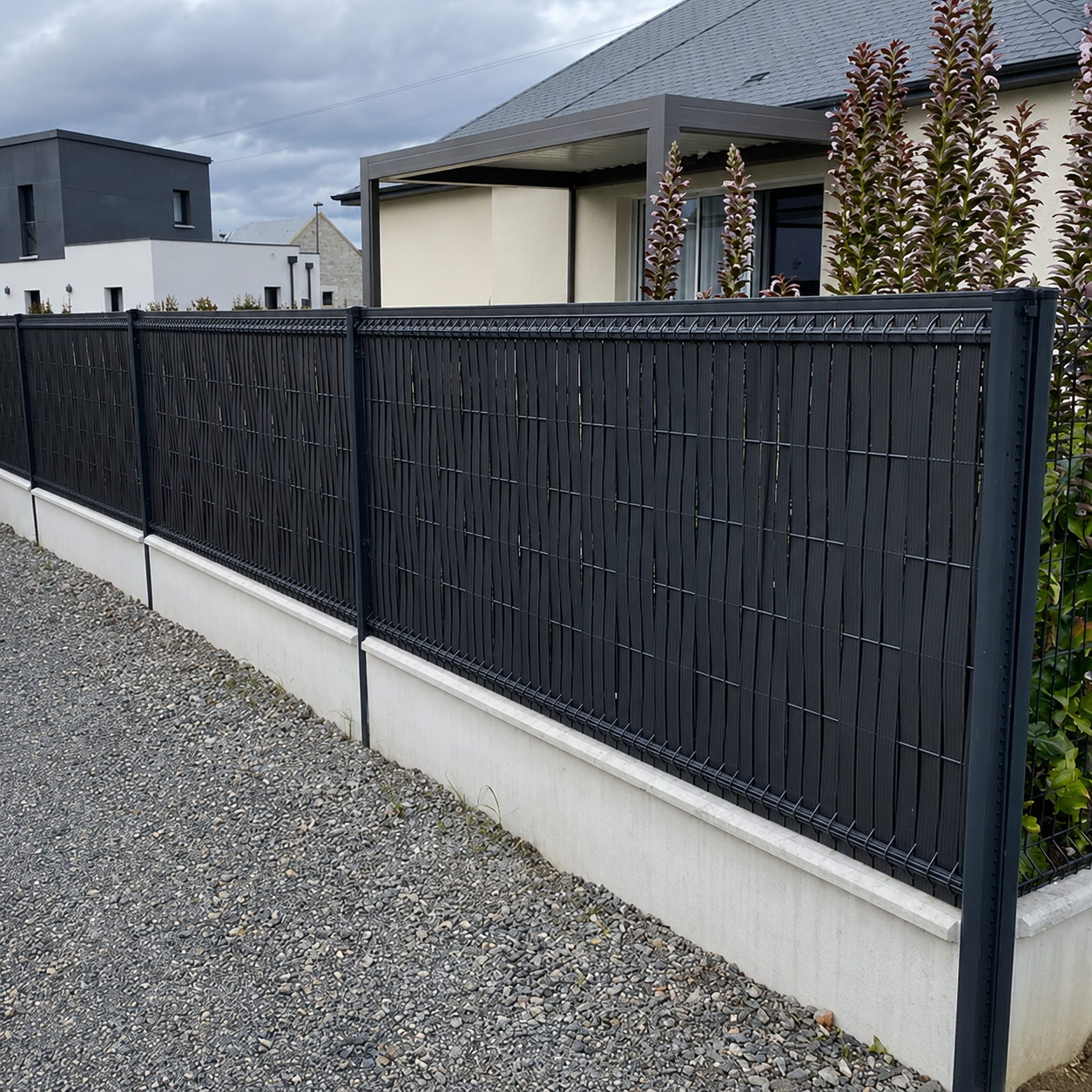
The company's 3D Fence With Privacy Tape — GR51 uses flexible PVC tape woven through a welded mesh panel and secured with clips.
The product is presented for residential compounds, private gardens, commercial properties, and other boundary applications.
Available color examples include RAL 7016, RAL 6005, and RAL 9005, subject to order confirmation.
The article's engineering calculations and cost comparisons are illustrative. They are not presented as measured Giant Fence test results.
Actual wind resistance, screening retention, weathering, and installation efficiency must be assessed using the proposed components and project conditions.
Which Privacy Screening Material Is Better for Housing Projects?
The appropriate material depends on what the buyer is trying to achieve.
Flexible PVC Tape for Mesh-Based Privacy Fencing
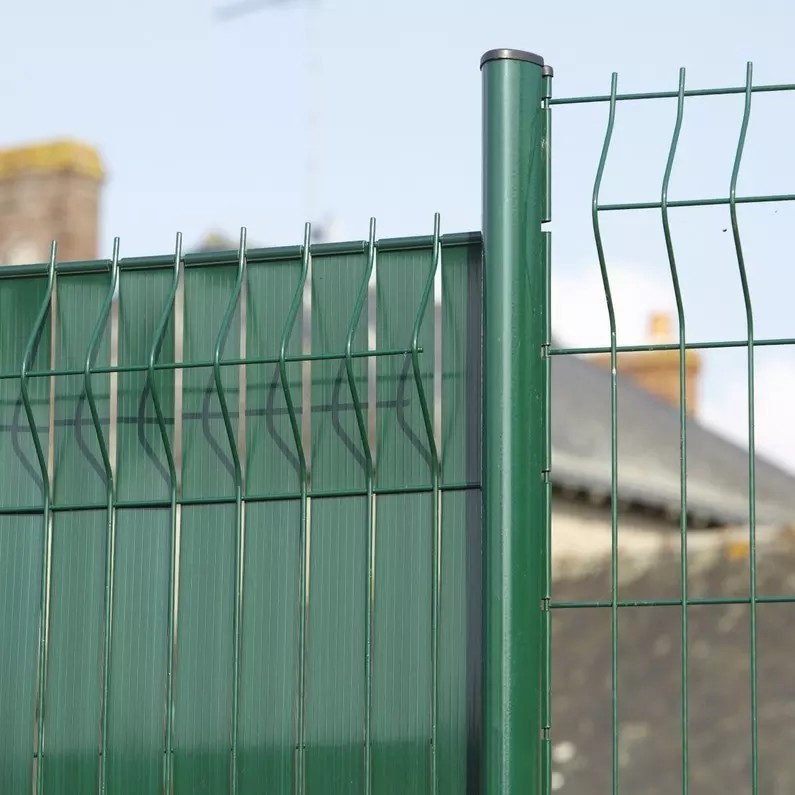
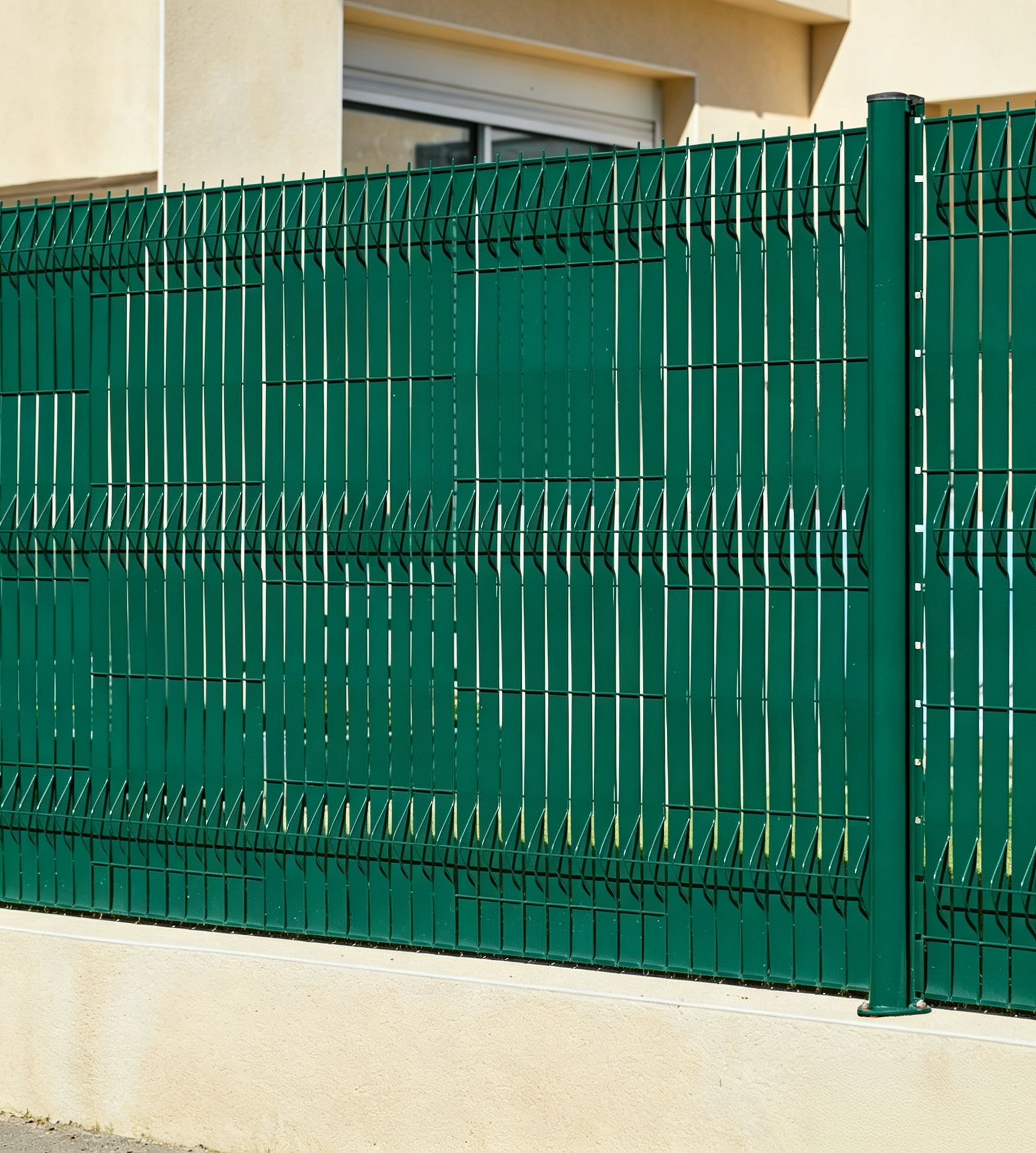
PVC privacy tape is woven through compatible openings in the metal fence panel.
The resulting arrangement reduces direct visibility without replacing the underlying steel structure.
Potential advantages include flexible installation patterns, different color options, and the ability to work with suitable existing mesh systems.
However, buyers must verify strip dimensions, fixing compatibility, and the method of retaining the tape ends.
Giant Fence's GR51 system specifically incorporates PVC end clips. Those components should be included in the procurement schedule.
Rigid PVC Slats for Defined Screening Profiles
Rigid PVC slats use formed profiles inserted into the mesh or a suitable support arrangement.
Their geometry can produce a different visual pattern from flexible woven tape.
Before specifying rigid slats, buyers must verify profile dimensions, mesh compatibility, thermal movement, and retention.
A rigid slat designed for a flat mesh fence cannot automatically be assumed to fit a 3D panel with reinforcing bends.
What About WPC Privacy Slats?
Wood-plastic composite screening is another material category that may be considered in architectural projects.
Its performance depends on composition, profile design, weathering resistance, and the connection arrangement.
For GIANT MESH orders, the availability of a particular WPC slat configuration must be confirmed directly with the supplier before it is included in an RFQ.
The Decision Threshold
Select the screening system only after confirming three conditions:
-
The product fits the approved metal mesh panel.
-
The completed structure meets the project's applicable engineering requirements.
-
The assembled sample satisfies the required visual privacy and installation criteria.
If one of these conditions is not satisfied, a different screening or fence system may be necessary.
When Does Wind Exposure Become a Structural Problem?
Wind loading becomes a critical design consideration when screening changes the aerodynamic behavior of the fence beyond what its existing structure was designed to resist.
An open welded mesh panel allows air to pass through its openings. Adding tape or slats reduces some of that open area.
This can change the forces acting on the panel, connectors, posts, and foundations.
Why Visual Coverage Is Not the Same as Wind Pressure
A fence that appears almost opaque should not automatically be modeled as a completely solid wall without engineering assessment.
Likewise, leaving small gaps between slats does not prove that the fence has adequate wind resistance.
Wind forces depend on site wind conditions, fence geometry, porosity, aerodynamic effects, and support arrangements.
Illustrative Fence Bay Calculation
Consider a residential fence bay with:
-
Nominal width: 2.5 m
-
Installed height: 2.0 m
The gross face area is:
A = Width × Height
A = 2.5 × 2.0 = 5.0 m²
For a project containing 60 identical bays:
Total Gross Face Area = 60 × 5.0 = 300 m²
These calculations establish the approximate exposed face area for preliminary project planning.
They do not determine design wind pressure or structural capacity.
A simplified expression for wind force is:
F = q × A × C
Where:
-
F represents an estimated wind force.
-
q represents the relevant wind pressure.
-
A represents the applicable reference area.
-
C represents the appropriate aerodynamic coefficient or combination of factors.
Actual design should use the governing standard and the applicable pressure and coefficient definitions.
Which Structural Components Must Be Checked?
| Component | Potential Engineering Concern |
|---|---|
| Privacy inserts | Movement, deformation, disengagement |
| Retaining clips | Connection loads and retention |
| Welded mesh panels | Bending and deformation |
| Panel-to-post fixings | Load transfer and connection capacity |
| Support posts | Bending, deflection, stability |
| Base plates and anchors | Pull-out and connection resistance |
| Foundations | Ground resistance and overturning |
EN 1991-1-4, Eurocode 1: Actions on Structures — Wind Actions, provides a recognized wind-loading design framework within its applicable scope.
The edition and national provisions relevant to the project location must be confirmed.
Engineering recommendation: Never specify a universal post spacing or minimum post thickness for every screened privacy fence. The complete installed system must be evaluated for its actual exposure.
How Do Mesh Openings and Fixings Affect Screening Reliability?
Screening performance depends on more than the visible PVC material.
The mesh structure determines how the screening can be installed and supported.
3D Welded Mesh Panels
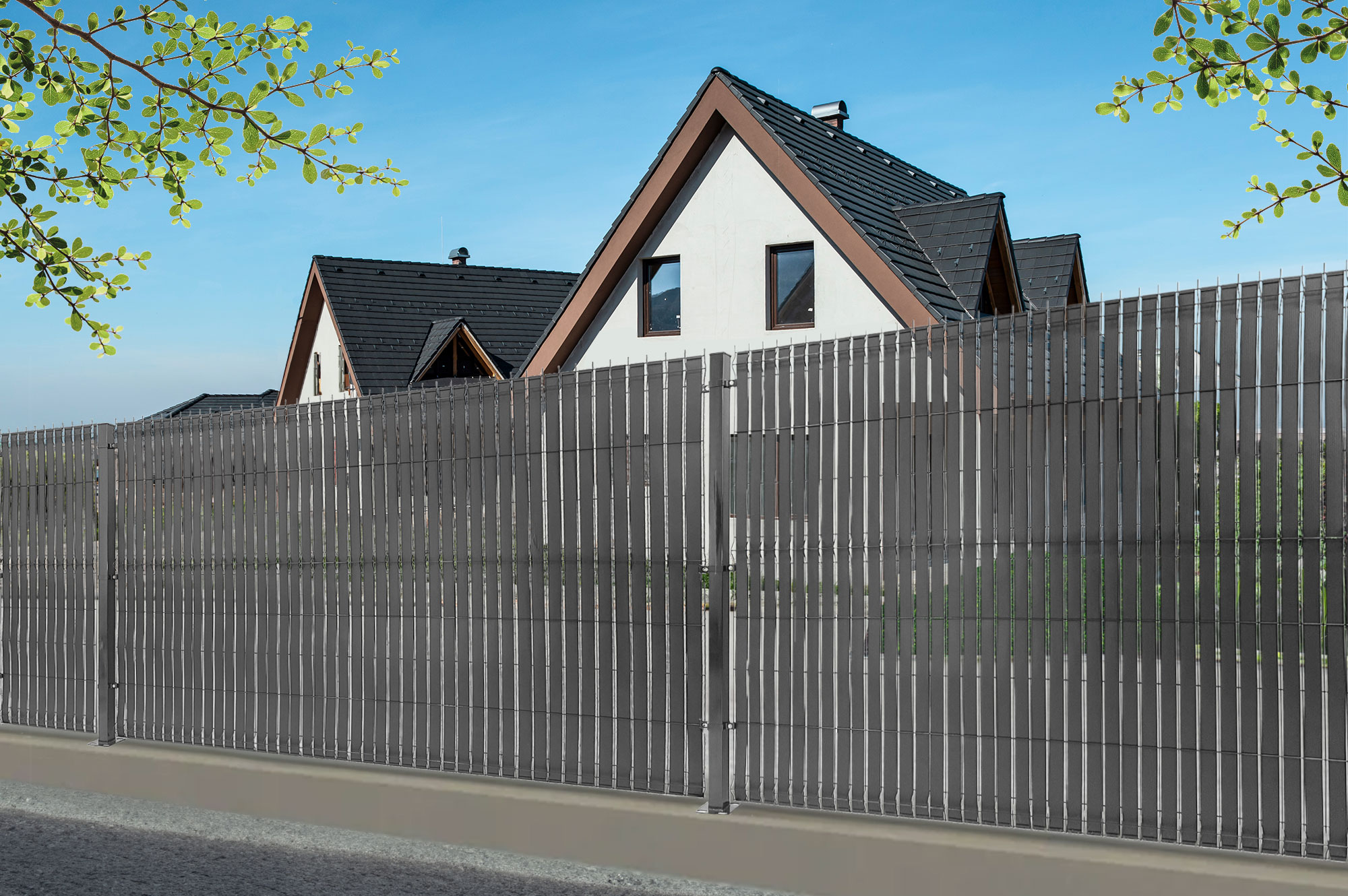
3D fencing incorporates reinforcing V-bends.
These bends influence how flexible strips pass through the mesh and where rigid profiles can be positioned.
If the screening system was developed for a particular panel geometry, it should not be transferred to another configuration without checking compatibility.
2D Double-Wire Mesh Panels
2D fencing has a flatter welded structure with paired horizontal wires.
This creates a different relationship between mesh openings and inserted screening components.
For buyers evaluating both systems, the correct screening material must be matched to each specific panel.
Screening Retention Checklist
Before approving bulk production, verify:
-
Clear mesh opening dimensions.
-
Strip or slat width and thickness.
-
Installation direction.
-
End-cap and clip compatibility.
-
Thermal expansion allowances.
-
Panel-edge treatment.
-
Corner and terminal details.
-
Replacement procedures.
An assembled sample should demonstrate the complete connection rather than only the screening material.
Which System Offers Better Outdoor Durability?
Outdoor durability depends on both the steel structure and the polymer screening.
These materials experience different deterioration mechanisms.
Galvanized Metal Panels
Zinc coatings protect steel through barrier and sacrificial corrosion-protection mechanisms.
Performance depends on the coating specification, application process, environmental exposure, and condition of the finished component.
Powder-Coated Fencing
Powder coating can provide consistent color and additional protection when correctly specified.
Buyers should establish the required substrate preparation, coating process, color, thickness where applicable, and acceptance criteria.
PVC Screening
PVC screening requires evaluation of weathering, temperature exposure, color stability, flexibility, and retention.
A steel coating inspection report does not prove that the PVC strips will retain their original appearance indefinitely.
Environmental Comparison
| Environment | Principal Concern | Recommended Procurement Check |
|---|---|---|
| Normal inland housing | General weather exposure | Compatible coating and screening specification |
| Humid residential area | Repeated moisture | Corrosion and drainage assessment |
| Coastal development | Chlorides and wind | Exposure-specific coating and structural review |
| High-sunlight area | UV and temperature effects | Relevant polymer weathering information |
| Open elevated site | Higher wind exposure | Structural and connection verification |
| Irrigated gardens | Localized moisture | Post-base and coating protection |
ISO 9223:2012 can help classify atmospheric corrosivity.
It should not be used as a direct guarantee of a particular fence's service life.
When Is PVC Tape More Cost-Effective Than Rigid Slats?
Material price alone does not establish the most economical screening solution.
The calculation should consider installation labor, retention hardware, packaging, replacement components, and project conditions.
Total Installed Cost Model
Total Privacy Fence Cost = Steel Panels + Posts + Screening + Fixings + Gates + Freight + Installation + Civil Works
To compare two screening alternatives, isolate the costs that differ between the options.
Illustrative Break-Even Calculation
Assume a contractor is comparing two compatible screening options for the same approved fence design.
The following figures are hypothetical assumptions, not supplier quotations or measured installation times.
| Cost Variable | Illustrative Value |
|---|---|
| Rigid-sl at material premium per bay | $12 |
| Installation labor rate | $30/hour |
| Number of fence bays | 60 |
| Additional material cost for rigid slats | $720 |
The required labor saving to offset the material premium is:
Break-Even Labor Saving = Material Premium ÷ Hourly Labor Rate
$12 ÷ $30 = 0.40 hours per bay
Therefore, rigid slats would need to save more than 0.40 installation labor hours per bay to offset the assumed $12 material premium, with other costs held equal.
For 60 bays:
60 × 0.40 = 24 labor hours
At $30 per hour, those 24 hours would be worth $720.
What Does This Calculation Mean?
It does not prove that rigid slats install faster.
It establishes a measurable threshold that procurement teams can test.
If a trial installation demonstrates lower labor savings, the rigid system may have a higher initial cost under the assumed conditions.
If labor savings exceed the threshold, the rigid option may become more competitive.
Freight, damaged components, replacement parts, and site conditions could change the result.
The correct purchasing decision should therefore use measured sample installation time and actual supplier quotations.
Where Should Different Privacy Fence Systems Be Used?
Not every housing project requires one uniform screening configuration.
A coordinated boundary may combine screened fencing, open mesh, gabion walls, and matching gates.
| Project Zone | Main Requirement | Possible System |
|---|---|---|
| Private backyards | Visual screening | 3D mesh with compatible privacy tape |
| Community side boundaries | Controlled privacy and consistent appearance | Compatible screened mesh system |
| Shared landscaped spaces | Visibility and boundary definition | Open 2D or 3D mesh |
| Street-facing entrances | Privacy and coordinated access | Privacy fence with matching gate |
| Decorative garden sections | Landscape integration | Gabion and privacy fence combination |
| Exposed elevated boundaries | Wind and structural performance | Engineer-selected fence and screening |
Giant Fence provides privacy and boundary protection solutions featuring combinations of privacy fencing, 2D welded mesh, gabion walls, and pedestrian gates.
Its driveways and entrances solutions also show coordinated privacy fencing and vehicle access arrangements.
When Is a Mixed Boundary System Better?
A mixed system may be appropriate when the project contains different privacy and visibility requirements.
For example, private gardens may require more screening, while common landscaped areas may benefit from open fencing.
This approach can also reduce unnecessary screening material use, provided each section meets the required site conditions.
Illustrative Housing Project: 150 Meters of Privacy Fencing
Consider a hypothetical housing development requiring 150 meters of screened fencing along one straight property boundary.
The preliminary assumptions are:
-
Fence height: 2.0 m
-
Nominal bay spacing: 2.5 m
-
Total length: 150 m
-
No gate openings in the measured run
-
No corners or elevation changes
-
Privacy screening to be applied throughout
Step 1: Calculate Initial Bay Quantity
150 ÷ 2.5 = 60 nominal bays
Step 2: Calculate Post Positions
For a single uninterrupted straight run:
60 + 1 = 61 nominal post positions
This assumes separate supports at both ends and compatible installation geometry.
Step 3: Calculate Gross Fence Face Area
150 × 2.0 = 300 m²
This is the gross geometric face area, not a validated aerodynamic area or screening-material order quantity.
Step 4: Compare Screening Alternatives
The procurement team should obtain quotations for flexible PVC tape and any compatible rigid slat alternative.
Both should be assessed using:
-
Identical approved mesh panels.
-
Compatible post and fixing arrangements.
-
Actual screening-material quantities.
-
Trial installation labor.
-
Engineering requirements.
-
Delivery and replacement-part costs.
Step 5: Confirm Structural Suitability
The original open-mesh fence design should be reviewed for the added screening.
If the required post section, foundation, or fixing arrangement changes, the resulting additional cost must be included in the comparison.
Project Insight
The most important finding is not which material appears cheaper on a quotation.
It is whether the complete privacy fence system can meet the project's visual, structural, maintenance, and commercial requirements.
This is an illustrative procurement scenario, not a completed Giant Fence customer project.
How Should Buyers Evaluate a Metal Privacy Fence Manufacturer?
A reliable manufacturer should be assessed using objective evidence and a complete supply scope.
Technical and Quality Evaluation Matrix
| Evaluation Area | Required Evidence | Risk Addressed |
|---|---|---|
| Panel manufacturing | Approved mesh dimensions and material specification | Incompatible or inconsistent panels |
| Screening compatibility | Completed sample assembly | Poor fit or missing components |
| Post system | Dimensioned post and connection drawings | Installation or structural problems |
| Material quality | Steel and screening material information | Unverified product construction |
| Surface treatment | Agreed coating process and inspection | Premature corrosion |
| Retaining components | Clip and fixing specifications | Screening movement or detachment |
| Quality control | First-article and final inspection records | Batch inconsistency |
| Export packing | Packaging and accessory identification | Transit damage or shortages |
| Customization | Drawing review and confirmed product options | Uncontrolled specification changes |
| Commercial terms | Itemized quotation and delivery milestones | Hidden costs and disputes |
Giant Fence Manufacturing Capabilities
Giant Fence, operated by Hebei Giant Metal Technology Co., Ltd., is a China-based metal fencing manufacturer.
Its published capabilities include welded mesh panel manufacturing, fence post fabrication, surface treatment, customization, and international project supply.
The company offers 3D privacy fencing with flexible PVC tape, including compatible mesh screening and retaining accessories.
For overseas distributors and residential contractors, this provides a starting point for discussing bulk privacy fence requirements.
However, specific MOQ, production timing, available screening variants, and compliance documentation should be confirmed for the actual order.
What Should Be Included in a Privacy Fence RFQ?
A complete request for quotation helps the manufacturer identify missing technical information before production.
| RFQ Item | Buyer Information |
|---|---|
| Application | Housing community, villa, garden, commercial boundary |
| Installation location | Country, exposure conditions, site environment |
| Fence length | Total meters and individual runs |
| Fence dimensions | Height, panel width, mesh opening |
| Steel specifications | Wire diameter and post section |
| Screening material | PVC tape, rigid PVC, or approved alternative |
| Screening requirement | Viewing angle, coverage, visual appearance |
| Retaining accessories | Clips, rails, caps, and other fittings |
| Wind requirements | Relevant project design criteria |
| Coating | Galvanizing, powder coating, RAL color |
| Gate schedule | Pedestrian and vehicle entrances |
| Quality requirements | Drawings, samples, inspection criteria |
| Shipping | Packaging, destination, trade terms |
| Quantity | Total order and delivery stages |
Planning a residential privacy fence project? Submit your drawings, preferred screening material, expected quantities, site conditions, and destination through the Giant Fence contact page to request a project-specific quotation.
Frequently Asked Questions
1. What should I look for in a metal privacy fence manufacturer?
Look for compatible fence panels, documented screening options, approved post connections, measurable quality-control procedures, and clear quotation details. Assess the complete system rather than the panel alone.
2. Is flexible PVC privacy tape better than rigid PVC slats?
Neither is universally better. Flexible tape and rigid slats have different installation and appearance characteristics. The correct choice depends on mesh compatibility, retention, environment, and project costs.
3. Does adding privacy screening increase wind loading?
It can. Adding screening changes airflow through the fence and may increase structural demands. The completed fence should be assessed under applicable wind-design requirements.
4. Can privacy tape be installed on existing 3D fence panels?
It may be possible when the tape, mesh geometry, fixing system, and existing structural design are compatible. The support and foundation capacity must also be reviewed.
5. Can rigid PVC slats be installed on any metal mesh fence?
No. Rigid profiles must fit the mesh opening and connection arrangement. Compatibility should be verified with an assembled sample.
6. Which privacy fence provides the highest visual screening?
The result depends on screening coverage, gaps, viewing direction, and edge details. Buyers should define their privacy requirements and inspect a sample from the relevant angles.
7. What coating is suitable for coastal privacy fencing?
The coating system should be selected according to actual corrosion exposure and project requirements. Galvanizing and compatible additional coatings may be considered, supported by appropriate documentation.
8. Can metal privacy fencing be customized for large housing projects?
Custom dimensions, colors, post arrangements, and screening configurations may be possible. The manufacturer must confirm technical feasibility, available options, MOQ, and production requirements.
9. What should be inspected before a bulk privacy fence shipment?
Inspect panel dimensions, wire specifications, surface treatment, screening material, retaining components, color consistency, trial assembly, quantities, and packaging.
10. How can buyers obtain a more accurate wholesale privacy fence quotation?
Provide fence drawings, dimensions, material requirements, screening type, site exposure, gate schedule, quantities, destination, and applicable technical requirements. Complete information allows more meaningful supplier comparisons.
Conclusion
Choosing a reliable metal privacy fence manufacturer requires balancing visual screening, system compatibility, wind exposure, installation efficiency, and total project cost.
Flexible PVC privacy tape and rigid privacy slats offer different characteristics, but neither should be selected solely because of material price or appearance.
For residential developers, contractors, and overseas distributors, the correct purchasing process begins with an approved fence design, compatible screening components, a realistic structural assessment, and an itemized quotation.
The most effective way to reduce procurement risk is to verify the complete assembly through technical drawings, representative samples, and appropriate quality checks.
Giant Fence, operated by Hebei Giant Metal Technology Co., Ltd., supplies welded mesh fencing and privacy-oriented solutions for international B2B customers.
Ready to source a customized privacy fence system? Share your site drawings, screening requirements, wind-exposure conditions, expected quantities, and delivery specifications with the Giant Fence team to discuss an appropriate manufacturing and supply proposal.