


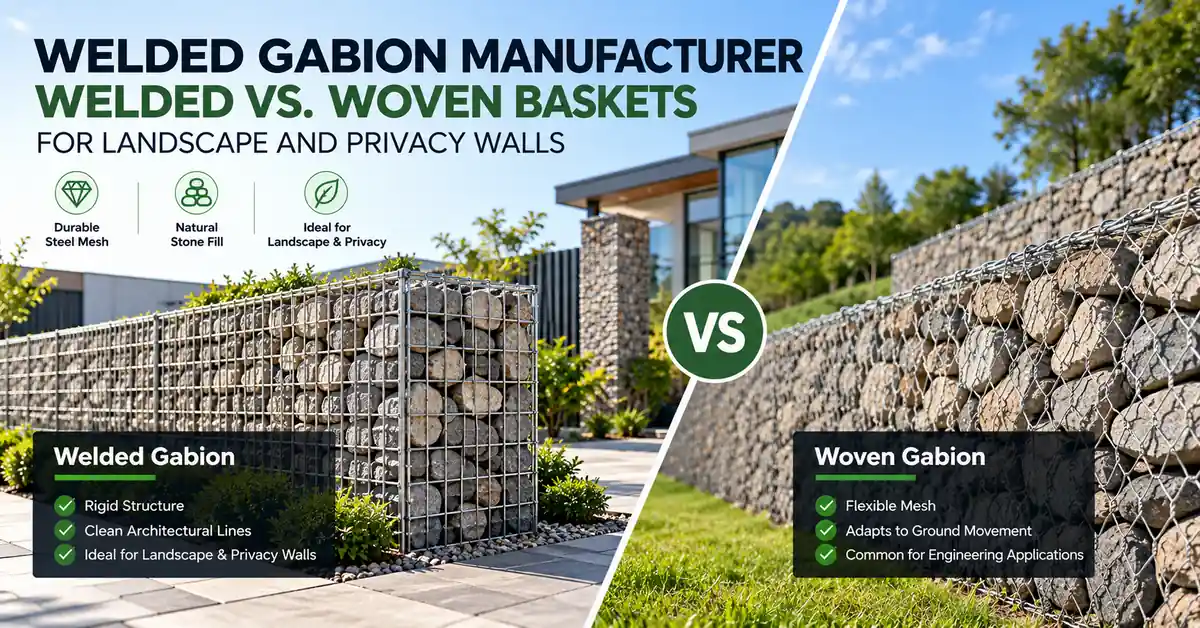
TL;DR: Choose welded gabion baskets when straight architectural lines, uniform mesh geometry, and a controlled stone-filled appearance are priorities. Double-twisted woven gabions can be preferable where an engineered design requires greater mesh flexibility and accommodation of ground movement. Neither system is automatically cheaper or stronger. Before selecting a welded gabion manufacturer, compare the complete basket assembly, connections, coatings, stone fill, installation labor, and project-specific stability requirements.
Landscape contractors, property developers, and international distributors often face the same purchasing decision: should they use rigid welded gabions or flexible woven gabion baskets?
The answer affects much more than appearance. Mesh construction influences assembly methods, face alignment, deformation behavior, connection details, and overall project cost.
For decorative garden walls and residential privacy boundaries, welded mesh often offers practical architectural advantages. For engineered river protection and some retaining structures, double-twisted woven mesh may be an appropriate alternative.
This guide explains how a professional welded gabion manufacturer should help buyers evaluate both systems, identify important engineering limitations, and prepare an accurate quotation.
Key Takeaways for Gabion Buyers
-
Architectural appearance: Welded gabions are often preferred for straight wall faces, defined corners, and regular mesh patterns.
-
Ground movement: Double-twisted woven gabions may accommodate certain deformations more readily, but overall structural suitability must be engineered.
-
Connection quality: Spiral binders, clips, diaphragms, and internal ties are essential parts of the completed system.
-
Stone compatibility: Mesh openings and the selected stone grading must be compatible.
-
Total project cost: A lower basket price does not necessarily produce a lower installed cost.
-
Corrosion protection: Coating selection should reflect environmental exposure and applicable technical requirements.
-
Supplier qualification: Request approved drawings, relevant inspection records, and a complete bill of materials before placing a bulk order.
Welded vs. Woven Gabion: Technical Comparison at a Glance
For B2B buyers, the fastest way to begin selection is to identify which system meets the project's most restrictive requirement.
| Evaluation Factor | Welded Gabion | Double-Twisted Woven Gabion | Procurement Decision |
|---|---|---|---|
| Mesh construction | Rigid welded intersections | Flexible double-twisted hexagonal mesh | Match product to engineering requirements |
| Face alignment | Defined panel geometry | More flexible mesh behavior | Welded often suits architectural walls |
| Corner definition | Straight panel edges | Flexible construction | Consider visible corners and finishes |
| Differential movement | Must be assessed for the rigid assembly | Can accommodate deformation in suitable designs | Consult the structural designer |
| Assembly | Panels with spirals, clips, and bracing | Mesh baskets with lacing or approved connectors | Compare actual installation methods |
| Stone retention | Depends on mesh opening and stone grading | Depends on hexagonal opening and stone grading | Verify minimum stone size |
| Corrosion protection | Zinc, zinc-alloy, or compatible additional coatings | Comparable protective coating options | Specify measurable protection |
| Primary applications | Landscape, privacy, architectural features, engineered walls | River works, erosion control, retaining and other engineered structures | Select by intended function |
| Procurement cost | Depends on wire, fabrication, connection system, and order quantity | Depends on mesh construction, accessories, and order quantity | Compare complete systems |
| Structural suitability | Requires project-specific design | Requires project-specific design | Neither has universal superiority |
Decision principle: If the main requirement is a consistent visible wall face, welded gabions are a strong candidate. If ground deformation or hydraulic conditions dominate, construction type should be selected through engineering evaluation rather than appearance alone.
What Makes This Comparison Relevant to Giant Fence Buyers?
Giant Fence is operated by Hebei Giant Metal Technology Co., Ltd., a metal fencing manufacturer based in Anping County, Hebei Province, China.
Its published product range includes welded gabion wall systems, welded mesh fencing, gates, and related perimeter components. The company also describes manufacturing capabilities involving wire welding, metal fabrication, finishing, and custom project specifications.
For landscape and residential buyers, Giant Fence presents coordinated combinations of gabion walls, privacy fencing, and matching entrance gates.
These offerings can be explored through the Giant Fence manufacturing profile and its gardens and landscaping solutions.
The comparisons below use established engineering principles and transparent illustrative calculations. They are not claimed to be independently measured performance results from a Giant Fence product test. Actual product dimensions, material properties, pricing, and load capacity must be confirmed for each project.
Which Gabion System Provides Better Architectural Alignment?
Welded gabions generally offer more predictable initial panel geometry because their mesh intersections are fixed by welding.
This characteristic is useful for architectural projects where the wall face is intended to follow straight lines and regular corners.
For example, a residential development may require a continuous gabion boundary aligned with a pedestrian path. The designer may want uniform basket heights, defined corner transitions, and neatly arranged stone.
Rigid welded panels can help establish this geometry during assembly.
However, the final appearance also depends on:
-
Panel dimensions and manufacturing tolerances.
-
Welding and panel flatness.
-
Edge-connection alignment.
-
Internal tie spacing.
-
Stone grading and placement.
-
Foundation settlement.
-
Installation workmanship.
Why Can Welded Gabion Faces Bulge?
Even a rigid welded mesh panel can deform when filled.
Stone generates pressure against the basket faces. Without suitable internal restraints, wide or tall panels may bow outward.
The solution is not simply increasing wire diameter. Manufacturers and project designers should also consider panel dimensions, mesh geometry, internal spacers, diaphragms, and assembly methods.
What Should Buyers Specify?
For projects where wall appearance is critical, request:
-
Permitted panel flatness and dimensional tolerances.
-
Mesh opening dimensions and measurement methods.
-
Approved connection and bracing details.
-
Visible-face stone requirements.
-
Trial assembly or reference samples where appropriate.
Do not accept a fixed claim such as "zero deformation" without a relevant test method and supporting evidence.
How Do Welded and Woven Gabions Respond to Ground Movement?
Welded and woven gabions behave differently because their wire intersections are constructed differently.
In a welded panel, wires are joined at fixed crossing points. In double-twisted mesh, the wire construction allows greater local geometric movement.
This can influence how the basket responds to changes in support conditions.
Welded Gabions: Defined Geometry
Rigid welded panels are suitable when straight lines and consistent basket geometry are important.
However, differential foundation movement can impose deformation on the panel connections and mesh.
The designer must assess whether the structure can accommodate the expected movement.
Woven Gabions: Greater Mesh Flexibility
Double-twisted woven mesh can accommodate deformation differently because of its flexible construction.
This can make it useful in certain erosion-control and retaining applications where movement is anticipated.
Nevertheless, flexibility does not eliminate the need for proper engineering.
A poorly designed woven gabion wall can still experience sliding, overturning, foundation failure, or excessive deformation.
When Should Engineering Requirements Decide?
Engineering assessment should take priority when the project involves retained earth, substantial wall height, surcharge loading, unstable ground, flowing water, or significant settlement.
Decorative landscape gabions should not automatically be treated as engineered retaining structures.
For more information on structural applications, see Giant Fence's gabion retaining wall guide for engineering projects.
Which Mesh and Connection Specifications Matter Most?
The most important gabion specifications are those that affect basket geometry, containment, corrosion protection, and the integrity of the complete assembly.
Welded Gabion Technical Specification Framework
| Specification | Illustrative Industry Configuration | Buyer Verification |
|---|---|---|
| Steel wire diameter | 3–5 mm examples | Confirm exact diameter, grade, and tolerance |
| Mesh opening | 50 × 50, 50 × 100, or 100 × 100 mm examples | Confirm stone compatibility |
| Basket length | 0.5–2.0 m examples | Confirm finished dimensions |
| Basket width | 0.3–1.0 m examples | Assess design and available space |
| Basket height | 0.3–1.0 m examples | Review wall stability and restraints |
| Connection system | Spiral binders, clips, or approved connectors | Verify component compatibility |
| Internal supports | Tie rods, spacers, or diaphragms | Confirm number and location |
| Surface protection | Zinc or zinc-alloy coating, with other options where specified | Verify process and acceptance criteria |
| Packing | Flat-packed panels or bundled kits | Confirm all components included |
These are illustrative industry ranges, not a confirmed specification sheet for a particular Giant Fence model.
Why Is Mesh Opening Important?
The stone fill must be large enough to remain contained by the mesh under the expected installation and service conditions.
The required grading depends on the opening size, stone shape, and placement method.
For decorative walls, mesh selection also influences the visible stone pattern.
Why Do Connections Matter?
A welded gabion manufacturer's quotation should clearly identify the supplied connectors.
Spiral binders, clips, tie rods, and internal spacers should not be treated as unimportant accessories.
They influence assembly, load transfer, face alignment, and maintenance.
Before approving a system, ask for a complete assembly drawing and a bill of materials identifying all required components.
Which System Has the Lower Cost for a Landscape Project?
Neither welded nor woven gabions are universally cheaper. The correct comparison is based on total installed cost, not basket price alone.
The final cost includes manufactured cages, accessories, stone, transport, foundations, assembly, filling, and inspection.
Cost Comparison Formula
Total Installed Cost = Basket System + Connectors + Stone + Freight + Foundations + Installation + Inspection
For a direct comparison between systems, consider:
Cost per Linear Meter = Total Comparable Project Cost ÷ Completed Wall Length
All quotations must use the same wall geometry, design criteria, and commercial scope.
Illustrative Cost Model: 30-Meter Landscape Wall
The following values are hypothetical and provided only to demonstrate the decision method. They are not market quotations or Giant Fence prices.
Assume a 30-meter decorative wall and a labor rate of $30 per hour.
| Cost Assumption | Welded Gabion | Woven Gabion |
|---|---|---|
| Basket system and connectors per meter | $68 | $53 |
| Illustrative assembly labor per meter | 0.80 hours | 1.35 hours |
| Labor cost per meter | $24.00 | $40.50 |
| Basket and assembly subtotal per meter | $92.00 | $93.50 |
| Subtotal for 30 meters | $2,760 | $2,805 |
This hypothetical calculation excludes stone, foundations, freight, filling labor, and other shared or variable costs.
In this example, welded gabions cost $15 more per meter in manufactured components but require 0.55 fewer assembly labor hours per meter.
At $30 per hour, that illustrative labor difference is worth $16.50 per meter.
The net calculated difference is $1.50 per meter in favor of welded gabions.
What Is the Labor Break-Even Threshold?
The calculation is:
Required Labor Saving = Basket Cost Premium ÷ Hourly Labor Rate
Using the hypothetical figures:
$15 ÷ $30/hour = 0.50 labor hours per meter
If welded gabion assembly saves more than 0.50 hours per meter under these assumptions, its higher basket cost is offset by assembly labor savings.
If the actual saving is smaller, the woven alternative may have the lower subtotal.
This calculation illustrates why suppliers should discuss site labor conditions and complete system costs. It does not predict real installation times.
Why Local Stone Costs Can Change the Result
Stone procurement and placement can represent a substantial portion of the project.
Stone grading, face arrangement, haulage distance, loading equipment, and waste allowances all influence the installed cost.
A visually demanding architectural wall may require more careful stone placement than a basic functional gabion installation.
The purchasing team should therefore obtain separate quotations for the steel baskets and the stone installation work.
How Do Stone Fill and Coating Selection Affect Performance?
The steel cage and stone fill form an integrated system, but they have different specification requirements.
Stone Compatibility
Stone should be selected based on grading, hardness, durability, appearance, and environmental exposure.
For landscape projects, the visible stone face may require controlled color and texture.
For engineered applications, additional requirements may apply to the stone's durability and mechanical characteristics.
Zinc-Coated Steel
Zinc coatings provide sacrificial corrosion protection to steel wire.
The actual performance depends on coating characteristics, manufacturing processes, exposure conditions, and maintenance.
Zinc-Aluminum Alloy Coatings
Zinc-aluminum alloy coatings are another option used for protective steel wire products.
The specified alloy composition and coating requirements should be confirmed at the quotation stage.
Relevant Technical Standards
EN 10223-8:2013 addresses welded mesh gabion products, including the metallic cages and accessories.
EN 10223-3:2013 addresses hexagonal steel wire mesh products used in civil engineering applications.
EN 10244-2:2023 concerns zinc and zinc-alloy coatings on steel wire.
These references should be applied according to the actual material and product configuration. They do not automatically certify every product offered by a manufacturer.
Important: Atmospheric corrosivity, coating tests, and service-life expectations must not be treated as interchangeable measurements.
Ask for relevant material and coating documentation whenever the project specification requires it.
When Should Buyers Choose Welded, Woven, or Combined Gabion Systems?
A practical sourcing decision starts with the project's function and constraints.
| Project Requirement | Welded Gabion | Woven Gabion | Suggested Approach |
|---|---|---|---|
| Decorative garden boundary | Often well suited | Possible | Prioritize appearance and approved structure |
| Straight architectural wall | Often advantageous | Possible | Compare panel alignment and stone presentation |
| Residential privacy boundary | Often well suited | Possible | Assess stability, foundation, and visibility |
| Riverbank erosion control | Application-dependent | Commonly considered | Follow hydraulic and geotechnical design |
| Anticipated ground movement | Requires careful assessment | May offer flexibility advantages | Engineer-led material selection |
| Feature entrance with gates | Suitable as a visual element | Application-dependent | Provide independent gate support design |
| Mixed landscape and retaining functions | Possible with proper design | Possible with proper design | Separate architectural and structural requirements |
Is a Combined System a Good Choice?
Yes, when different parts of a development require different functions.
A residential project may use welded gabion features at entrances, metal privacy fencing along private boundaries, and open welded mesh fencing in landscaped areas.
This can provide visual continuity without requiring the same material in every location.
Giant Fence presents a welded gabion wall, privacy fence, and pedestrian gate combination for residential boundaries.
For vehicle entrances, its driveway and entrance solutions also illustrate gabion walls coordinated with metal fencing and gates.
Such arrangements require proper interfaces and independent structural consideration for gate loads.
Illustrative Project Study: A 24-Meter Residential Privacy Wall
Consider a hypothetical residential project requiring a 24-meter-long stone-filled boundary.
The landscape designer wants a consistent visible face, defined corners, and coordinated appearance with nearby metal fencing.
Project Requirements
-
Nominal wall length: 24 m.
-
Nominal height: 1.0 m.
-
Nominal depth: 0.5 m.
-
Proposed module length: 2.0 m.
-
Main function: visual screening and landscape definition.
-
No retained earth or additional surcharge assumed.
Initial Design Decision
Welded gabions are a reasonable candidate because their defined panel geometry can assist with architectural alignment.
However, wall stability must be checked before the basket dimensions are approved.
Quantity Calculation
Number of baskets:
24 m ÷ 2.0 m = 12 baskets
Nominal enclosed volume per basket:
2.0 × 0.5 × 1.0 = 1.0 m³
Total nominal enclosure volume:
12 × 1.0 = 12 m³
The 12 m³ figure is the enclosed geometric volume, not the volume of solid stone.
The final stone order requires grading and bulk-density information, along with allowances for handling and placement.
Procurement Risks
Before purchasing, the contractor must confirm:
-
Foundation and stability requirements.
-
Basket construction and connection details.
-
Internal restraints.
-
Stone grading and appearance.
-
Coating suitability.
-
Corner conditions and wall termination.
-
Delivery and assembly sequence.
What This Example Demonstrates
A basic material takeoff is useful, but it does not establish a structurally safe design.
The key lesson is to coordinate appearance, geometry, engineering, and procurement before approving bulk production.
This scenario is illustrative and does not represent a completed or tested customer project.
How Should a Welded Gabion Manufacturer Be Evaluated?
A supplier should be evaluated through documented capabilities rather than promotional claims alone.
1. Technical Capability
Can the manufacturer confirm wire diameter, mesh geometry, basket dimensions, and connection requirements?
2. Manufacturing Quality
Are the welding process, dimensional checks, coating requirements, and final inspection procedures clearly defined?
3. System Completeness
Does the quotation include panels, spirals, ties, diaphragms, and other required components?
4. Customization
Can the manufacturer review nonstandard dimensions, design drawings, coating requirements, and packaging requests?
5. Delivery Planning
Can production and shipment be coordinated with the project schedule?
6. Commercial Transparency
Are the Incoterms, packing scope, inspection responsibilities, and delivery conditions clear?
7. Supporting Documentation
Can the supplier provide relevant drawings, material specifications, and inspection information when required?
Giant Fence as a B2B Gabion Supplier
Giant Fence supplies welded mesh and gabion-related products for residential, landscaping, and other perimeter applications.
Its published capabilities include metal mesh manufacturing, custom specifications, surface finishing, and coordinated project solutions.
For overseas distributors and contractors, these capabilities provide a starting point for discussing custom gabion baskets and related fencing systems.
Actual MOQ, production timing, product availability, and technical compliance should be confirmed through the order-specific quotation.
Recommended RFQ Checklist for Bulk Welded Gabion Orders
Before requesting a quotation, prepare the information needed to compare offers consistently.
| RFQ Item | Required Information |
|---|---|
| Project application | Decorative wall, privacy boundary, or engineered structure |
| Installation country | Location and environmental exposure |
| Wall dimensions | Length, height, depth, and design drawings |
| Basket dimensions | Module size and required quantity |
| Mesh specification | Wire diameter, opening, material and tolerances |
| Corrosion protection | Required metallic or additional coating |
| Connections | Spirals, clips, spacers and internal ties |
| Stone fill | Grading, type, appearance, and local availability |
| Engineering conditions | Foundation, loading, drainage, and ground conditions |
| Quality requirements | Inspection criteria and supporting documentation |
| Packaging | Flat-pack arrangement and component labeling |
| Commercial conditions | Delivery terms, destination and schedule |
For a more accurate quotation, provide the latest drawings rather than only an estimated wall length.
Need custom welded gabion baskets for a landscape project? Send your specifications and expected quantities through the Giant Fence contact page to discuss manufacturing options and project requirements.
Frequently Asked Questions
1. Are welded gabions stronger than woven gabions?
Not universally. Strength and performance depend on material properties, mesh geometry, connections, installation, and loading. A meaningful comparison requires defined performance criteria and suitable technical evidence.
2. Which gabion type is better for residential privacy walls?
Welded gabions are often a good choice when straight lines, controlled geometry, and architectural appearance are important. Stability and foundation requirements must still be checked.
3. Can welded gabion baskets be used for retaining walls?
Yes, welded gabions can be used in engineered retaining structures. However, the project must be designed for retained soil pressure, stability, drainage, and applicable regulations.
4. What wire diameter should buyers specify?
The required diameter depends on basket dimensions, design loads, mesh geometry, and the applicable product specification. Buyers should request a technical recommendation instead of assuming that thicker wire is always sufficient.
5. What is the best mesh opening for gabion stones?
The opening must be compatible with the stone grading and basket design. Stone shape and placement conditions matter in addition to nominal stone size.
6. Do welded gabions require internal spacers?
Many designs use internal spacers or tie rods to control panel movement during filling. Their number and placement should follow the approved system details.
7. Is zinc-aluminum coating better than ordinary galvanizing?
The appropriate coating depends on composition, coating requirements, exposure, manufacturing processes, and project expectations. Neither should be selected solely through a generic lifespan claim.
8. Can a gabion manufacturer provide nonstandard sizes?
Custom dimensions and connection details may be possible depending on manufacturing capabilities. Confirm drawings, feasibility, MOQ, and delivery requirements before ordering.
9. What should importers check before shipment?
Verify panel dimensions, wire specification, welding, coating, connectors, accessory quantities, product identification, and packaging against the approved purchase documents.
10. How can buyers compare welded gabion quotations fairly?
Use the same basket dimensions, wire and coating specifications, accessories, delivery terms, and inspection requirements. Include stone procurement and installation costs when comparing total project economics.
Conclusion
Choosing a welded gabion manufacturer requires evaluating more than the purchase price of a steel mesh basket.
For architectural landscape walls and residential privacy boundaries, welded gabions can offer useful advantages in initial geometry, visible-face alignment, and coordinated modular design.
Double-twisted woven gabions remain a valuable alternative for appropriate engineered applications where different deformation characteristics are required.
The correct choice depends on project function, wall geometry, stone compatibility, connection details, environmental exposure, installation conditions, and total cost.
For landscape contractors, property developers, and international distributors, a detailed technical RFQ is the most reliable way to reduce procurement uncertainty.
Giant Fence, operated by Hebei Giant Metal Technology Co., Ltd., supplies metal fencing and gabion-related systems for international B2B customers, including coordinated landscape and privacy solutions.
Planning a welded gabion project? Share your wall dimensions, design drawings, mesh requirements, preferred coating, stone specifications, and estimated quantity with the Giant Fence team to discuss an appropriate manufacturing and supply proposal.