



Introduction
Airports are high-security critical infrastructure that requires strict isolation between restricted operational zones and public areas. Airport fences, also known as airport perimeter security fencing, form the first physical defence line of the whole airport security system. Unlike ordinary garden or industrial fences, airport perimeter fences are engineered to meet strict aviation security regulations, with outstanding anti-climb, anti-cut, anti-break and impact-resistant performance.
Every year, unauthorised access, wildlife intrusion and debris intrusion bring huge risks to runway operations, aircraft take-off and landing, passenger safety and airport assets. High-quality airport fences work together with CCTV, alarm systems, lighting and access control to build a layered security barrier. All Giant Fence airport fence systems follow international aviation security requirements and UNE‑EN‑10223‑7:2013, with corrosion protection graded under ISO 9223:2012 to adapt to coastal, humid, inland and high-pollution airport environments.
This article explains what airport perimeter fences are, their core functions, mandatory performance requirements, common types, supporting accessories and key selection points, helping contractors and distributors understand the standards and procurement logic of professional airport fences.
What Is an Airport Perimeter Fence?
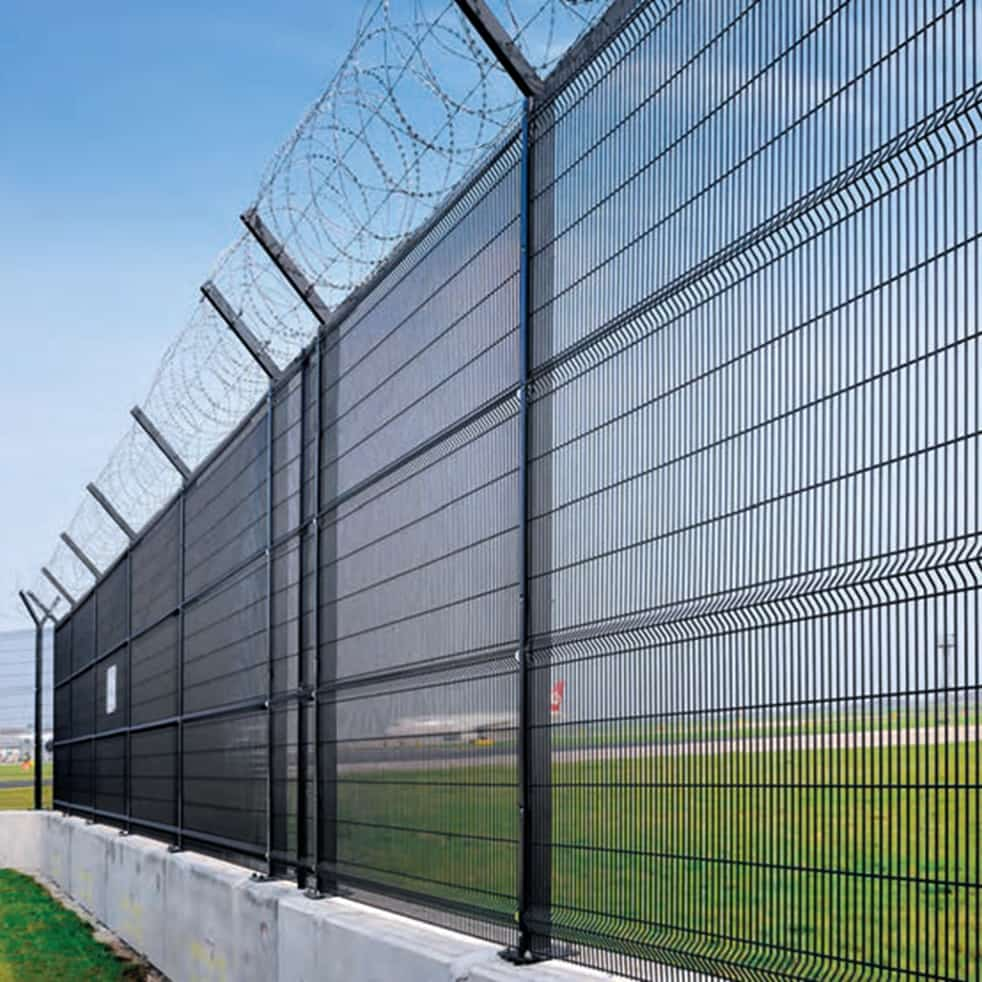
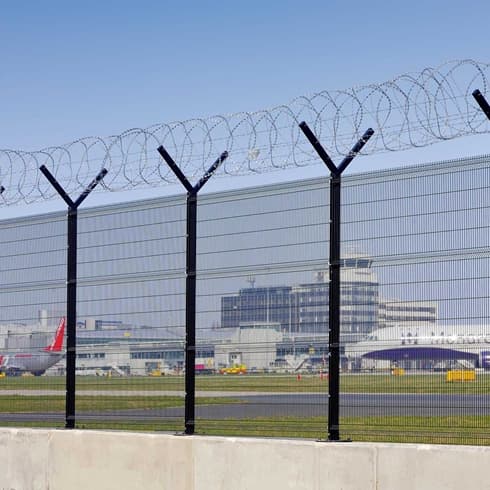
An airport perimeter fence is a heavy-duty security fence installed along the boundary of airport restricted areas, including runways, taxiways, aprons, cargo zones and maintenance yards. It separates restricted airside from public landside areas.
Standard airport fences are not simple welded mesh. They are complete security assemblies consisting of high-strength fence panels, reinforced posts, anti-climb top barriers, security gates, tension wire brackets, alarm mounting bases and heavy-duty fixings. They are designed to delay or block unauthorised crossing attempts and give security teams enough response time when breaches happen.
Airport fences must remain stable under long-term outdoor exposure, strong winds, collision attempts and vandalism. Any weak point in the fence line can become a major aviation safety hazard.
Why Airport Fences Are Critically Important
- Prevent Unauthorised Human Intrusion
The top priority of airport fences is stopping trespassers from entering runways and apron zones. People entering restricted areas may cause runway incursions, flight diversions, emergency shutdowns and even serious flight accidents, leading to massive economic losses and safety threats.
- Reduce Wildlife Strike Risks
Birds, deer and other animals entering runway zones are one of the top threats to aircraft engines. Well-installed continuous airport fencing blocks large animals and helps manage wildlife movement, lowering bird and animal strike risks during take-off and landing.
- Protect Aircraft, Facilities and Ground Assets
Airports store high-value aircraft, cargo, fuel and ground support equipment. Robust airport fences protect these assets from theft, sabotage and intentional damage.
- Support Surveillance & Alarm Integration
Professional airport fence systems are pre-designed to integrate with vibration sensors, pulse fences, CCTV and lighting. A stable, uniform fence line provides a reliable carrier for electronic security systems; poor fencing will trigger false alarms or blind zones.
- Meet Regulatory & Audit Requirements
Civil aviation authorities around the world set mandatory standards for airport perimeter security. Qualified airport fences are a basic requirement for security inspections, certification and regular audits. Non-compliant fencing can result in operational restrictions.
- Separate Functional Zones Inside the Airport
Besides the outer boundary, airport fences are also used to divide cargo areas, fuel depots, maintenance workshops and staff-only zones, achieving internal zoning management.
Core Performance Requirements for Qualified Airport Fences
Ordinary security fences cannot be used for airport projects.Airport fences must satisfy strict performance indexes:
- Excellent anti-climb design: Small mesh apertures, smooth no-foothold surface, topped with barbed wire or razor wire brackets to eliminate climbing points.
- Anti-cut & high tensile strength: High-tensile wire is adopted to resist bolt cutters and manual cutting attempts.
- High impact resistance: Reinforced panels and heavy posts resist vehicle impact, kicking and heavy object strikes without easy collapse.
- Continuous integrity: No gaps, loose joints or easily removable panels; all fixing parts are anti-removal type.
- Superior anti-corrosion performance: Powder coating for coastal salt spray, high humidity and extreme weather conditions.
- Wind load adaptability: Designed according to local wind speed data to prevent overturning in strong winds or typhoon zones.
Common Types of Airport Fences
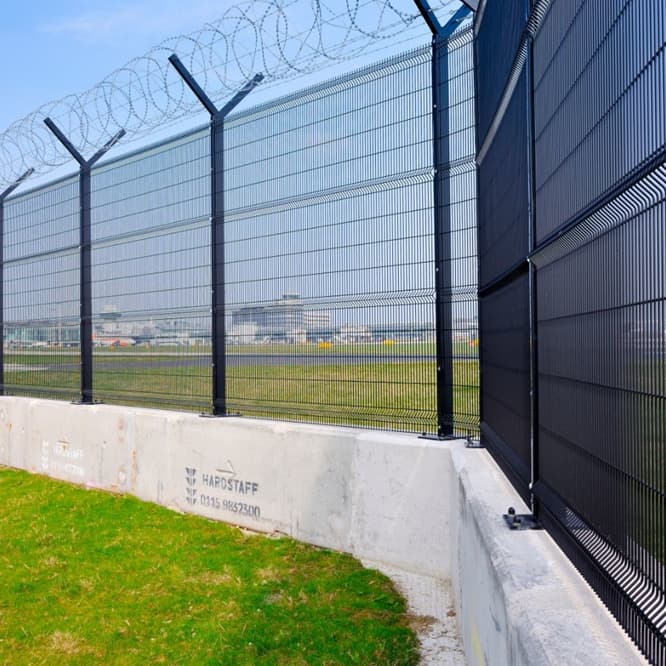
- Anti-climb 358 mesh airport fence
Also known as prison mesh. Small aperture (12.7×76.2mm), hard to grip and cut. It is the most widely adopted airport fence type for main perimeters.
- Welded mesh airport fence with V-bend
Rigid 3D bent panels for medium-level zoning inside airports, usually matched with barbed wire on top.
- Chain-link airport security fence
Flexible, low cost, often used for temporary boundaries or secondary isolation zones, normally fitted with barbed wire arms.
- Palissade / vertical bar security fence
High visual deterrence, widely used for airport terminal surrounding areas and high-level restricted zones.
For most main airport perimeter lines, 358 anti-climb mesh is the first recommendation due to its balanced anti-climb, anti-cut and surveillance-friendly features.
Complete Supporting System for Airport Fence Projects
A qualified airport perimeter solution is not just mesh panels. Giant Fence supplies full matched sets for airport fences:
- Heavy-duty galvanised posts, base plates and concrete embedded accessories
- Barbed wire / razor wire brackets, arms and fixing clips
- Security swing gates, sliding gates and emergency access gates for airport vehicles and staff
- Sensor mounting brackets for vibration fence and pulse alarm systems
- Anti-removal bolts, post caps, warning signs and reflective markers
Key Installation & Maintenance Notes
Airport fence installation requires strict construction control. Posts must be plumb with solid concrete foundations. Panel joints should be tightly connected without gaps. Top anti-climb accessories must be installed continuously with no breakpoints.
After handover, regular inspection is required: check for mesh damage, loose fixings, coating peeling, tilted posts and vegetation growth that can create climbing footholds. Timely repair ensures the fence stays effective through its whole service life.
FAQ
Q1: What is the most common airport fence type?
A1: 358 anti-climb mesh fence is the mainstream choice for airport main perimeters, thanks to its small mesh, anti-cut and anti-climb advantages.
Q2: Are airport fences required to add razor wire or barbed wire?
A2: It depends on local aviation security rules and risk grades. Most main perimeters require top barbed or razor wire as an extra anti-climb barrier.
Q3: Can airport fences work with security alarm systems?
A3: Yes. Professional airport fences reserve mounting points for vibration sensors and electronic perimeter alarms, forming an integrated physical + electronic defence system.
Q4: Do airport fences need special anti-corrosion treatment for coastal airports?
A4: Yes. Coastal airports belong to C4-CX corrosion categories. We use thicker hot-dip galvanisation plus high weather-resistant powder coating against salt spray corrosion.
Conclusion
Airport fences are far more than simple boundary markers. They are an essential physical security layer for airport safe operation, responsible for blocking trespassers, controlling wildlife, protecting airport assets and satisfying aviation regulatory standards.
Giant Fence provides full-spec airport perimeter fence systems including 358 anti-climb mesh panels, heavy posts, security gates and anti-climb topping accessories. Our products comply with UNE‑EN‑10223‑7:2013 and adopt ISO 9223:2012 graded anti-corrosion treatment for inland and coastal airport projects. We support custom heights, colours and complete technical drawings for tender and bidding use.
If you are working on airport security fencing projects, contact Giant Fence to get compliant airport fences solutions and competitive quotations.