



For industrial contractors, logistics park developers, and fencing distributors, choosing a 2D double wire fence manufacturer is a project-risk decision—not just a price comparison. Two quotations may show identical panel heights but differ in wire diameters, mesh openings, post thickness, clamps, coating processes, and delivery scope. Those differences become costly across a large perimeter.
This guide explains how to specify a complete twin-wire fencing system, choose between 656 and 868 configurations, review production quality, and compare landed project costs. It focuses on factories, warehouses, logistics yards, parking areas, and other industrial sites where durability, visibility, and controlled access matter.
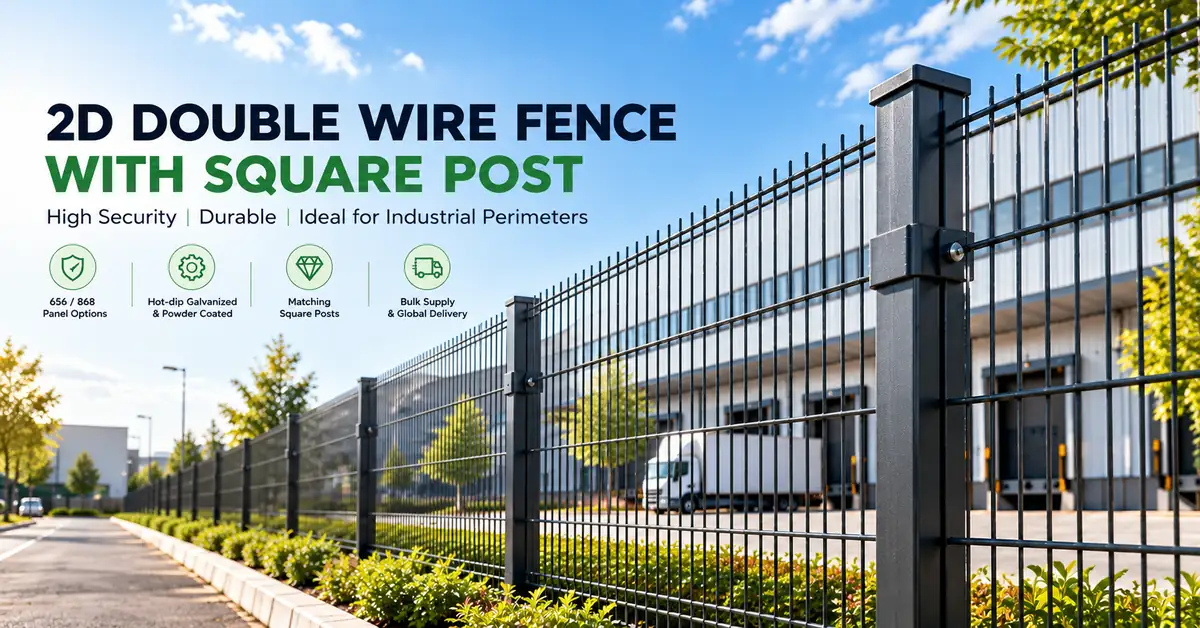
Quick Answer: How Do You Choose a 2D Double Wire Fence Manufacturer?
Choose a manufacturer that can document the entire fencing system: approved panel drawings, 656 or 868 steel-wire configuration, matching posts and fixings, corrosion protection, quality inspections, and gates. Compare suppliers against the same bill of materials and acceptance criteria. For industrial projects, also verify site conditions, vehicle exposure, delivery stages, and the evidence supporting any performance claims.
What Is a 2D Double Wire Fence—and Who Should Buy It?
A 2D double wire fence, also called a twin-wire mesh fence, consists of a flat welded steel mesh panel with two horizontal wires joined to one vertical wire at the crossing locations. Unlike a 3D fence, it normally has no reinforcing V-bends. Its double horizontal arrangement provides an alternative way to achieve panel rigidity while keeping an open view through the mesh.
The design suits fence distributors needing repeatable stock configurations; EPC contractors managing large, straight perimeter runs; and industrial property buyers seeking visible, defined boundaries. Typical applications include warehouse perimeters, manufacturing facilities, commercial parking areas, sports infrastructure, and certain public facilities.
When not to specify it automatically: a standard double-wire panel is not a crash barrier, certified anti-ram structure, or guaranteed anti-climb system. Forklift routes and truck yards may need independent vehicle barriers. Higher-risk sites may require specialist security fencing, surveillance, intrusion detection, or a separately engineered perimeter system.
For an overview of the company's manufacturing focus, visit Giant Fence's company profile.
Core Technical Specifications for a Reliable Industrial RFQ
Specifications must refer to the approved product variant. Giant Fence publishes 656 and 868 wire configurations, panel heights around 0.83–2.4 m, commonly listed 50 × 100 and 50 × 200 mm openings, and galvanized or powder-coated finishes. Its existing 656 article also discusses a 50 × 150 mm opening; therefore, buyers should not infer mesh opening from the 656/868 name alone.
| RFQ Item | Common / Published Reference | What to Confirm Before Ordering |
|---|---|---|
| Wire arrangement | Double horizontal + single vertical | Welding layout and wire location |
| 656 configuration | 6 mm horizontal / 5 mm vertical / 6 mm horizontal | Steel-core diameter and tolerance |
| 868 configuration | 8 mm horizontal / 6 mm vertical / 8 mm horizontal | Steel-core diameter and tolerance |
| Panel height | Approximately 0.83–2.4 m | Exact finished size and allowable deviation |
| Mesh opening | Product-dependent; examples include 50 × 100, 50 × 150, 50 × 200 mm | Opening direction and measurement basis |
| Panel width | Project-specific; 2.0 and 2.5 m appear in published guides | Finished width versus installed post spacing |
| Finish | Galvanizing and/or powder coating options | Actual process, coating specification and color |
| Supports | Matching posts, brackets, clamps and fasteners | Profiles, wall thickness and connection drawings |
| Access | Pedestrian and vehicle gates where required | Gate type, clear opening and post foundations |
A wire-size designation identifies the nominal diameters in a configuration; it does not define the mesh aperture, product security rating, load capacity, or corrosion performance. Request a dimensioned drawing showing the finished panel and all connection details.
656 vs 868 Double Wire Fence: Which Is Right for the Site?
The main structural distinction is the nominal wire configuration. The 868 design contains larger steel wires than 656, which generally means more steel and potentially greater panel rigidity when other design factors are comparable. But a performance claim requires evidence that accounts for welds, geometry, posts, installation, and loading.
| Comparison Point | 656 Twin-Wire Panel | 868 Twin-Wire Panel |
|---|---|---|
| Nominal horizontal wires | Two 6 mm wires | Two 8 mm wires |
| Nominal vertical wire | 5 mm | 6 mm |
| Typical buying priority | Balance material use and everyday boundary needs | Heavier panel configuration for demanding specifications |
| Relative material demand | Lower for comparable layout | Higher for comparable layout |
| Appropriate decision | Where project performance requirements permit | Where design specifications justify heavier construction |
| Must still verify | Weld integrity, support spacing, coating and fixings | Weld integrity, support spacing, coating and fixings |
For example, a low-exposure warehouse perimeter may not justify the same panel as a frequently used sports boundary. Conversely, automatically selecting 868 does not solve an inadequate foundation or weak post connection.
If you need more background on the lighter variant, see Giant Fence's 656 double wire fence technical guide.
Match Posts, Clamps, Foundations and Gates as One System
A panel-only price rarely tells a contractor what the installed fence will cost. The support structure is equally important.
Confirm the post cross-section and wall thickness, center-to-center spacing, clamp quantity, fastener grade, post caps, base plates or embedment details, and treatment of cut or drilled surfaces. Industrial corner posts, terminal posts, and gate supports may need different configurations from intermediate posts.
For projects considering an H-post or square-post arrangement, ask the manufacturer for a physical trial assembly or approved installation drawing. A supplier's statement that panels use "standard posts" does not establish interchangeability with another manufacturer's clips.
Gates deserve their own schedule. A vehicle entrance may require a different supporting structure from an adjacent fixed fence, even if the visible infill matches. Confirm leaf width, operating direction, ground clearance, hinges, locking, corrosion protection and any powered-gate safety requirements.
The objective is a complete bill of materials (BOM) rather than an incomplete shipment of panels followed by emergency accessory purchases.
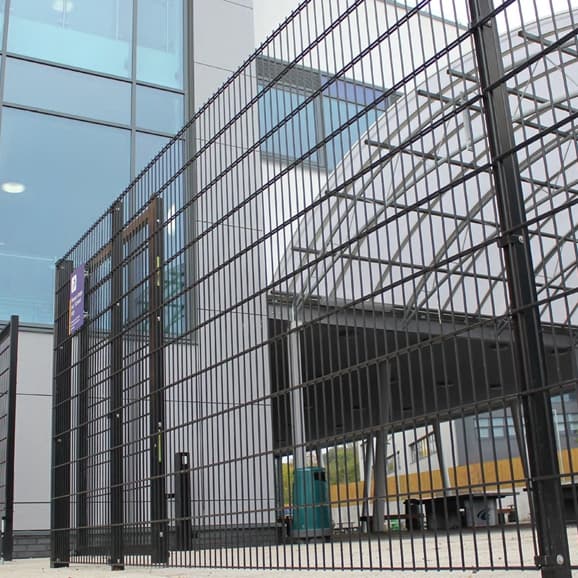
Design the Perimeter for Real Industrial Conditions
Logistics yards: Locate pedestrian crossings and vehicle gates before finalizing the fence line. Where trucks or forklifts can hit the perimeter, specify separate vehicle-impact protection appropriate to the assessed hazard; mesh fencing alone should not be treated as a protective crash barrier.
Warehouses and factories: Prioritize clear sightlines, maintainable gate access, durable fixings and secure interfaces around service entrances. Determine whether security cameras need uninterrupted visibility along the fence.
Parking and shared access roads: Consider turning radii, drainage, access control, foundations and the possibility of minor vehicle contact. A more substantial panel cannot compensate for poor traffic design.
Sloping industrial sites: Decide whether panels will be stepped or specially made. The resulting ground gaps, post lengths and extra corner components should be shown in the quantity schedule.
Coastal facilities: Specify corrosion protection using actual exposure conditions rather than a generic claim that every powder-coated fence is suitable for sea air.
For mixed-use developments with multiple boundary and access conditions, Giant Fence also describes coordinated 2D fencing and entrance arrangements for residential communities.
Manufacturing Process and Quality Control: Evidence to Request
A capable 2D double wire fence manufacturer should explain how it controls incoming steel wire, welding, panel geometry, post manufacture, surface finishing and packing. Giant Fence publicly describes these manufacturing functions; individual order requirements should still be approved in writing.
For B2B sourcing, inspection records matter more than an unsupported "premium quality" claim.
| Production / Inspection Stage | Evidence or Check | Procurement Risk Reduced |
|---|---|---|
| Incoming wire | Material identification and measured diameter | Undersized or inconsistent steel |
| Mesh welding | Weld completeness and agreed test method | Weak or missed intersections |
| Panel dimensions | Width, height, flatness, aperture and tolerance measurements | Misaligned installation |
| Post production | Tube size, wall thickness, holes and brackets | Incompatible assemblies |
| Coating | Process records and relevant thickness / adhesion checks | Early finish failure |
| Trial assembly | Correct panel, post and clamp fit | Missing or mismatched accessories |
| Final dispatch | Quantity, labels, packaging and loading photos | Shortage and freight damage |
Agree a first-article approval, in-process checks and a final inspection plan before manufacturing. Third-party inspection can be useful for a substantial order, but sampling methods and acceptance limits must be agreed—not improvised at the loading stage.
Giant Fence lists technical catalogs and management-system materials in its resource center. Verify the current validity and product scope of any certificate before using it as a tender qualification.
Galvanizing, Powder Coating and Relevant Standards
Outdoor service conditions determine how much corrosion protection is needed. Salt-laden coastal air, persistent humidity and industrial pollutants can create different exposures from an ordinary inland warehouse site.
Specify whether panels are made from previously galvanized wire, are galvanized after fabrication, or receive a compatible combination of zinc protection and powder coating. These are not interchangeable specifications. Agree measurable coating requirements and inspection methods for panels, posts, welds and fasteners.
Three authoritative references help structure discussions:
-
EN 10223-7:2012 addresses welded steel wire panels for fencing, including relevant characteristics and tolerances.
-
ISO 9223:2012 classifies atmospheric corrosivity; it does not guarantee a finished fence's lifespan.
-
ISO 1461:2022 covers batch hot-dip galvanized coatings on fabricated iron and steel articles within its scope. It explicitly excludes continuously hot-dip-galvanized wire and welded mesh, so it must not be applied indiscriminately to every galvanized panel.
Technical standards are references for specifying and evaluating products—not evidence that every product sold by a particular company automatically complies. Request project-relevant reports and confirm the applicable edition and scope.
What Really Determines Wholesale Fence Cost?
The cheapest panel quotation can produce a higher project total once posts, access gates, coating upgrades, fixings and logistics are considered.
Compare offers using the same specification and commercial basis:
| Cost Driver | Questions for the Supplier |
|---|---|
| Steel content | Is the quoted wire diameter measured before or after coating? |
| Panel configuration | Are mesh opening, size and tolerances identical? |
| Posts and connectors | What profiles, wall thicknesses and quantities are included? |
| Corrosion protection | What process and measurable acceptance criteria apply? |
| Gates | Are entrance structures and hardware priced separately? |
| Export packing | How are panels and coated surfaces protected? |
| Freight and terms | Are EXW, FOB or CIF quotations being compared on the same basis? |
| Nonstandard items | Are corner sections, special panels and spare fixings included? |
A useful planning principle is total delivered system cost ÷ net installed fence length, with consistent treatment of gates, foundations and taxes. Ask for an itemized quotation before making decisions based on price per panel.
OEM Customization, Production Planning and Export Supply
Industrial buyers may require custom panel dimensions, mesh openings, post profiles, RAL colors, branded packaging or matched gate infill. Giant Fence describes support for custom specifications and project drawings, subject to technical confirmation.
For repeat orders, insist on controlled drawing revisions and product codes so replacement panels and clips remain compatible. For phased industrial construction, align manufacturing and shipping lots with the installation sequence. Production lead time, minimum order quantities and sample availability should be confirmed against the actual order; do not assume that general website claims apply to every customized SKU.
A useful supplier-qualification process is: technical enquiry → approved drawing → sample or first-article review → confirmed quotation and purchase order → production inspection → final packing and shipment documentation.
Why Discuss Your 2D Fence Project with Giant Fence?
Giant Fence, operated by Hebei Giant Metal Technology Co., Ltd. in Anping County, China, presents 2D double-wire panels alongside 3D fencing, posts, gates and other perimeter products. Its published capabilities cover welding, post fabrication, surface treatment, technical specification support, and export-order coordination.
For an industrial buyer, the practical value lies in discussing the full perimeter package with one technical supplier and obtaining a quotation tied to your drawings—not in accepting unsupported promises about strength, certification, or delivery speed.
To request a tailored proposal, send project length, location, 656/868 preference, panel height, mesh opening, post details, coating requirements, gates and quantities using the Giant Fence quotation form.
2D Double Wire Fence Manufacturer: 10 Buyer FAQs
1. What is a 2D double wire fence?
It is a flat welded steel mesh panel constructed with paired horizontal wires and single vertical wires. The design provides a rigid, open-visibility boundary when combined with appropriate posts and fixings.
2. What do 656 and 868 mean?
They indicate nominal horizontal-vertical-horizontal wire diameters in millimeters: 6/5/6 and 8/6/8. They do not define mesh aperture, certified security level, or coating specification.
3. Which configuration is better for a logistics warehouse?
Choose the configuration that meets the project's verified structural, operational and security needs. Heavier 868 construction may be appropriate for some specifications, but sound post and foundation design remains essential.
4. Are 2D fence panels anti-climb?
They provide a physical boundary, but security depends on mesh geometry, height, top treatment, fixings and the site's threat assessment. Do not assume a certified anti-climb rating without supporting evidence.
5. What mesh opening should importers order?
Select it from an approved product drawing. A 656 or 868 label alone cannot establish mesh size, and published variants may differ.
6. Can double-wire fencing stop vehicle impacts?
Ordinary mesh fencing should not be used as a substitute for an engineered vehicle restraint or crash barrier. Protect exposed truck and forklift routes separately where the risk assessment requires it.
7. Is galvanized and powder-coated fencing suitable for coastal sites?
Potentially, with a coating system selected for the actual corrosive environment. Specify processing, thickness, preparation and acceptance tests; do not rely on a universal service-life claim.
8. Can panels, posts and gates be bought together?
Yes, a coordinated procurement package can include compatible posts, brackets, gates and fittings. Confirm every component and quantity in the approved bill of materials.
9. What should a pre-shipment inspection include?
Check material and wire dimensions, welds, mesh and panel geometry, coating, trial fit, accessory counts, packing and agreed documentation using defined sampling criteria.
10. How can I get an accurate wholesale quotation?
Provide a site plan, required fence length, panel dimensions, wire configuration, finish, supports, gates, delivery destination and trade terms. A documented RFQ makes competing offers more comparable.
Conclusion
Choosing a 2D double wire fence manufacturer for an industrial perimeter is primarily about controlling specification, assembly, corrosion and procurement risk. The nominal 656 or 868 wire configuration is important, but it is only one element of a complete solution. Panel dimensions, weld consistency, post connections, gates, coating and commercial scope must all be verified together.
For fence importers, industrial contractors and logistics park developers, a detailed RFQ and agreed inspection plan can reduce avoidable project delays and disagreements over quality or missing components. Giant Fence offers a starting point for discussing coordinated double-wire fence systems and custom requirements. Share your drawings and expected quantities through the Giant Fence contact page to discuss a project-specific quotation.