


Introduction
Solar farms hold large values of solar panels, inverters, transformers and cables. They are often built in remote, open countryside areas with limited on-site security staff, which makes perimeter protection a top priority. Palisade fences are one of the most popular perimeter security solutions for utility-scale solar projects, widely preferred by EPC contractors and asset owners.
Unlike chain link or 358 mesh fencing, palisade fences feature vertical steel pales with sharp pointed tops. They deliver strong visual deterrence, good anti-climb and anti-cut performance, and long service life. Giant Fence supplies full-set palisade fences specially designed for solar farm applications. This article covers their core security benefits, common types, critical installation points and practical selection tips for solar photovoltaic projects.
What Are Palisade Fences?
Palisade fences are rigid vertical bar security fences, constructed from individual steel pales fixed to horizontal rails and support posts. Each pale is usually pointed at the top to stop intruders from climbing over.
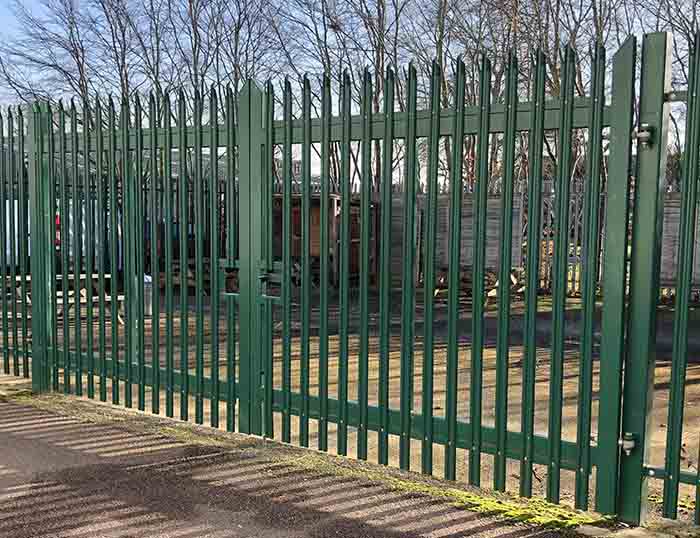
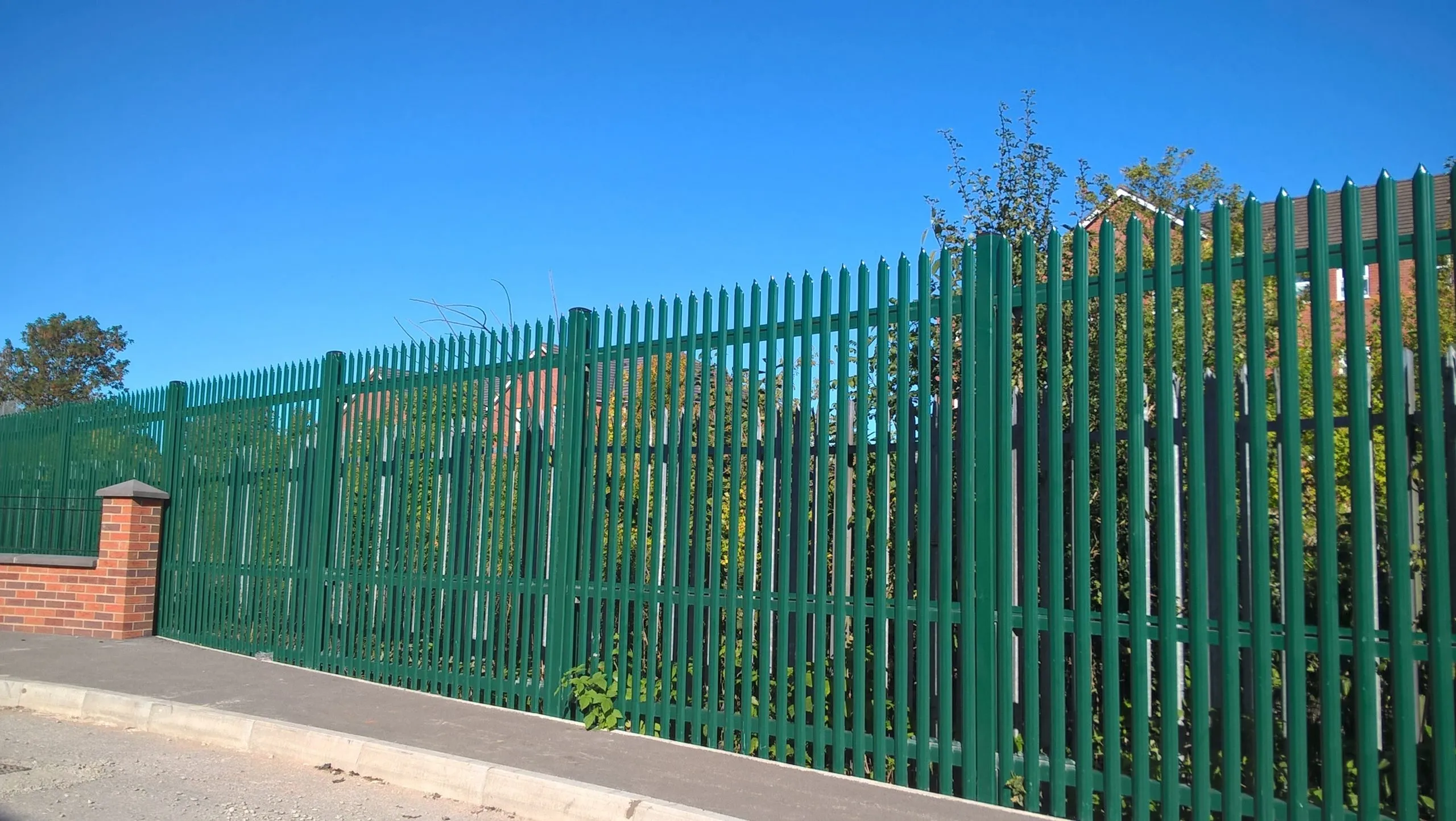
There are two mainstream types in the market: D-section palisade and W-section palisade. D-pales have a curved D-shaped profile, while W-pales adopt a reinforced W profile for higher impact resistance. Both styles are hot-dip galvanised or galvanised plus powder coated for outdoor corrosion protection. For solar farms, W-section palisade fences are more commonly selected for better rigidity and vandal resistance.
Why Palisade Fences Suit Solar Farm Security
- Strong visual deterrent effect
Sharp pointed tops and solid vertical steel bars create a clear high-security appearance. Trespassers are less likely to attempt to climb, which reduces intrusion risks at the first stage. This is a major advantage of palisade fences over mesh fences for remote solar sites.
- Anti-climb & anti-vandal performance
The pointed top design directly prevents easy over-climbing. Solid steel pales are hard to bend or kick apart. It is difficult to get hand or footholds between closely spaced pales, effectively protecting solar panels, copper cables and electrical equipment from theft and sabotage.
- Good airflow and low wind load
There are gaps between vertical pales, so wind can pass through freely. Compared with solid panel hoarding, palisade fences have much lower wind load, which is very important for large open solar farms exposed to strong winds and storms.
- Clear sightline for patrol and CCTV
The gaps between pales allow security cameras and patrol teams to see through the perimeter easily. No blind zones are created, making it easier to monitor the whole solar site.
- Long service life and low maintenance
With hot-dip galvanised treatment, palisade fences can resist rust for decades. They do not sag like chain link mesh. Damage is usually limited to individual pales, so replacement is simple and maintenance cost stays low for large solar parks.
- Compatible with extra security upgrades
Palisade fence lines can be fitted with razor wire arms, vibration sensors, warning signs and lighting brackets. Asset owners can upgrade the security level according to risk assessment requirements.
Key Installation Considerations for Solar Farm Palisade Fences
- Site survey and ground preparation
Solar farms are usually on uneven land, sloped terrain or farmland. Survey the route first, mark rock areas, drainage ditches and underground cables. Avoid damaging buried PV cables during post foundation digging. For slopes, install the fence in stepped sections instead of tilting the whole fence line.
- Foundation and post installation
Concrete footing size depends on local wind speed and soil type. Loose sandy soil needs deeper and wider foundations. Posts must be kept plumb during pouring. Incorrect post alignment will affect the straightness and stability of the wholepalisade fences line.
- Clearance for grass and vegetation
Keep a clear strip along the fence base. Overgrown weeds and bushes can form natural climbing steps. Solar farm operators should plan regular mowing along the perimeter to maintain the security function of the fence.
- Gate matching for solar site access
Solar farms require large vehicle gates for delivery trucks, maintenance vehicles and cleaning machines. Palisade sliding gates or double swing gates should match the same pale profile, height and coating as the main fence. Locking systems and access control can be integrated on site.
- Corrosion specification matching the environment
For inland dry areas, standard hot-dip galvanisation is enough. For coastal solar farms near salt water, specify extra zinc thickness plus polyester powder coating to reach C4 corrosion grade.
- Lightning and earthing coordination
Solar sites have strict earthing rules. The palisade fence system should be properly earthed and separated from PV array earthing design as required by local electrical codes.
Common Specifications for Solar Farm Palisade Fences
- Profile: W-section palisade (preferred) / D-section palisade
- Height: 1.8m, 2.1m, 2.4m, 2.7m; 2.4m is widely used for solar perimeter
- Pale thickness: 2.0mm, 2.5mm, 3.0mm
- Top style: single point, double point, chisel point
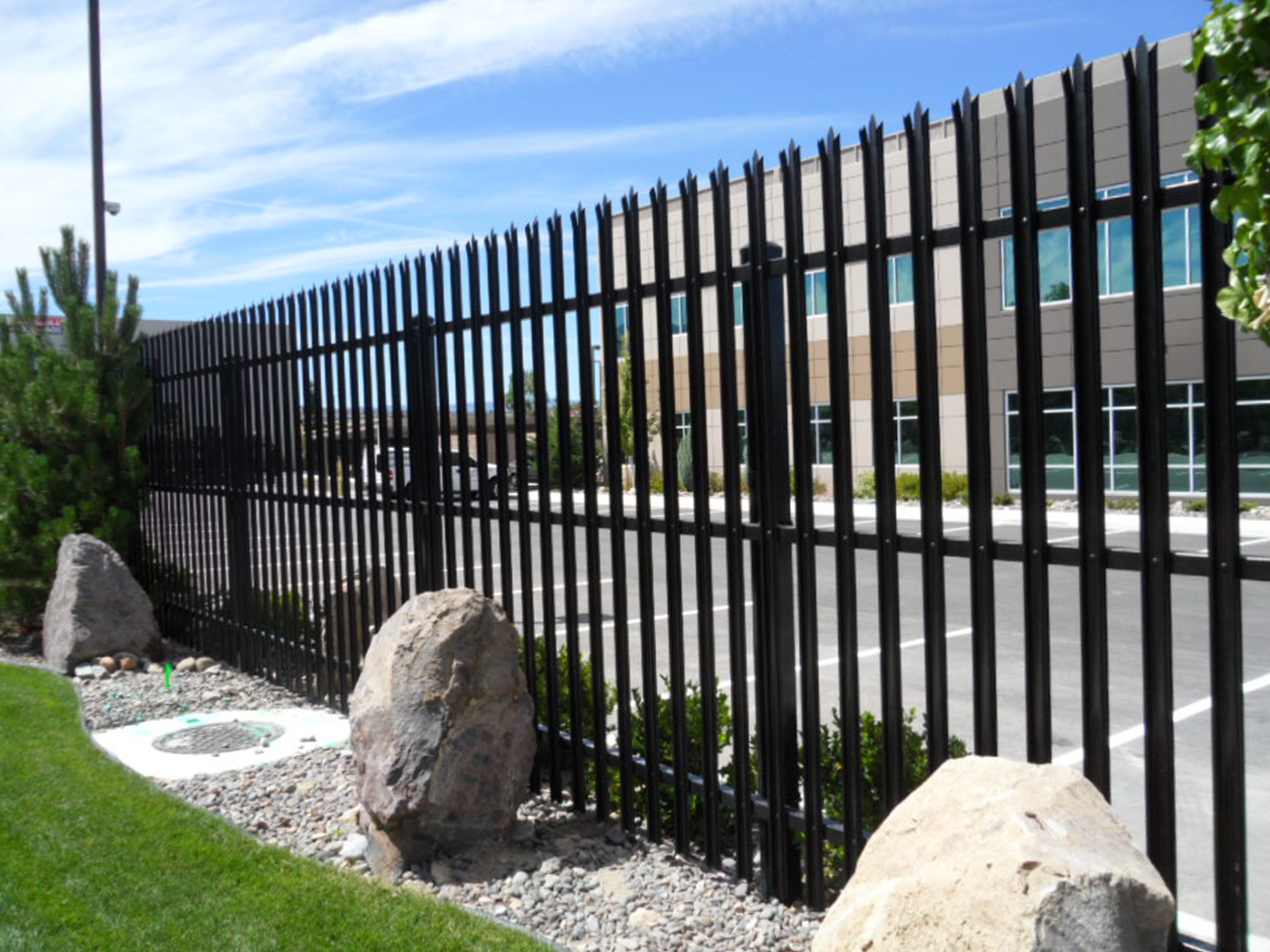
- Surface finish: hot-dip galvanised;
powder coating (green, black, grey)
Limitations & Alternative Comparison
Palisade fences are not suitable for every solar project. Compared with 358 anti-climb mesh, palisade fences have slightly weaker anti-cut performance. If the site faces high copper cable theft risk, owners may combine palisade fencing with top razor wire or choose 358 mesh as an alternative. Compared with chain link, palisade has higher unit cost but stronger deterrence and longer lifespan.
Supporting Accessories
Giant Fence supplies complete accessories for solar farm palisade fence projects:
- W / D pales, horizontal rails, rectangular posts
- Anti-theft fixing bolts, brackets, post caps
- Razor wire brackets and arms
- Palisade swing gates, sliding gates for solar vehicles
- Warning plaques, sensor mounting brackets
FAQ
Q1: Which is better for solar farms, D-palisade or W-palisade?
A1: W-section palisade fences have higher rigidity and impact resistance, so they are the first recommendation for most solar farm perimeters. D-palisade is a cost-saving option for lower-risk zones.
Q2: Can palisade fences be installed on sloped land for solar parks?
A2: Yes. The standard method is stepped installation, each section horizontal, following the land contour step by step, rather than tilting the whole fence panel.
Q3: Do palisade fences need regular maintenance on solar farms?
A3: Low maintenance. Main tasks include checking loose bolts, inspecting coating damage, and clearing vegetation at the fence bottom.
Q4: Is palisade fence wind-friendly for large open solar sites?
A4: Yes. The open structure allows wind penetration, greatly reducing wind load compared with solid hoarding panels.
Conclusion
Palisade fences balance visual deterrence, anti-climb performance, wind permeability and long-term durability, making them a mature perimeter solution for utility-scale solar farms. Reasonable design of foundation, stepped layout, earthing and gate matching will help reduce security risks and lower long-term operation costs.
Giant Fence offers custom W and D section palisade fence systems tailored for solar PV projects. We can provide technical drawings, load calculation support and tender documents for EPC contractors. Contact us for a suitable palisade fences quotation for your solar farm project.