



TL;DR: A reliable temporary fencing manufacturer should provide more than low-cost portable fence panels. Construction contractors, rental companies, and distributors need compatible panels, stable bases, secure clamps, suitable bracing, durable finishes, and replaceable accessories. Compare the complete system and its expected reuse economics before ordering. Wind resistance and site safety must be assessed for the actual installation—not assumed from panel dimensions alone.
Temporary fencing is one of the most frequently moved and reused products in the construction safety industry.
Unlike permanent welded mesh fencing, portable fence panels may be installed at one construction site, removed, transported, stored, and deployed again on a different project.
This creates an important purchasing challenge.
A temporary fence that looks inexpensive when new may become costly if its frames deform, connectors are frequently lost, or its bases are incompatible with replacement panels.
For construction equipment rental companies, international fence distributors, and EPC contractors, the better purchasing decision often comes from evaluating cost per deployment rather than purchase price alone.
This guide explains how to compare temporary fence systems, manage wind exposure, assess manufacturing quality, calculate reuse costs, and prepare a complete wholesale RFQ.
Key Takeaways
-
Buy a complete system: Panels, bases, clamps, braces, gates, and replacement components must be compatible.
-
Specify the application: Construction boundaries, event perimeters, pedestrian control, and temporary site hoarding have different requirements.
-
Assess wind exposure: Open mesh, screened mesh, and solid barriers behave differently under wind loading.
-
Prioritize repeated handling: Frame geometry, weld quality, corrosion protection, and stackability influence rental-fleet economics.
-
Standardize components: Consistent panel dimensions and interchangeable accessories simplify inventory management.
-
Inspect before shipment: Check panel geometry, frame joints, mesh attachment, coating, bases, and clamps.
-
Compare lifecycle costs: Include maintenance, lost accessories, transport, damaged units, and expected deployment cycles.
What Should Buyers Look for in a Temporary Fencing Manufacturer?
Choose a temporary fencing manufacturer that can supply a consistent, reusable fencing system with documented specifications, compatible accessories, and clear quality-control requirements.
The most important supplier capabilities are:
-
Manufacturing portable panels to approved dimensions.
-
Providing appropriate mesh and frame options.
-
Supplying matching bases, clamps, braces, and gates.
-
Maintaining consistency between repeat production batches.
-
Supporting customization for the destination market.
-
Providing suitable export packaging and spare components.
-
Identifying which structural performance requirements need site-specific verification.
The objective is not simply to purchase fence panels.
It is to create a dependable temporary perimeter system that can be transported, assembled, inspected, dismantled, and reused efficiently.
Which Temporary Fence System Is Best for Your Market?
Different portable fencing systems use different structural arrangements.
An importer should first decide which product category matches the customer and the intended installation environment.
Temporary Fencing System Comparison
| Fence Type | Main Construction | Typical Application | Primary Buying Consideration |
|---|---|---|---|
| Framed Welded Mesh Temporary Fence | Welded mesh within a steel tube frame | Construction sites and temporary boundaries | Frame geometry, mesh welds, accessory compatibility |
| Framed Chain Link Temporary Fence | Chain-link mesh attached to a tubular frame | Construction, infrastructure projects, temporary site isolation | Mesh attachment, frame strength, repeated handling |
| Crowd Control Barrier | Interlocking portable steel barrier sections | Queues, events, pedestrian routing | Connection method and pedestrian management |
| Solid Temporary Hoarding | Substantially closed fence or hoarding panels | Construction screening and visual separation | Higher wind actions and engineered support |
| Temporary Edge Protection | Specialized fall-prevention system | Elevated construction edges | Application-specific testing and approval |
These products should not be treated as interchangeable.
A pedestrian crowd barrier is not automatically a suitable construction security fence. Similarly, ordinary temporary mesh panels should not be substituted for an approved edge-protection system.
Framed Welded Mesh Temporary Fencing
Welded mesh panels combine a rigid frame with welded steel mesh.
They can be considered for modular construction boundaries and repeat-use inventory.
Key considerations include mesh attachment, frame welds, dimensions, surface protection, and the connection method.
Chain Link Temporary Fencing
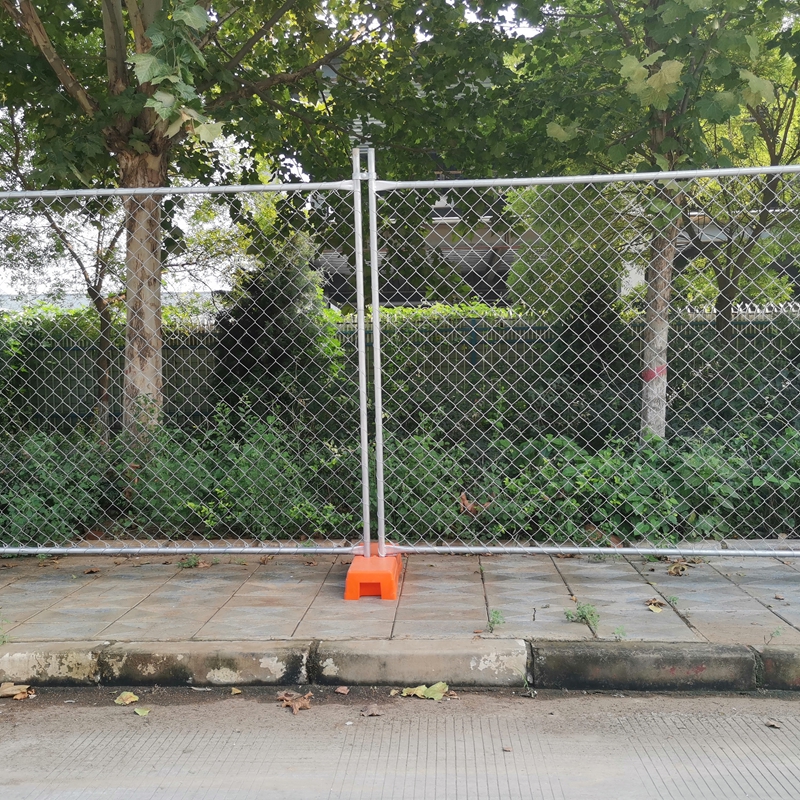
Chain-link temporary fence panels use interwoven wire mesh secured to a steel tube frame.
The construction can accommodate different panel sizes and mesh specifications.
Buyers should examine how the mesh is tensioned or attached to the frame, particularly where repeated loading and transportation are expected.
GIANT MESH has documented a U.S. project involving framed chain-link temporary fencing and matching gates, providing a relevant reference for this type of supply.
Crowd Control Barriers
Crowd barriers are primarily associated with organizing pedestrian movement and defining temporary access zones.
They require separate consideration of crowd conditions and applicable safety requirements.
For further information, see Giant Fence's wholesale crowd control barrier buying guide.
Technical Specifications for Bulk Temporary Fence Orders
Temporary fencing quotations should include more than panel height and width.
For repeat rental use, the entire component specification matters.
Temporary Fence Specification Checklist
| Component | Information to Specify | Why It Matters |
|---|---|---|
| Fence panel | Finished width and height | Inventory compatibility and quantity planning |
| Frame | Tube diameter, wall thickness and material | Handling durability and structural assessment |
| Mesh | Welded or chain link; wire diameter and opening | Product suitability and visibility |
| Frame connections | Welding and assembly details | Repeated-use reliability |
| Base | Material, dimensions, weight and fitting arrangement | Stability and compatibility |
| Clamps | Material, dimensions, fastener and connection arrangement | Secure panel joining |
| Support braces | Type and connection points | Site-specific stabilization |
| Surface finish | Galvanizing or other specified protection | Corrosion control |
| Gates | Clear opening, frame, latch, wheel or support arrangement | Access and system coordination |
| Packing | Stacking method, pallet dimensions and bundle quantities | Freight and damage prevention |
Why Panel Dimensions Must Be Standardized
A rental company may purchase an initial shipment of portable fencing and reorder additional panels several months later.
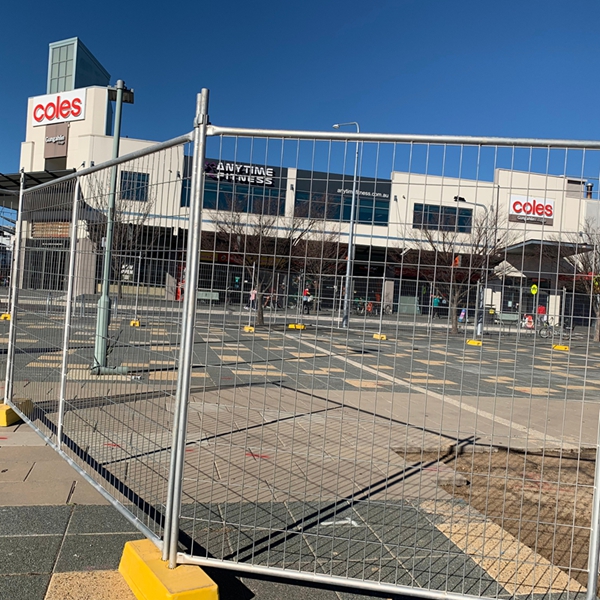
If the replacement panels use different frame diameters or connection heights, existing clamps and bases may not fit.
Before production, buyers should approve a master drawing identifying all critical dimensions.
The drawing should also specify permissible variations and the corresponding inspection method.
Why Frame and Mesh Specifications Matter
Steel tube diameter alone does not determine structural strength.
Wall thickness, steel properties, weld details, geometry, and supporting connections must also be considered.
Likewise, a heavier mesh does not automatically make the completed fence safer in every situation.
The entire system should match its intended use.
How Do Bases, Clamps and Braces Affect Fence Stability?
Temporary fencing is designed to be removable.
Because it generally does not rely on the same permanent foundations as fixed perimeter fencing, the support system requires particular attention.
Temporary Fence Bases
Depending on the approved design, bases may be manufactured using steel or suitable molded materials.
Their dimensions, weight, ground contact, and panel connection arrangement affect stability and handling.
A heavier base is not necessarily adequate for every site condition.
Panel Connection Clamps
Clamps connect adjacent panels and help maintain system continuity.
Buyers should verify the clamp's fit, material, fastening arrangement, and compatibility with the frame.
For rental businesses, replacement availability is also important because small components are easily lost between projects.
Support Braces
Bracing may be required where the site design identifies additional stability needs.
The appropriate arrangement depends on wind conditions, ground conditions, fence configuration, and the engineered installation system.
Do not select bracing quantities from a universal rule of thumb. Obtain the applicable design or manufacturer's approved configuration.
Gates and Access Points
Temporary fence gates require coordinated frames, hinges or wheels, locking components, and sufficient support.
A gate that fits the nominal panel height may still be incompatible with the required operating arrangement.
For an overview of different temporary access configurations, see Giant Fence's temporary and portable fence gate comparison.
How Does Wind Exposure Affect Temporary Fencing?
Wind is a critical design consideration for temporary fences because panels, bases, and connections can be exposed to lateral loads without permanent foundations.
The actual forces depend on panel geometry, wind climate, terrain, local surroundings, installation layout, and any materials attached to the mesh.
Open Mesh vs. Screened Mesh
Open mesh generally allows more airflow through the fence than solid panels.
However, an open temporary fence still experiences wind loading.
Adding privacy screening, printed banners, debris netting, or other attachments can significantly change its behavior.
A temporary fence design assessed for open mesh should not automatically be used with screening.
Components That Require Assessment
| Component | Potential Concern |
|---|---|
| Fence panel | Deformation and movement |
| Panel clamps | Connection forces or separation |
| Fence bases | Sliding, overturning or displacement |
| Bracing | Inadequate or incorrectly installed supports |
| Gates | Movement, operational loads and support stability |
| Ground | Uneven surfaces and limited support resistance |
| Attached screening | Increased aerodynamic forces |
Which Temporary Fencing Standards Are Relevant?
In Australia, AS 4687.1:2022 addresses general requirements for temporary fencing and hoarding systems.
AS 4687.2:2022 addresses the design, installation, and performance of temporary fencing and temporary pedestrian barriers within its scope.
In the United Kingdom, the Health and Safety Executive recognizes site fencing and hoarding as temporary works requiring suitable planning, installation, and maintenance.
Requirements differ by country and project.
These standards and guidance documents are references for technical evaluation, not proof that a particular GIANT MESH product has been independently certified.
Procurement recommendation: Ask for relevant design information and confirm the applicability of the proposed installation with the site's responsible designer or competent person.
What Makes Temporary Fencing Suitable for Repeated Rental Use?
A temporary fence manufacturer supplying rental companies must consider what happens after the first installation.
Repeated handling introduces wear that may not be obvious when the panels are new.
1. Frame Durability
Frame joints, tube ends, and frequently handled sections should be evaluated for the intended service conditions.
2. Mesh Attachment
Inspect how welded or woven mesh is connected to the frame.
Poor attachment can require repairs even when the surrounding frame remains usable.
3. Corrosion Protection
Galvanizing and other suitable protective treatments can help control deterioration during outdoor use and storage.
The required coating depends on the destination environment.
4. Stackability and Transport
Portable fencing must be loaded, unloaded, stacked, and stored.
The manufacturer should provide package dimensions and a suitable transport arrangement.
5. Accessory Replacement
A rental fleet benefits from standardized clamps, feet, and other replaceable components.
The goal is to repair or replace individual components without unnecessarily discarding complete usable panels.
6. Inspection Between Deployments
Rental operators should inspect returned fencing before issuing it to another customer.
Bent frames, damaged connections, missing clamps, and unsuitable bases should be identified before reuse.
Temporary Fencing Lifecycle Cost: Cheap vs. Durable Panels
The lowest factory price is not always the lowest long-term cost for a rental fleet.
A buyer should compare the purchase cost against the number of usable deployment cycles.
Illustrative Cost Comparison
Consider two hypothetical portable fence options.
The figures below are assumptions for explaining the purchasing method—not GIANT MESH prices, product testing, or performance guarantees.
| Cost Factor | Option A | Option B |
|---|---|---|
| Initial panel price | $52 | $68 |
| Assumed usable deployment cycles | 7 | 12 |
| Initial panel cost per cycle | $7.43 | $5.67 |
The basic calculation is:
Initial Panel Cost per Cycle = Purchase Price ÷ Usable Deployment Cycles
For Option A:
$52 ÷ 7 = $7.43 per cycle
For Option B:
$68 ÷ 12 = $5.67 per cycle
Under these assumptions, the more expensive panel has a lower initial purchase cost per deployment.
What Is Missing from This Calculation?
Actual ownership costs also include transportation, labor, cleaning, repairs, missing accessories, storage, and disposal.
The assumed deployment cycles must be replaced with real fleet records or reliable testing evidence before making a purchasing decision.
Practical Rental-Fleet Cost Formula
Lifecycle Cost per Deployment = (Purchase + Freight + Repairs + Replacement Components − Residual Value) ÷ Completed Deployments
This provides a better comparison than purchase price alone, provided all costs and assumptions are consistently measured.
Real GIANT MESH Project: 550 Sets of Temporary Chain-Link Fencing
Giant Fence has published a case study involving an American customer who purchased 550 sets of chain-link temporary fencing and matching gates.
The project was intended for temporary site isolation and event-related applications.
According to the manufacturer's published project information, the specified fence system included:
| Specification | Published Project Detail |
|---|---|
| Fence type | Framed chain-link temporary fencing |
| Individual panel dimensions | 1.83 m high × 2.9 m wide |
| Mesh opening | 60 × 60 mm |
| Frame tube | Approximately 40 mm diameter |
| Accessories | Removable bases and connection clips |
| Gate supply | Matching temporary gates |
| Additional support | Bracing on selected panels |
The published case also reports a 25-day production period for that specific order.
This demonstrates project-level supply and accessory coordination, but it should not be interpreted as a fixed lead time for future orders.
The same case mentions arrangements for dismantling and reuse.
For rental businesses, that feature is commercially important because fencing must remain manageable after each deployment.
Read the 550-set temporary fencing project case for more details.
Planning Example: Temporary Fencing for a 440-Meter Site
Consider a hypothetical construction contractor requiring temporary fencing around a 440-meter straight boundary.
Assume a nominal installed module width of 2.9 m.
Step 1: Estimate the Number of Panels
Panel Quantity = Fence Length ÷ Installed Module Width
440 ÷ 2.9 = 151.72
Round upward:
152 nominal panels
This assumes the installed module width really is 2.9 m and does not account for gate openings or special end sections.
Step 2: Allow for Spare Inventory
Suppose the rental operator chooses an illustrative 5% spare-panel allowance:
152 × 5% = 7.6
Rounded upward, that is eight spare panels.
Initial Procurement Estimate = 160 panels
The spare allowance is a commercial planning assumption, not an engineering requirement.
Step 3: Prepare the Accessory Schedule
A completed bill of materials should also account for:
-
Compatible fence bases.
-
Panel connection clamps.
-
Site-specific support braces.
-
Pedestrian and vehicle access gates.
-
Replacement fasteners and accessories.
-
Packing and storage requirements.
Actual base and clamp quantities depend on the manufacturer's connection design and the site's layout.
Step 4: Validate the Installation
Before ordering, review ground conditions, wind exposure, pedestrian interfaces, access arrangements, and the intended installation instructions.
The final quantity must follow the approved layout rather than the preliminary estimate.
Manufacturing Quality Control: What Should Importers Inspect?
A reliable temporary fencing manufacturer should establish clear inspection requirements for the complete product.
Giant Fence, operated by Hebei Giant Metal Technology Co., Ltd., is based in Anping County, Hebei Province, China.
The company's published manufacturing activities cover wire mesh production, metal fence fabrication, surface treatment, and related fencing products.
Buyers can review Giant Fence's company and manufacturing background when evaluating supplier capability.
Recommended Quality-Control Matrix
| Inspection Stage | What to Check |
|---|---|
| Raw materials | Steel wire and frame tube specifications |
| Mesh production | Mesh dimensions and assembly condition |
| Frame fabrication | Dimensions, squareness, weld quality |
| Surface treatment | Coating process and visible condition |
| Base manufacturing | Dimensions, material and fitting compatibility |
| Clamps | Fit, connection details and quantity |
| Trial assembly | Panel-to-panel and panel-to-base compatibility |
| Final inspection | Product consistency and component count |
| Packaging | Stacking, edge protection and identification |
First-Article Inspection
For customized production, ask the supplier to prepare a representative completed assembly.
Approve the panel, base, clamp, and relevant gate connections together.
A sample panel without its compatible accessories is not sufficient to establish full system compatibility.
Batch Consistency
Repeat orders should identify an approved drawing revision.
Rental companies should also track product versions to avoid mixing incompatible generations of components.
Export Inspection
Before shipment, verify the packing list, component quantities, dimensions, protective packaging, and agreed quality records.
Management-system certification does not replace inspection of the actual products supplied.
How Should Buyers Compare Temporary Fencing Wholesale Prices?
Temporary fencing quotations often differ because suppliers include different components.
One supplier may quote panels only.
Another may include bases, clamps, braces, gates, and packing.
These prices are not directly comparable.
Complete Wholesale Cost Checklist
| Cost Category | Required Comparison |
|---|---|
| Fence panels | Construction, dimensions and quantity |
| Bases | Type, material and quantity |
| Clamps | Connection design and quantity |
| Bracing | Design-specific components |
| Gates | Frames and operating accessories |
| Coating | Specified protective treatment |
| Packing | Pallets, bundling and protection |
| Freight | Container loading and shipping |
| Import charges | Duties, clearance and local delivery |
| Maintenance | Replacement components and repairs |
A useful cost model is:
Total Landed System Cost = Product Supply + Export Packing + Freight + Import Charges + Local Delivery
For rental businesses, the broader lifecycle calculation should also include maintenance and recovery costs.
OEM and Customized Temporary Fencing Supply
Overseas contractors and distributors may need configurations suited to their regional market.
Possible customization topics include panel dimensions, mesh specifications, frame profiles, coating, connection systems, and packaging.
The manufacturer should confirm technical feasibility and available production options.
Customization Checklist
-
Panel height and width.
-
Frame diameter and wall thickness.
-
Mesh type and opening.
-
Base and clamp compatibility.
-
Required gates and access openings.
-
Coating specification.
-
Packaging and identification.
-
Distributor or rental-fleet labeling.
For OEM supply, agree on approved drawings and quality criteria before manufacturing.
MOQ and Production Lead Time
MOQ and lead time depend on the actual product, customization, order quantity, material availability, and production schedule.
Ask the supplier to confirm milestones for sample approval, manufacturing, inspection, packaging, and shipment.
Avoid assuming that a previous project's delivery schedule will apply to every future order.
Temporary Fencing Manufacturer RFQ Checklist
Use the following table when contacting a manufacturer.
| RFQ Item | Buyer Information |
|---|---|
| Application | Construction, rental fleet, events or infrastructure |
| Destination market | Country and delivery location |
| Fence type | Welded mesh or framed chain link |
| Panel size | Height, width and required quantity |
| Frame | Tube diameter, wall thickness and material |
| Mesh | Type, opening and wire diameter |
| Bases | Material, dimensions and required configuration |
| Clamps | Connection type and quantity |
| Wind requirements | Site exposure and design criteria |
| Bracing | Approved support requirements |
| Gates | Quantity, dimensions and opening arrangement |
| Coating | Protective treatment and inspection |
| Quality control | Samples, testing and acceptance criteria |
| Packing | Bundle design and container requirements |
| Commercial terms | Incoterms, destination and delivery milestones |
| Repeat orders | Annual demand and spare-component requirements |
Looking for a temporary fencing manufacturer for wholesale distribution or construction rental fleets? Send your product specifications, target market, estimated quantities, and required accessories through the Giant Fence contact page to discuss available configurations and an itemized quotation.
Frequently Asked Questions
1. What does a temporary fencing manufacturer supply?
A manufacturer may supply portable fence panels, compatible bases, clamps, braces, gates, and other accessories. Buyers should confirm the exact scope of each quotation.
2. Which temporary fencing system is better for rental companies?
The better system is the one that matches the rental market's requirements for installation, reuse, transport, compatibility, and total lifecycle cost. Framed welded mesh and chain-link options should be compared using approved specifications.
3. Can temporary fencing be reused multiple times?
Yes, suitable portable fencing can be reused after inspection and maintenance. Actual usable cycles depend on construction, handling, exposure, damage, and maintenance practices.
4. How do I choose temporary fence bases?
Choose bases according to the approved fence system and applicable site design. Consider compatibility, ground conditions, stability, handling and maintenance. Do not select bases solely by weight.
5. Does temporary fencing require wind bracing?
Some installations require additional bracing or stabilization. The need depends on site conditions, fence geometry, exposure, and any attached screening. Follow the applicable engineering design.
6. Can banners or privacy screens be installed on temporary fences?
Only where the completed system has been assessed for the additional wind effects and other relevant requirements. Screening can change fence stability significantly.
7. Is temporary fencing suitable for construction sites?
Yes, appropriately specified portable fencing is commonly used for construction site separation and access control. The installation must meet applicable site safety and local requirements.
8. What should importers inspect before shipping?
Inspect panel dimensions, mesh, frame joints, coating, bases, clamps, trial assembly, accessory quantities, and packaging against the approved order.
9. Can temporary fence panels be customized for different markets?
Customization may be possible for dimensions, mesh, frames, bases, finishes and packaging. Confirm compatibility, production feasibility, MOQ and inspection requirements with the manufacturer.
10. How can I get an accurate temporary fencing wholesale quotation?
Provide the required fence type, panel specifications, quantity, bases, clamps, braces, gates, coating, destination, and technical requirements. Request an itemized system quotation rather than a panel-only price.
Conclusion
Selecting a reliable temporary fencing manufacturer requires understanding how the complete fencing system performs throughout purchasing, transportation, installation, dismantling, and reuse.
For construction contractors, international distributors, and rental-fleet operators, the most important purchasing considerations include panel compatibility, frame durability, secure connections, appropriate bases and bracing, corrosion protection, and spare-component availability.
The initial panel price is only one part of the commercial decision.
A well-specified temporary fence system can support more efficient inventory management and repeat deployment, provided its installation and maintenance requirements are met.
Wind exposure and site stability must always be assessed according to the intended location and applicable requirements.
Giant Fence, operated by Hebei Giant Metal Technology Co., Ltd., supplies metal fencing products and has documented international temporary fencing projects, including a 550-set chain-link fencing order for a U.S. customer.
Ready to source temporary fencing for your rental fleet or construction project? Share your drawings, panel requirements, accessory specifications, quantities, destination, and expected repeat-order needs with the Giant Fence team to discuss a coordinated manufacturing and export quotation.