



Introduction
When you are shopping for high security perimeter solutions, palisade fences always stand out for their rigid steel slat design, strong anti-intrusion performance and sharp looking appearance. Two mainstream types you will run into are W-profile and D-profile palisade fences. Many buyers get confused at first glance, since they look quite similar. It is easy to pick the wrong profile and end up paying extra money or failing to meet on site security demands.
Beyond the shape difference, manufacturing standards and anti-corrosion treatment also play huge roles in long-term performance. As an experienced manufacturer of palisade fences, Giant Fence applies the UNE-EN-10223-7:2013 standard across our welded and steel palisade product lines. We strictly control raw steel quality, coating weight and welding workmanship. Meanwhile, we reference the ISO 9223:2012 atmospheric corrosion classification system to deliver tailored anti-corrosion coating packages for different site conditions.
This article uses casual, easy to understand language to break down W-profile and D-profile palisade fences. We will compare their structural features, physical strength, installation traits, suitable scenarios and anti-corrosion options, helping you figure out which one fits your project best.
Quick Overview: What Are W-Profile and D-Profile Palisade Fences
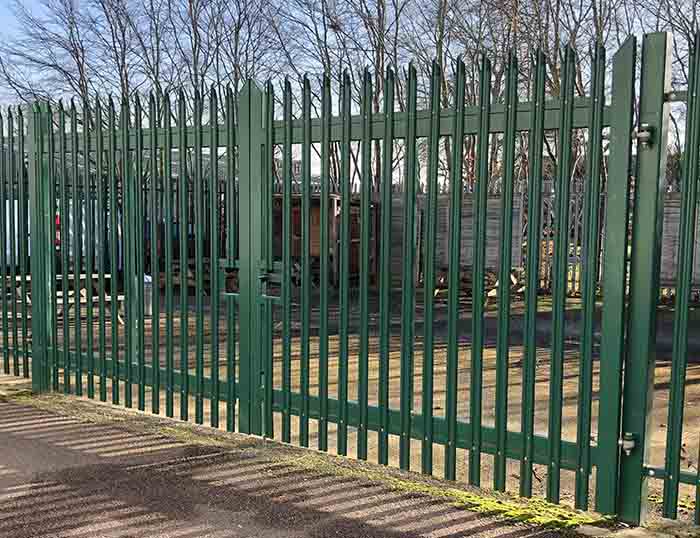
Both types belong to heavy duty palisade fences, built with vertical steel slats mounted onto horizontal rails. They are widely used for sites requiring high-level perimeter protection. The main gap lies in the cross section shape of individual pickets.
*D-profile palisade fence: Each vertical slat forms a D-shaped cross section. One side is flat, and the other side curves outward. It creates solid thickness with moderate material consumption.
*W-profile palisade fence: The picket is pressed into a W-shaped cross section with multiple folded ridges. Those extra folds act like built in reinforcing ribs to boost overall rigidity.
All pickets and rail assemblies from Giant Fence are produced following UNE-EN-10223-7:2013. This standard keeps checks on base metal material, zinc coating weight and welding joint quality, avoiding common problems such as brittle steel, insufficient galvanization and weak welds found on low cost palisade products. Good manufacturing sets the base for real world security and service life.
Core Comparison: W Profile VS D Profile Palisade Fences
1.Structural strength and impact resistance
D-profile palisade pickets offer decent stiffness for regular risk projects. The curved D-shape gives enough rigidity against ordinary knocking and light impact. Still, under heavy brute force strikes, deformation is more likely to happen compared with W-profile options of equal material thickness.
Thanks to its multi fold W-shaped structure, W-profile palisade fences deliver noticeably higher bending resistance. Even when facing heavy impact or attempted prying, the folded ridges disperse force across the whole picket. If your site faces high vandalism or intrusion risks, W-profile is the more robust choice.
2.Material cost and weight
D-profile pickets need less raw steel. For large scale projects with medium security requirements, D-profile brings clear cost advantages without sacrificing basic protection.
W-profile uses more steel for the multi bend forming process. So unit cost and overall weight go up accordingly. You pay more in exchange for superior mechanical performance. Giant Fence can adjust steel thickness for both profiles to match your budget and security goals.
3.Visual style and installation
Visually, D-profile palisade fences show smooth, rounded outer surfaces, delivering a relatively clean, streamlined look. W-profile shows distinct folded lines, giving a tougher, more industrial visual impression.
Both profiles share similar installation workflows. Pickets are fixed onto horizontal rails, then assembled to support posts. Giant Fence supplies matching posts, bolts, security fixings and palisade gates for both styles. That said, W-profile pickets are heavier, so they require slightly stronger posts and more careful handling during installation.
4.Typical applicable scenarios
D-profile palisade fence best fit scenarios
*General industrial parks, ordinary factory perimeters
*Commercial compound boundaries, office premises
*Storage yards with medium security requirements
*Municipal facility enclosures with limited project budget
W-profile palisade fence best fit scenarios
*High risk industrial sites, energy related installations
*Logistics hubs with high value stored goods
*Prison grade, high security zones, critical infrastructure
*Sites with frequent vandalism or attempted break ins
Anti-corrosion Solutions Guided by ISO 9223:2012
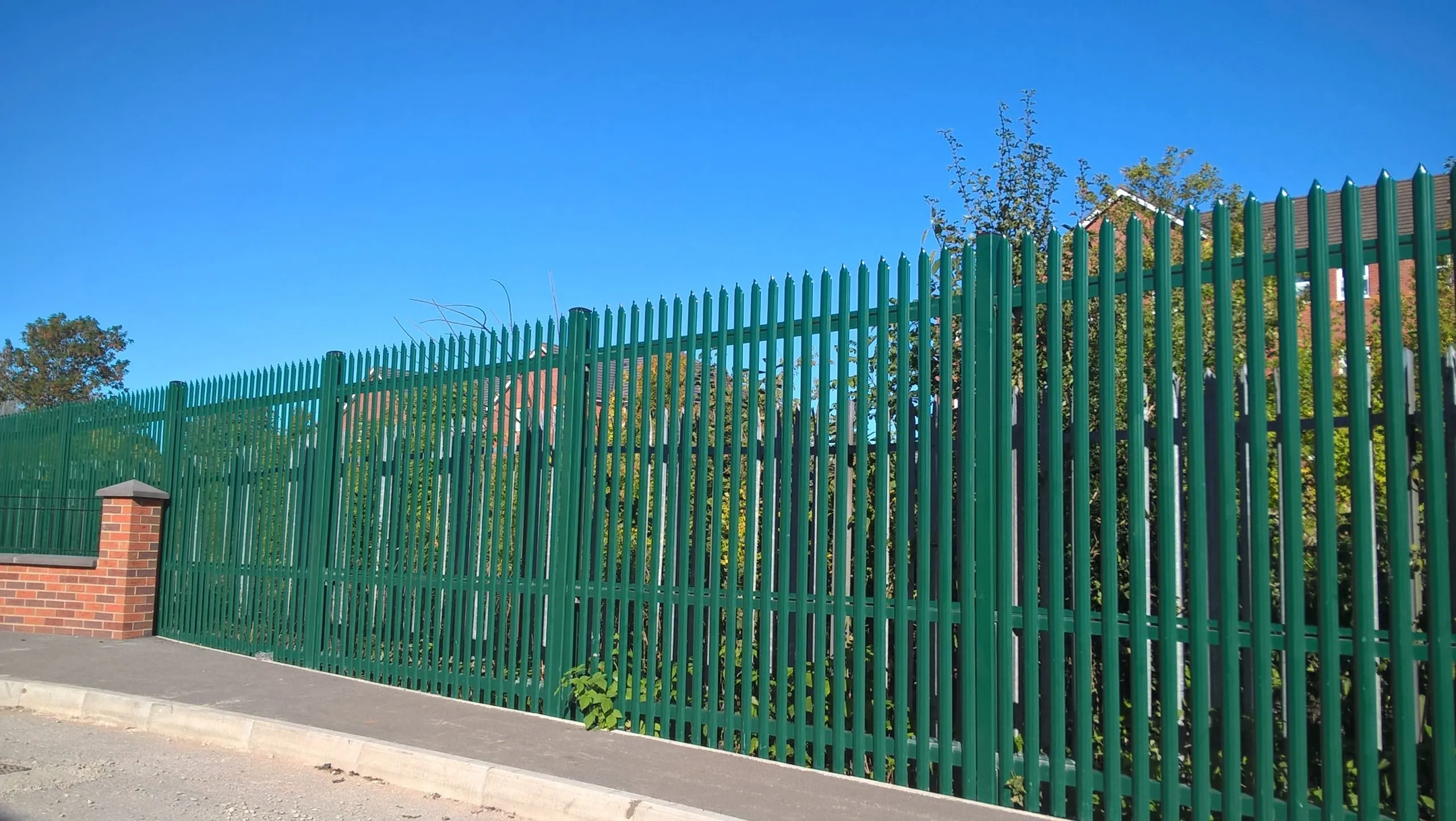
No matter you go for W-profile or D-profile palisade fences, corrosion resistance will decide how long your fence keeps its strength and appearance. Giant Fence follows ISO 9223:2012 atmospheric corrosion rating system to provide targeted coating solutions for different environments.
C1-C3 Low to moderate corrosion (inland sites)Most inland industrial zones, urban commercial parks and inland warehouses fall under C1-C3. Under ideal operating conditions: no mechanical damage and professional compliant installation, our standard hot dip galvanized plus powder coated palisade fences can achieve their theoretical service life. This is our most popular configuration for inland projects for both D-profile and W-profile models.
C4-CX High to extreme corrosion (coastal & heavy industry locations)Seaside salt spray, chemical pollutants and heavy industrial fumes push corrosion level to C4-CX. Ordinary coating systems will degrade quickly here. For these harsh environments, Giant Fence offers upgraded heavy duty anti-corrosion packages for palisade fences, adopting enhanced hot dip galvanizing plus high performance outdoor powder coating to slow down rust development.
*Important note: The theoretical service life for each coating option is valid only under ideal conditions. Surface scratches, dents or impact damage that expose bare steel will trigger local rust, regardless of profile type or coating grade. Routine visual inspection is still recommended after installation.
Practical Tips Before Making Your Final Choice
Before you place an order for palisade fences with Giant Fence, run through these key points:
1.Clarify your actual security risk level: Choose D-profile for medium security ordinary sites; pick W-profile if vandalism, heavy impact or forced entry risks are high.
2.Figure out your site corrosion category under ISO 9223:2012. Confirm whether you need standard or upgraded anti-corrosion coating.
3.Confirm products are manufactured complying with UNE-EN-10223-7:2013. Giant Fence implements this standard for steel material, coating weight and welding process control.
4.Take installation conditions into account. W-profile palisade fences are heavier, so supporting posts need to have adequate strength.
5.Don’t forget matching accessories: security bolts, posts, and palisade style gates, which Giant Fence can supply as a full set.
Frequently Asked Questions
Q1: Does W-profile always mean better than D-profile palisade fences?
A1: Not exactly. W-profile has stronger mechanical performance, yet it comes with higher cost. For many medium risk inland commercial and industrial projects, D-profile palisade fences can fully satisfy project requirements with better cost efficiency. Giant Fence will evaluate your site conditions to recommend the more suitable profile.
Q2: Can I use D-profile palisade fences in coastal C4-CX environment?
A2: You can use D-profile, but you have to select Giant Fence’s upgraded heavy duty anti-corrosion coating solution for C4-CX environments. Profile shape does not resist rust; the anti-corrosion coating system does.
Q3: Will compliance with UNE-EN-10223-7:2013 increase my project cost significantly?
A3: It adds reasonable cost for qualified raw material and stable processing, but helps you avoid huge later stage losses caused by poor quality palisade fences such as deformed pickets or premature rusting.
Conclusion
When comparing W-profile and D-profile palisade fences, there is no universal “better” option, only the more suitable one for your project. D-profile works great for medium security projects with tight budget requirements. W-profile brings superior rigidity and anti-vandalism performance for high risk sites.
Meanwhile, good performance cannot rely merely on profile geometry. Production carried out to UNE-EN-10223-7:2013 guarantees reliable steel material and qualified processing. And by selecting anti-corrosion coatings according to ISO 9223:2012 corrosion grades, you get proper protection for C1-C3 inland or C4-CX coastal industrial environments.
If you are unsure which profile to select for your perimeter project, get in touch with the Giant Fence team. Share your site security needs, location environment and budget, and we will deliver professional suggestions and a complete quotation for your palisade fences.