


For industrial and residential fencing projects, galvanized fence panels are a practical choice when corrosion protection is the main priority, while powder coating is useful when buyers need a specified color and finish. However, the two treatments are not always alternatives. A properly designed galvanized-and-powder-coated system can provide both zinc-based protection and an attractive colored surface. The best option depends on environmental exposure, manufacturing processes, coating quality, maintenance requirements, and total project cost.
For B2B importers, fencing distributors, EPC contractors, and property developers, choosing galvanized vs powder coated fence panels should be a technical procurement decision rather than a simple comparison of appearance or unit price.
This guide explains how the coating systems work, what to specify for different installation environments, which inspection documents to request, and how GIANT MESH supports fencing projects involving different finishes.
Key Takeaways for B2B Fence Buyers
-
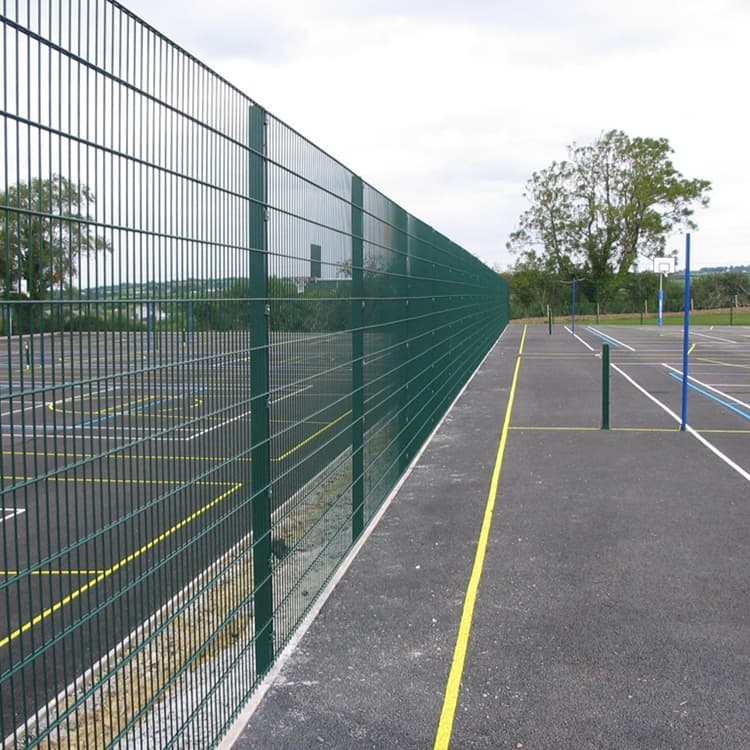
Galvanized fencing: Zinc coatings provide barrier protection and sacrificial protection to the underlying steel.
-
Powder-coated fencing: Organic coatings provide a colored protective barrier, but performance depends on the substrate, pretreatment, coating material, and application.
-
Duplex protection: Powder coating over suitably prepared hot-dip galvanized steel combines two protective mechanisms.
-
Coastal environments: Require an exposure-specific coating specification rather than an automatic assumption that one finish is sufficient.
-
Welded joints and edges: Must be included in inspection requirements because coating coverage can vary at these locations.
-
Bulk purchasing: Compare documented coating systems, not generic terms such as "anti-rust" or "weatherproof."
The most important purchasing question is:
What protective layers will be present on the finished fence panel, and how will the manufacturer verify them?
Galvanized vs Powder Coated Fence Panels: Technical Comparison
The two treatments use different corrosion-protection mechanisms.
Galvanizing applies a zinc coating to steel, while powder coating applies an organic film that is subsequently cured.
Powder coating may be applied to suitably prepared bare steel or over a galvanized substrate.
Coating System Comparison Table
| Parameter | Galvanized Only | Powder Coated on Steel | Galvanized + Powder Coated |
|---|---|---|---|
| Main protection | Zinc barrier and sacrificial action | Organic barrier | Zinc protection plus organic barrier |
| Substrate | Steel | Prepared steel | Galvanized steel |
| Appearance | Metallic zinc finish | Colored finish | Colored finish |
| RAL color options | Not inherent | Available | Available |
| Weld protection | Depends on galvanizing route | Depends on preparation and coverage | Depends on both coating stages |
| Main quality concern | Zinc coverage and coating thickness | Pretreatment, adhesion and cure | Zinc quality, preparation, adhesion and cure |
| Initial cost | Quote-dependent | Quote-dependent | Often higher process cost |
| Suitable applications | Projects prioritizing zinc protection | Projects with an approved organic coating specification | Projects balancing corrosion protection and appearance |
| Key maintenance issue | Zinc consumption and damage | Barrier damage and corrosion beneath defects | Damage and condition of both layers |
Important: This table compares protective systems, not identical commercial grades. Actual performance and cost depend on the specified materials, coating processes, installation environment, and testing.
What Is a Duplex Coating System?
A duplex system combines hot-dip galvanizing with a compatible organic coating, such as powder coating.
The galvanized layer provides corrosion protection beneath the organic coating, while the outer coating helps shield the zinc and provides the specified appearance.
A properly engineered combination can improve long-term corrosion protection compared with either system used independently.
However, compatibility and surface preparation are essential.
How Does Hot-Dip Galvanizing Protect Welded Mesh Fences?
Hot-dip galvanizing protects steel through a zinc coating.
Zinc acts as a physical barrier and also provides sacrificial protection when the underlying steel is exposed at a small defect.
For procurement purposes, buyers must distinguish between different zinc-coating production routes.
Galvanizing Before and After Welding
Two commonly discussed manufacturing arrangements are:
1. Welding pre-galvanized wire
Zinc-coated wires are welded into fence panels.
The welding process can affect the existing coating around welded intersections, so those areas need suitable process controls and inspection.
2. Galvanizing a fabricated panel
Uncoated steel wire is welded into a panel, then the fabricated product undergoes a hot-dip galvanizing process.
This can provide coating coverage after welding, but feasibility depends on product dimensions, design, handling, and process conditions.
The manufacturer must confirm that the selected panel can be processed without unacceptable distortion or dimensional changes.
Why Is the Difference Important?
A quotation stating only "hot-dip galvanized" does not necessarily tell buyers when galvanizing takes place.
That distinction affects the product standard, coating measurement requirements, and inspection plan.
For example, ISO 1461:2022 addresses hot-dip galvanized coatings on applicable fabricated iron and steel articles. It expressly excludes wire and welded mesh products that are continuously hot-dip galvanized.
Therefore, buyers should not apply ISO 1461 indiscriminately to every galvanized wire-mesh product.
The correct technical specification depends on the actual manufacturing route.
When Is Galvanized-Only Fencing Appropriate?
Galvanized-only panels are worth evaluating where a metallic finish is acceptable and the project prioritizes a defined zinc-protection system.
Applications may include industrial boundaries, utility sites, and residential perimeters where a colored architectural finish is not essential.
However, performance must still be evaluated against local atmospheric conditions and maintenance expectations.
How Does Powder Coating Protect Fence Panels?
Powder coating applies a dry coating material to a suitably prepared substrate, followed by curing to form a protective film.
Outdoor fence applications typically require a coating system selected for outdoor exposure.
What Are the Main Benefits?
Powder coating allows specifiers to request consistent colors, surface appearance, and an additional protective barrier.
For residential developments, parks, schools, and commercial estates, a uniform finish can help integrate fencing into the surrounding architecture.
GIANT MESH lists several colors for its 3D Fence with Rectangular Post, including RAL 6005 green, RAL 7016 grey, RAL 9005 black, and RAL 9010 white.
The product page also describes multiple surface-treatment routes.
Buyers should confirm which specific combinations are available for their proposed panel and post configuration.
Is Powder Coating Alone Enough to Prevent Rust?
Not automatically.
A powder coating acts primarily as a protective barrier.
If the coating is damaged and the steel is exposed, corrosion may begin at the affected location.
The coating's adhesion, continuity, thickness, formulation, preparation, and curing all influence performance.
A statement such as "powder-coated steel" is therefore not a complete corrosion-protection specification.
What About Powder Coating Over Galvanized Steel?
Applying powder coating over galvanized steel requires particular attention to the zinc surface.
Inadequate pretreatment or trapped moisture can contribute to adhesion problems, pinholes, blistering, or other visible defects.
ASTM D7803-25 addresses preparation of hot-dip galvanized steel surfaces for powder coating.
For B2B buyers, this means the coating-process sequence should be documented before approving the final finish.
Which Fence Coating Is Better for Different Environments?
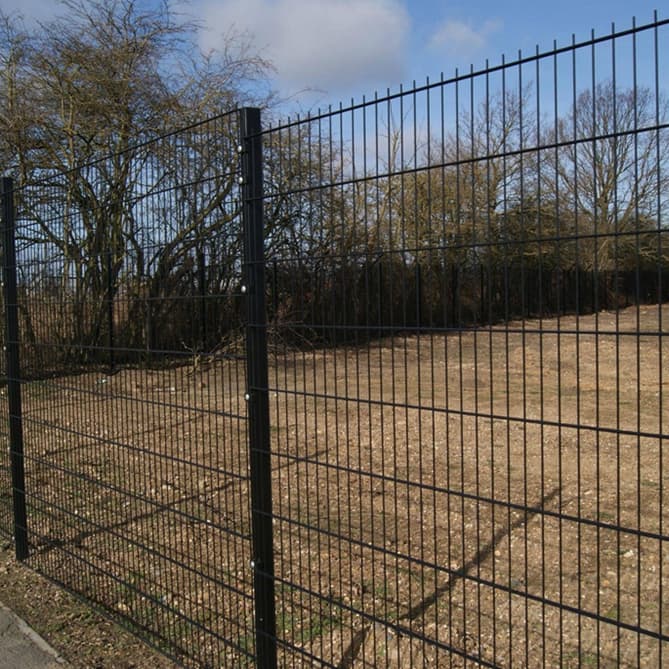
The correct coating depends on environmental exposure.
ISO 9223:2012 provides a classification system for atmospheric corrosivity using factors including humidity, temperature, sulfur dioxide pollution, and airborne salinity.
A location should not be assigned a corrosion category solely because it is described as inland or coastal.
Environmental Selection Guide
| Project Environment | Main Exposure Concern | Coating Selection Approach |
|---|---|---|
| Ordinary inland residential | Moisture and weathering | Evaluate galvanized and compatible coated systems |
| Humid or rainy area | Repeated wetting and drying | Define appropriate zinc and organic coating requirements |
| Coastal residential project | Airborne chlorides | Evaluate a protection system against the assessed corrosivity |
| Industrial perimeter | Atmospheric pollutants | Specify according to actual exposure |
| Decorative garden boundary | Color and appearance | Consider powder-coated or duplex systems |
| Public infrastructure | Long-term maintenance and access | Compare coating performance and lifecycle cost |
Residential Communities
For residential projects, visual consistency may be a major purchasing requirement.
A galvanized-and-powder-coated system may be appropriate when both appearance and corrosion protection are important.
GIANT MESH's Residential Communities applications show configurations combining welded mesh fencing with pedestrian and vehicle access systems.
Panels, posts, and gates should use compatible finishes.
Coastal Projects
Salt exposure can accelerate corrosion.
For a coastal project, ask the supplier to review the coating system against the actual environmental classification and relevant requirements.
A sufficiently specified hot-dip galvanized system, a compatible duplex system, or another engineered protective arrangement may be considered.
Do not assume that ordinary powder coating alone provides an adequate corrosion-protection system for every coastal location.
Industrial and Utility Sites
Industrial projects may prioritize maintainability, protection against the identified atmosphere, and consistency across long fence runs.
A metallic zinc finish may be acceptable where decorative color is less important.
Where color coding or architectural uniformity is required, a compatible organic topcoat may also be specified.
What Coating Specifications Should B2B Buyers Confirm?
When comparing galvanized vs powder coated fence panels, buyers should ask suppliers to describe the actual coating build-up rather than using a single finish name.
Technical Specification Checklist
| Parameter | Information to Request |
|---|---|
| Base material | Steel-wire specification and dimensions |
| Galvanizing route | Before welding, after fabrication, or another identified process |
| Zinc coating | Agreed coating mass or thickness and test method |
| Pretreatment | Cleaning and preparation process |
| Powder material | Intended outdoor coating type and compatibility |
| Powder thickness | Agreed nominal requirement, measurement and acceptance criteria |
| Coating color | RAL reference and approved sample |
| Surface appearance | Gloss, texture and defect acceptance |
| Weld intersections | Protection and inspection method |
| Edges and connections | Coating coverage requirements |
| Quality testing | Sampling, test methods and acceptance criteria |
| Packaging | Protection from abrasion and impact during shipment |
Should Buyers Specify Coating Thickness?
Yes, where required by the applicable coating system and standard.
However, there is no single universal thickness suitable for all fence panels.
Zinc-coating specifications may use coating mass or thickness. Organic coating requirements may use film thickness and additional performance criteria.
For coated mesh, the agreed inspection method should account for the shape and accessibility of wires, welds, and other surfaces.
A numerical coating requirement without a measurement method or acceptance criterion is incomplete.
Should Buyers Require Salt-Spray Testing?
Salt-spray testing can support comparative quality verification when the test method, specimen, duration, and acceptance criteria are clearly defined.
But a salt-spray result does not directly establish how many years a fence will last outdoors.
Buyers should request the original test report rather than relying on a single advertised number of test hours.
What Manufacturing Processes Affect Fence Coating Quality?
For a fence manufacturer, corrosion protection cannot be separated from welding, forming, post fabrication, and handling.
GIANT MESH operates under Hebei Giant Metal Technology Co., Ltd. in Anping County, Hebei Province, China.
The company's published development history describes the introduction of Schlatter welding equipment in 2017 and the addition of a powder-coating production line in 2024.
These are relevant manufacturing capabilities, but product-specific coating quality must be demonstrated through order-specific specifications and inspection records.
Manufacturing and Surface-Treatment Workflow
| Manufacturing Stage | Key Consideration |
|---|---|
| Wire preparation | Verify material and diameter |
| Mesh welding | Inspect joints and geometry |
| 3D panel bending | Maintain approved panel dimensions |
| Post fabrication | Confirm section and fixing positions |
| Galvanizing | Confirm process route and zinc coverage |
| Surface preparation | Ensure compatibility with the next coating |
| Powder application | Control coverage, coating process and cure |
| Assembly verification | Check panel, post, clamp and gate compatibility |
| Final inspection | Verify coating and dimensions |
| Export packing | Prevent abrasion and component damage |
The precise order depends on the chosen product and finish.
Not every listed operation applies to every fence panel.
Why Are Welding Points Important?
Weld intersections are potential problem areas if coatings are incomplete or the metal surface has not been properly prepared.
Buyers should agree on how welded intersections will be inspected.
For pre-galvanized wire assemblies, the process should also address any coating effects caused by welding.
Why Does Powder-Coating Preparation Matter?
The surface condition affects adhesion.
In a duplex system, suppliers must consider the galvanized surface, possible contaminants, the required surface profile, and the appropriate powder-curing process.
BS EN 15773:2018 provides guidance on industrial powder coating over hot-dip galvanized or sherardized steel articles.
It emphasizes coordination among parties responsible for galvanizing, pretreatment, and coating.
How Should Products Be Protected During Export?
Coated panels need suitable stacking and separation.
Metal-to-metal rubbing, unsecured bundles, or careless unloading may damage the finish.
For bulk orders, buyers can request a packing specification that identifies protection between panels, packaging quantities, labels, and handling instructions.
The manufacturer's About Us page provides more background on GIANT MESH's production and surface-treatment capabilities.
Real GIANT MESH Project Experience: Galvanized and Coated Fence Systems
Published project examples can demonstrate how coating choices are connected to actual fencing orders.
However, each project has its own specification. A manufacturer's case report should not be treated as an independent performance test for all products.
Case 1: Galvanized Residential Fencing in Costa Rica
GIANT MESH published a residential community fencing project in Costa Rica involving 1,000 sets of 3D fence panels.
The manufacturer reports the following configuration:
| Item | Published Detail |
|---|---|
| Application | Residential community perimeter |
| Panel dimensions | 2.0 m × 2.5 m |
| Quantity | 1,000 sets |
| Structure | 3D welded mesh |
| Reinforcement | Customized five-bend design |
| Connection | Anti-theft screws |
| Surface treatment | Hot-dip galvanized finish |
The case demonstrates how a galvanized configuration was selected for a real residential order.
The project report also describes dimensional and surface-quality inspections.
It does not provide independently verified data establishing universal performance for all climates or projects.
Read the Costa Rica residential 3D fencing project.
Case 2: Galvanized and Powder-Coated Airport Fencing in Türkiye
Another manufacturer-published project concerns airport fencing in Türkiye.
GIANT MESH reports supplying 2,084 airport fence sets, with panels measuring 2.5 m high × 2.0 m wide, using galvanized steel with a RAL 6005 green powder-coated finish.
This is a different application from residential fencing, but it illustrates a project in which metallic protection and a colored organic finish were specified together.
It also demonstrates why the coating system, color, panel dimensions, and supporting components belong in the same technical documentation.
Buyer lesson: Real projects should inform specification questions, not replace project-specific coating assessment.
Practical B2B Buying Scenario: Comparing Three Fence Coating Quotations
Consider a hypothetical overseas contractor sourcing 600 welded mesh panels for a residential development.
The project requires a consistent appearance across the main entrance, shared gardens, and perimeter sections.
The contractor receives three proposed coating options.
Comparing the Supplier Offers
| Quotation | Proposed Finish | What the Buyer Must Verify |
|---|---|---|
| A | Hot-dip galvanized only | Zinc specification, process and acceptance criteria |
| B | Powder coated on prepared steel | Pretreatment, outdoor coating material, adhesion and cure |
| C | Hot-dip galvanized plus powder coated | Zinc requirements, galvanized surface preparation, powder compatibility and inspection |
The buyer should first confirm whether all three quotes use identical panel dimensions, wire configurations, posts, and accessories.
Otherwise, the price difference may reflect unrelated changes in the product.
Which Offer Should the Contractor Choose?
Quotation A is worth evaluating when the galvanized appearance is acceptable and the specified zinc protection meets the environmental requirements.
Quotation B may be considered if the proposed organic coating system is suitable for the exposure and the required finish can be maintained.
Quotation C may be attractive when the project demands both protective layers and a controlled architectural appearance, provided manufacturing and adhesion requirements are properly addressed.
The final decision should be supported by technical evidence, not generic claims that one coating always lasts longer.
How Should Total Cost Be Compared?
Use a lifecycle procurement framework:
Total Ownership Cost = Initial Supply + Freight + Installation + Inspection + Maintenance + Repairs + Replacement
An initially more expensive coating system may reduce future maintenance costs under certain conditions.
But the financial benefit must be estimated using the actual environment, design life, access requirements, and maintenance assumptions.
Do not assign a specific service life or cost-saving percentage without supporting project data.
How Can Buyers Inspect Coated Fence Panels Before Shipment?
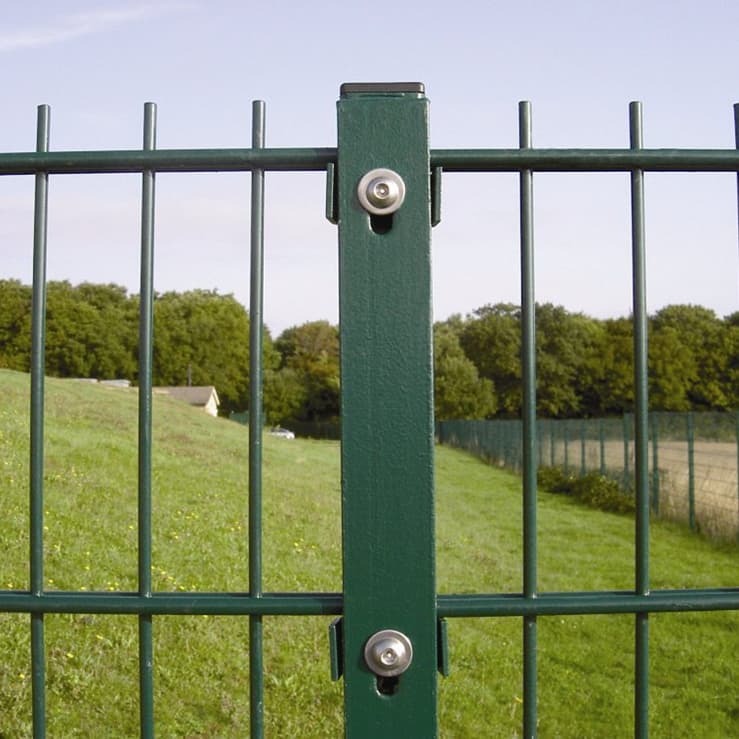
A bulk purchase should include a documented inspection and acceptance plan.
Coating Quality-Control Matrix
| Inspection Item | What to Check | Recommended Evidence |
|---|---|---|
| Raw steel | Correct material and dimensions | Material and receiving records |
| Weld joints | Required geometry and weld quality | Production inspection |
| Zinc protection | Approved coating specification | Relevant test results |
| Pretreatment | Appropriate process sequence | Process records |
| Powder application | Coverage and film requirements | Inspection records |
| Adhesion | Performance against agreed criteria | Applicable test report |
| Appearance | Color, texture, visible defects | Approved reference sample |
| Panel dimensions | Approved measurements and tolerances | Dimensional inspection |
| Posts and gates | Finish compatibility and assembly | Trial-fit records |
| Packaging | Surface protection | Loading and packing records |
What Defects Should Buyers Watch For?
Possible defects include incomplete coverage, visible blistering, coating separation, pinholes, mechanical scratches, damaged edges, and inconsistent appearance.
Not every visual variation is automatically a rejection.
The inspection specification should distinguish acceptable process characteristics from defects that affect the agreed product requirements.
Should Panels and Posts Be Tested Separately?
Yes, when their material or coating routes differ.
Fence panels, fabricated posts, gates, and fasteners may require different treatment processes and applicable standards.
A coating report for one component does not automatically demonstrate conformity for every component in the shipment.
What Should Be Included in a Galvanized or Powder-Coated Fence RFQ?
A complete RFQ helps buyers compare suppliers on an equivalent technical basis.
RFQ Checklist for Bulk Fence Orders
| RFQ Item | Required Information |
|---|---|
| Project type | Residential, commercial, industrial or infrastructure |
| Location | Country, site environment and exposure conditions |
| Fence type | 3D, 2D or another approved mesh system |
| Panel specifications | Height, width, wire diameter and mesh opening |
| Post system | Section, wall thickness and installation arrangement |
| Coating option | Galvanized, powder coated, or combined system |
| Galvanizing specification | Process sequence and applicable requirements |
| Powder specification | Material, color, pretreatment and inspection |
| Matching components | Gates, clamps, bolts, caps and fasteners |
| Quantity | Panels, posts, gates and accessories |
| Quality requirements | Approved samples, inspection and tests |
| Packaging | Export protection and labeling |
| Shipping | Destination, Incoterm and delivery schedule |
For importers and distributors comparing galvanized vs powder coated fence panels, the most useful quotation is the one that clearly identifies what is included, which specifications apply, and how conformity will be verified.
Request a Project-Specific Coating Recommendation
GIANT MESH supplies welded mesh fencing systems and provides product configurations for different project requirements.
Before making a coating recommendation, buyers should supply the installation location, panel dimensions, project requirements, preferred color, estimated quantity, and relevant inspection standards.
Need a quotation for galvanized or powder-coated fencing? Submit your project specifications through the GIANT MESH contact page and request a comparison of suitable coating systems for your application.
Frequently Asked Questions
Q1: Are galvanized fence panels better than powder-coated fence panels?
Neither is automatically better for every project. Galvanizing provides zinc-based corrosion protection, while powder coating forms an organic barrier and can deliver a specified color. Performance depends on the substrate, process, coating quality, and environment. Buyers should also consider a compatible duplex system when they require both zinc protection and a colored architectural finish.
Q2: Can galvanized welded mesh fence panels be powder coated?
Yes, galvanized steel can be powder coated when the selected surfaces and coating materials are compatible and properly prepared. The correct process depends on how the galvanized layer was produced and its surface condition. Buyers should request the production sequence, pretreatment requirements, curing controls, and relevant adhesion evidence before approving a galvanized-and-powder-coated fence order.
Q3: Which fence coating is more suitable for coastal environments?
Coastal installations require a protection system selected for the actual exposure to chlorides, moisture, and other local conditions. Hot-dip galvanizing and suitable duplex systems may be considered, but their specifications must be assessed against the project's corrosivity requirements. Buyers should avoid assuming that any standard powder-coated finish is automatically adequate for severe coastal exposure.
Q4: What coating quality documents should fence buyers request?
Buyers should request the coating specification, process sequence, relevant material information, inspection criteria, and applicable test results. For duplex systems, documentation should address both the zinc layer and powder coating, including surface preparation and adhesion where required. Approved color samples and packing records may also be necessary for large architectural or export orders.
Q5: Is powder coating over galvanized steel more expensive?
A duplex coating system commonly involves additional process steps and may have a higher initial manufacturing cost. However, actual pricing depends on the product, coating requirements, quantity, and available production arrangements. A fair comparison should include installation, expected inspection, maintenance, repair, and replacement costs rather than relying only on the initial price per fence panel.
Q6: Can 3D and 2D fence panels use the same coating specifications?
They may be specified with similar protective systems, but the actual process and inspection requirements must be confirmed for each configuration. Different wire arrangements, weld details, posts, and accessories can affect coating application and inspection. Buyers should approve component-specific documentation and verify that panels, posts, gates, and fasteners meet the intended environmental and appearance requirements.
Conclusion
Choosing between galvanized vs powder coated fence panels requires more than comparing a metallic finish with a colored finish.
Galvanizing provides zinc-based corrosion protection. Powder coating provides an organic protective barrier and a wide range of appearance options. A properly designed duplex system combines these approaches.
For B2B buyers, the correct decision depends on environmental exposure, project specifications, surface preparation, manufacturing quality, inspection requirements, and total ownership cost.
A successful order should also coordinate panels, posts, gates, fasteners, and export packaging under approved technical documents.
GIANT MESH, operated by Hebei Giant Metal Technology Co., Ltd., offers welded mesh fencing systems and published manufacturing capabilities covering welding, post production, surface treatment, and quality inspection.
Planning a wholesale fencing order or perimeter project? Contact GIANT MESH with your preferred fence system, installation environment, coating requirements, and estimated quantities to request a technical review and project-specific quotation.