



Selecting the right 3D welded mesh fence manufacturer is a critical decision for fence distributors, construction contractors, residential developers, and international procurement teams. A successful bulk fencing project depends on much more than the appearance of welded wire panels or the supplier's initial quotation.
For residential communities, housing developments, schools, industrial boundaries, and landscaped properties, buyers must evaluate the entire fencing system: mesh panels, reinforcing bends, posts, fixing accessories, corrosion protection, gates, manufacturing consistency, and delivery coordination.
A competitively priced panel can become an expensive procurement mistake if it arrives with incompatible posts, inconsistent coatings, missing accessories, or dimensions that do not match the installation drawings.
This guide explains how to evaluate a manufacturer, specify 3D welded mesh fence systems, calculate project quantities, compare construction options, and establish measurable quality requirements before placing a wholesale order.
It also shows how Giant Fence, operated by Hebei Giant Metal Technology Co., Ltd., supports buyers sourcing coordinated fencing systems for residential and commercial perimeter projects.
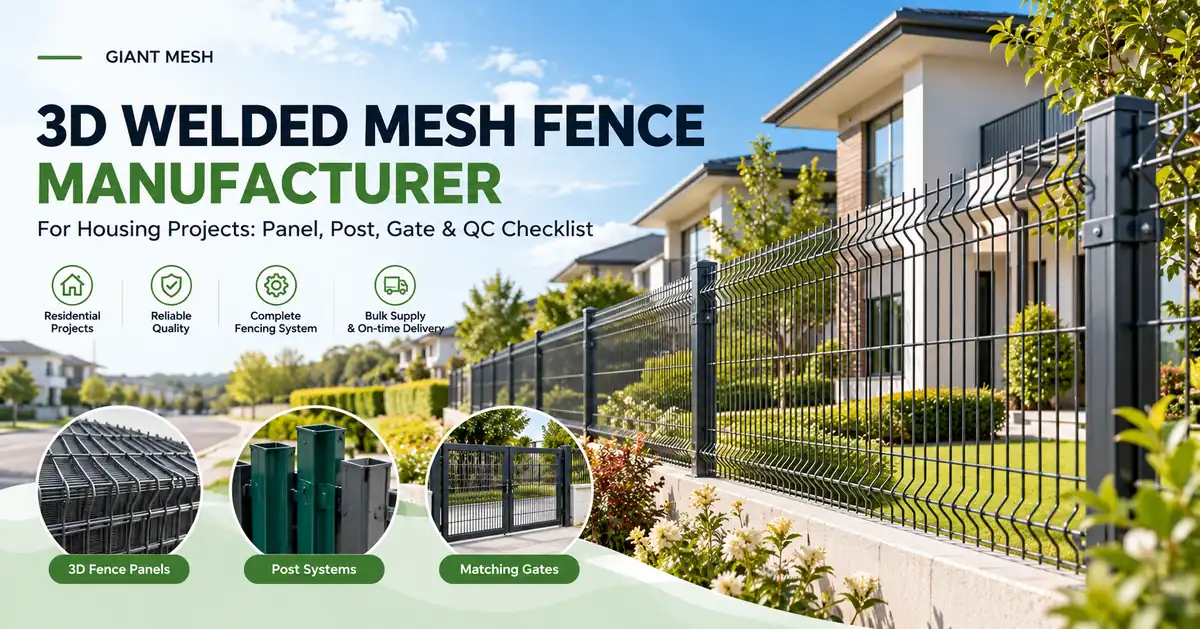
What Should Buyers Look for in a 3D Welded Mesh Fence Manufacturer?
The best 3D welded mesh fence manufacturer for a particular project is one that can supply a compatible, documented, and inspectable fencing system—not simply the lowest-priced mesh panels.
For B2B buyers, five capabilities deserve priority:
-
Technical consistency: Confirmed panel dimensions, wire diameters, mesh openings, reinforcing bends, and manufacturing tolerances.
-
System compatibility: Matching posts, clamps, brackets, fasteners, corners, and gates.
-
Corrosion protection: Clearly specified galvanizing and coating processes suitable for the installation environment.
-
Manufacturing quality: Documented checks for weld integrity, panel geometry, coating condition, and shipment completeness.
-
Project procurement support: Reliable drawings, production planning, packaging information, and quotations covering the complete required system.
These factors directly affect installation efficiency, procurement risk, maintenance requirements, and the total cost of ownership.
For a residential development covering hundreds or thousands of linear meters, small specification errors multiply quickly. A single incompatible connection detail repeated across hundreds of fence bays can delay an entire installation.
This is why experienced contractors compare suppliers using approved technical specifications and a complete bill of materials rather than relying on promotional descriptions such as "heavy duty," "premium quality," or "best price."
Understanding 3D Welded Mesh Fence Systems
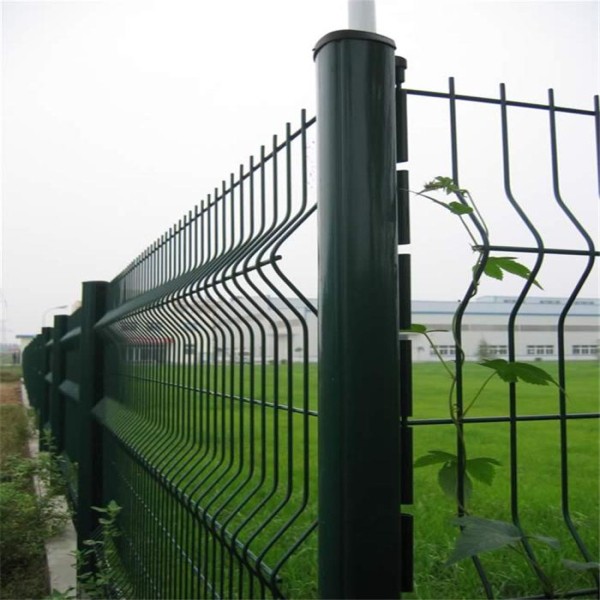
A 3D welded mesh fence, also called a V-bend fence, curved welded wire fence, or 3D panel fence, consists of steel wires welded into a mesh panel with horizontal reinforcing bends.
Unlike a flat welded mesh panel, the 3D design incorporates formed sections that give the panel additional geometric stiffness.
The bends help the panel resist certain types of deformation without requiring every component to be made from exceptionally heavy steel wire.
However, panel rigidity depends on the entire design, including wire diameter, mesh geometry, bend dimensions, panel height, support spacing, and connections. A V-bend alone does not establish a certified security or structural performance rating.
Main Components of a Complete 3D Fence System
A standard 3D fence installation generally includes:
-
Welded steel mesh panels with V-shaped reinforcing bends.
-
Steel support posts selected for the required installation method.
-
Clamps, brackets, hooks, or other compatible fixing components.
-
Post caps and corrosion-protected fasteners.
-
Embedded foundations or base-plate anchoring systems.
-
Matching pedestrian or vehicle gates where required.
-
Corner, terminal, and elevation-transition details.
These components should be treated as one coordinated system.
For example, an imported panel with a nominal width of 2,500 mm cannot automatically be installed at 2,500 mm post centers. The actual distance depends on the connection arrangement, post dimensions, panel engagement, and manufacturing tolerances.
A supplier should provide an assembly drawing that confirms these dimensions before production.
You can explore Giant Fence's published 3D welded mesh fencing products and manufacturing capabilities to understand the available system options.
Who Should Buy 3D Welded Mesh Fence Systems?
3D welded mesh fencing is particularly suitable for buyers who need modular perimeter protection with a relatively open appearance and repeatable installation methods.
Fence Distributors and Importers
Distributors usually require a consistent range of panel heights, widths, colors, and matching posts that can be stocked and resold.
Their priorities include repeat-order consistency, export packaging, predictable product codes, and compatibility between successive shipments.
A distributor may benefit from standardizing several frequently requested configurations rather than carrying numerous slightly different products that cannot share accessories.
Residential Developers and EPC Contractors
Housing projects require coordinated perimeter layouts, pedestrian entrances, vehicle gates, and sometimes privacy screening.
These buyers need technical drawings, site-specific dimensions, planned deliveries, and clear responsibility for special panels and installation accessories.
Giant Fence provides a dedicated residential community fencing solution that illustrates how welded mesh panels, pedestrian gates, vehicle gates, and privacy sections can form an integrated perimeter design.
Fence Installation Contractors
Installers place particular importance on post spacing, connection details, foundation requirements, panel handling, and adjustment allowances.
A low-priced panel may not deliver the lowest installed cost if its fixing system requires additional drilling, specialized tools, or extensive modifications on-site.
Architects and Landscape Contractors
For landscape applications, appearance and material coordination may be as important as conventional boundary protection.
Panel proportions, RAL colors, post profiles, and gate aesthetics influence how the finished perimeter integrates with buildings and outdoor spaces.
When Is 3D Fence Not the Best Choice?
Standard 3D mesh fencing is not automatically suitable for every perimeter.
Projects requiring certified high-security resistance, specialized anti-climb performance, blast protection, or demanding intrusion-delay characteristics may need a different fencing system.
Similarly, applications involving extensive privacy screening, severe wind exposure, or specialized safety regulations require further engineering evaluation.
A knowledgeable manufacturer should explain these limitations rather than recommending one product for every application.
Technical Specifications: What Should Be Included in a Bulk Fence RFQ?
A professional request for quotation should define measurable construction requirements.
Without a complete specification, two manufacturers may quote products that look similar but contain different steel quantities, post sections, and coating systems.
Typical Giant Fence 3D Panel Specifications
The following table summarizes published product ranges and common project selection considerations. These values are product-family references, not a universal specification for every configuration.
| Specification | Published Range or Option | Why Buyers Must Check It |
|---|---|---|
| Product Type | 3D / V-bend welded mesh fence | Identifies the panel construction |
| Wire Diameter | Typically 4–6 mm | Influences steel content and rigidity |
| Panel Height | Approximately 0.8–2.4 m | Determines boundary height and application |
| Standard Panel Width | 2.0 / 2.2 / 2.5 m | Influences bay planning and shipment |
| Mesh Opening | 50 × 100 / 50 × 200 mm | Affects visibility, material use, and layout |
| Reinforcing Bends | Dependent on panel design and height | Affects panel geometry and stiffness |
| Material | Welded steel wire | Confirm grade and wire-core diameter |
| Surface Treatment | Galvanizing, powder coating, or PE coating options | Determines corrosion protection requirements |
| Color | Project-selected RAL colors | Maintains architectural consistency |
| Post Types | BD, rectangular, round, and other compatible profiles | Determines installation system |
| Accessories | Clamps, hooks, fixings, caps, and gate hardware | Ensures complete installation |
Important: Panel dimensions, wire diameter, and mesh opening must be confirmed for the specific product variant. The final purchase order should reference an approved drawing and specification rather than relying solely on this general table.
Why Steel Wire Diameter Matters
Wire diameter influences panel weight, steel consumption, and stiffness.
For a circular steel wire, cross-sectional area is proportional to the square of its diameter:
Wire cross-sectional area = π × diameter² / 4
As a simple geometric comparison, increasing the steel-core diameter from 4 mm to 5 mm increases the cross-sectional area of each wire by approximately 56%, assuming the same material and a circular cross-section.
That does not mean the entire fence becomes 56% stronger. Actual system performance depends on wire placement, weld quality, panel geometry, and support conditions.
However, it demonstrates why a seemingly small change in wire diameter can affect material cost.
Buyers should confirm whether the stated diameter refers to bare steel, galvanized wire, or finished coated wire. Coating thickness can otherwise create misleading comparisons.
Mesh Openings and Reinforcing Bends
Mesh geometry influences visibility, steel usage, panel rigidity, and compatibility with accessories.
A 50 × 200 mm mesh panel will not necessarily have the same weight or behavior as a 50 × 100 mm design of identical outer dimensions.
Similarly, the number and position of V-bends should be shown on the approved drawing.
Ask the manufacturer to identify:
-
The clear or center-to-center definition of mesh openings.
-
The finished panel dimensions and tolerances.
-
The bend count, depth, location, and orientation.
-
The edge wire configuration.
-
Any special processing required for post connections.
These details prevent unnecessary disputes during installation and inspection.
Choosing the Right 3D Fence Post System
The post system is one of the most important purchasing decisions because it determines how panels are secured, aligned, and supported.
A 3D welded mesh fence manufacturer should demonstrate panel-to-post compatibility before confirming a bulk order.
Different post profiles can offer different assembly methods, architectural appearances, and accessory requirements.
Comparison of Common 3D Fence Post Systems
| Post System | Connection Characteristics | Suitable Procurement Situation | Main Verification Point |
|---|---|---|---|
| BD Post | Proprietary post design using a matching connection arrangement | Projects seeking an integrated fencing system | Panel engagement and locking details |
| Peach Post | Shaped post profile with compatible grooves or fixing elements | Residential and commercial modular fencing | Profile, prepared panel edge, and fixing compatibility |
| Rectangular Post | Rectangular steel section commonly using clamps or bolts | Industrial, commercial, and residential projects | Post size, wall thickness, clamp arrangement |
| Round Post | Circular steel tube with suitable panel brackets or clips | Gardens and general boundary installations | Bracket geometry and fixing stability |
| CM / Hook-Type Post | Integrated hook-style connection where specified | Projects requiring a particular panel engagement system | Hook geometry, panel preparation, and approved assembly drawing |
This comparison describes design options, not a universal performance ranking. Actual compatibility depends on the manufacturer's specified profiles and components.
BD Post: Integrated System Design
Giant Fence offers a BD Post 3D Fence system based on a company-developed post design.
The product uses a matching connection arrangement intended to coordinate with its 3D welded mesh panels.
For distributors, an integrated system may simplify product standardization if panels, posts, and installation accessories are kept under controlled product codes.
Before ordering, buyers should request a cross-section drawing, installation instructions, and a representative assembled sample.
Rectangular Posts: Flexible Project Specification
Rectangular posts are often selected when buyers require defined tube dimensions, wall thicknesses, and mechanical fixings.
Giant Fence's Rectangular Post 3D Fence product page provides examples of rectangular post profiles, wall thickness options, and matching mesh specifications.
When comparing rectangular post quotations, do not compare external tube dimensions alone.
A 60 × 80 mm post with a thin wall is not equivalent to a post with the same external dimensions and a substantially thicker wall.
The base plate, anchor arrangement, and installation height also need to be considered.
Round Posts: Practical for Open Residential Environments
Round posts offer a different visual profile and can be appropriate for gardens, public spaces, and general property boundaries.
The Round Post 3D Fence series illustrates compatible circular post options.
However, fixing brackets designed for one tube diameter may not fit another.
Always confirm the complete connection assembly, not just the nominal post diameter.
Post Compatibility Checklist
Before approving a post system, request:
-
A dimensioned post-to-panel assembly drawing.
-
Steel section and wall thickness specifications.
-
Post length and installation method.
-
Connection components and quantities.
-
Corner and terminal arrangements.
-
Gate-post compatibility.
-
Relevant corrosion protection specifications.
-
A sample assembly or installation demonstration where appropriate.
For a detailed discussion of one specialized post family, read Giant Fence's peach post fence supplier selection guide.
Planning 3D Fence Systems for Residential Housing Projects
Residential developments rarely consist of one perfectly straight boundary.
The actual installation may include multiple plots, entrances, parking areas, landscaped sections, utility corridors, changes in elevation, and different privacy requirements.
An effective procurement strategy begins with dividing the project into clearly defined fence zones.
Zone A: Main Residential Perimeter
The main perimeter often requires uniform panel heights, consistent colors, and repeatable installation details.
A standardized 3D panel and post combination can simplify installation and future replacement.
However, corners, terminal posts, and gate connections must be identified separately.
Zone B: Gardens and Shared Landscapes
Garden fencing may prioritize visual openness and integration with landscaping.
The specification can differ from the main perimeter if security requirements are lower and architectural considerations are more important.
Giant Fence's private homes and villas fencing solutions show combinations of welded mesh panels, matching gates, and landscape features.
Zone C: Pedestrian and Vehicle Entrances
Gates introduce concentrated loads, moving components, and different foundation requirements.
They should appear as separate items in the bill of materials rather than being included in an undefined allowance for fencing accessories.
Zone D: Privacy-Sensitive Areas
Some developments require screening near streets, neighboring properties, or outdoor living spaces.
Privacy slats or screening panels may increase wind loading significantly compared with open mesh.
Therefore, adding privacy components may require revisiting post dimensions, connection details, and foundations.
Zone E: Sloping Ground
On sloping sites, installers may step panels, use specially designed sections, or adopt other approved arrangements.
The chosen method affects the gap below the panel, the visual appearance, installation quantities, and sometimes manufacturing dimensions.
Buyers should identify changes in elevation during the drawing stage rather than allowing installers to discover them after delivery.
Worked Example: Calculating Fence Panels, Posts, and Gates
One of the most useful services a manufacturer can provide is assistance translating the site layout into a practical bill of quantities.
Consider the following illustrative planning example. It is a calculation demonstration, not a completed Giant Fence project or a substitute for a detailed site survey.
Project Assumptions
A residential community has:
-
Total nominal perimeter: 480 m.
-
Two vehicle gate openings: 4 m each.
-
Two pedestrian gate openings: 1.2 m each.
-
Four independent straight fence runs.
-
Nominal fence bay module: 2.5 m.
-
Separate fence end posts and gate posts.
-
No unmeasured changes in terrain or boundary length.
First, subtract the gate openings:
Net fence length = 480 − (2 × 4) − (2 × 1.2) = 469.6 m
For this example, divide the net fencing into four runs:
| Fence Run | Net Length | Standard 2.5 m Bays | Special Bay | Fence Posts* |
|---|---|---|---|---|
| A | 120.0 m | 48 | 0 | 49 |
| B | 110.0 m | 44 | 0 | 45 |
| C | 130.0 m | 52 | 0 | 53 |
| D | 109.6 m | 43 | 1 × 2.1 m | 45 |
| Total | 469.6 m | 187 | 1 | 192 |
Post counts assume each straight run has its own two terminal positions and one additional post relative to its number of bays. The nominal 2.5 m measurement is the planning bay pitch, not automatically the finished panel width.
Under these assumptions, the initial bill of quantities includes:
-
187 standard fence bays.
-
One special-width fence bay.
-
192 regular fence posts.
-
Two vehicle gate sets.
-
Two pedestrian gate sets.
-
Up to eight separate gate posts if each opening uses two independent posts.
-
The associated clamps, fixings, caps, and other accessories.
The initial combined post count would therefore be 200 under a fully separate support arrangement.
However, a final design may allow certain gate posts to serve as adjacent fence terminal supports. Any reduction should be confirmed through compatible connection details and structural assessment.
Why This Example Matters
Simply dividing 469.6 m by 2.5 m does not create a reliable procurement quantity.
The actual number of panels depends on the distribution of fence runs, gate openings, corners, end posts, slopes, and custom sections.
A manufacturer should verify:
-
Each run length against the latest site drawings.
-
The difference between finished panel width and installed bay spacing.
-
The required width of nonstandard panels.
-
Terminal and corner post details.
-
Additional bracing or structural support.
-
Spare parts and replacement-stock requirements.
For contractors, this calculation reduces the risk of material shortages, unnecessary cutting, and costly emergency shipments.
For distributors, it also illustrates why complete system quotations are more meaningful than isolated panel prices.
Manufacturing Process: How Quality Is Built into 3D Fence Panels
A professional 3D welded mesh fence manufacturer should be able to explain its production process and provide evidence of the controls applied to each manufacturing stage.
Giant Fence is operated by Hebei Giant Metal Technology Co., Ltd., a fencing manufacturer located in Anping County, Hebei Province, China.
Its published company and manufacturing profile describes production capabilities involving welded wire mesh, post manufacturing, surface treatment, and fencing-system supply.
The company's published development timeline also references the introduction of Schlatter welding equipment and investment in powder-coating capacity.
For buyers, these capabilities are useful supplier-qualification information. Actual suitability should still be confirmed through current equipment records, samples, and order-specific inspection procedures.
Stage 1: Wire Preparation
Production begins with preparing steel wire to the required diameter and length.
The manufacturer should control material identity, wire dimensions, and straightness before welding.
Inconsistent material or preparation can affect panel geometry and manufacturing repeatability.
Stage 2: Resistance Welding
Vertical and horizontal wires are welded at their intersections to create the mesh.
Important inspection characteristics include weld continuity, missing or defective welds, wire spacing, and distortion.
A welded panel should not be accepted solely because it looks uniform from several meters away.
Stage 3: V-Bend Forming
The welded mesh undergoes forming operations to create its reinforcing bends.
The number, location, and depth of bends must match the approved design.
Inconsistent bend geometry can affect panel appearance and installation fit.
Stage 4: Post Fabrication
Posts may require tube cutting, forming, punching, welding, or other machining depending on the selected system.
Connection locations and post profiles should be checked against the matching panels.
Stage 5: Corrosion Protection
The steel components receive the specified protective treatment.
The exact sequence depends on whether the product uses galvanized wire, post-fabrication galvanizing, powder coating, or another approved system.
Stage 6: Inspection and Packing
Completed panels, posts, gates, and accessories should be inspected against the purchase specifications before export packaging.
The packing process must protect finished surfaces and maintain product identification during transport.
Galvanized vs Powder-Coated 3D Fence: What Should Buyers Specify?
Corrosion protection is essential for outdoor welded mesh fencing, but a single coating recommendation cannot be applied to every geographic location.
A project in a dry inland residential district may face different exposure conditions from one near the coast or in an industrial atmosphere.
Buyers should evaluate the actual environment, required appearance, expected maintenance, and coating process.
Galvanized Steel
Zinc coatings provide corrosion protection through both barrier effects and the sacrificial behavior of zinc relative to steel.
However, galvanizing methods differ.
A product manufactured from previously galvanized wire is not necessarily equivalent to a fully fabricated component galvanized after welding.
Coating coverage, cut edges, welded intersections, and process suitability should all be considered.
Powder-Coated Steel
Powder coating provides a colored finish that can improve appearance and contribute to corrosion protection.
For housing projects, powder-coated fencing is frequently selected where architectural consistency matters.
RAL colors can help coordinate panels, posts, and gates across the development.
However, powder coating alone should not be assumed to provide the same protection as a properly specified zinc-based system.
Duplex Protection
A compatible zinc coating combined with an organic coating can provide complementary corrosion protection.
When specifying this approach, buyers should confirm surface preparation, coating compatibility, adhesion, and inspection methods.
Environmental Selection Table
| Installation Environment | Main Exposure Concern | Procurement Recommendation |
|---|---|---|
| Ordinary inland residential area | Rain and normal atmospheric moisture | Specify suitable galvanized and/or coated construction |
| Humid environment | Extended wetness | Review coating performance and drainage details |
| Coastal project | Chloride-containing atmosphere | Assess corrosion category and stronger protective systems |
| Industrial zone | Potentially corrosive pollutants | Define material and coating requirements for the actual exposure |
| Landscaped irrigation area | Repeated water contact and ground-level moisture | Check coating condition near soil and irrigation equipment |
| High-wind coastal development | Combined corrosion and structural loads | Coordinate coating selection with structural design |
ISO 9223 provides a framework for classifying atmospheric corrosivity. ISO 1461 addresses requirements for hot-dip galvanized coatings on fabricated iron and steel articles within its scope.
EN 10223-7 may also be relevant when specifying welded steel wire panels for fencing.
These standards should be applied only where technically appropriate, using the correct editions and project requirements.
A salt-spray test result should not be converted directly into a guaranteed number of outdoor service years.
Similarly, a company's management-system certification should not be presented as proof that every fence variant has independently passed a particular product-performance test.
For major projects, request applicable coating records, acceptance requirements, and supporting technical documents.
Quality Control Checklist Before a Bulk Order
An effective inspection plan measures what matters to the project's installation and long-term performance.
A manufacturer's general statement that products undergo quality inspection is not a replacement for clearly defined acceptance criteria.
Recommended Inspection Matrix
| Inspection Item | Required Evidence | Procurement Risk Addressed |
|---|---|---|
| Raw Material | Material specifications and relevant records | Incorrect substrate or diameter |
| Wire Diameter | Agreed measurement method and sampled results | Material inconsistency |
| Mesh Aperture | Dimension checks against approved drawing | Poor fit or specification deviation |
| Panel Dimensions | Height, width, and tolerance records | Installation misalignment |
| V-Bend Geometry | Bend number, position, and shape checks | Uneven appearance or fit |
| Weld Integrity | Agreed visual and mechanical inspection | Weak or defective connections |
| Post Profile | Section, length, wall thickness, and fixing locations | Panel-to-post incompatibility |
| Coating | Process and relevant thickness, adhesion, or appearance checks | Premature coating defects |
| Assembly Fit | Trial installation using matching components | Missing or incompatible fixings |
| Packing | Packaging specification and loading inspection | Transport damage or shortages |
Establish Inspection Hold Points
Rather than waiting until production is finished, buyers can use a staged inspection plan:
Hold Point 1 — Specification Approval: Confirm drawings, materials, coatings, and components.
Hold Point 2 — First-Article Inspection: Approve initial panels, posts, and assembled connections.
Hold Point 3 — In-Process Inspection: Check dimensional consistency and production characteristics during manufacturing.
Hold Point 4 — Final Inspection: Verify completed goods, finishes, accessories, labels, and quantities.
Hold Point 5 — Loading Verification: Confirm packaging condition, pallet identification, and container loading arrangements.
Sampling plans, acceptance limits, and any third-party inspection requirements should be agreed before manufacturing begins.
This provides a much more reliable basis for quality assurance than vague statements such as "100% premium quality."
Matching Fence Panels with Pedestrian and Vehicle Gates
Housing developments frequently require multiple entrance types.
A complete 3D fence project may combine standard mesh panels with pedestrian swing gates, double-leaf vehicle gates, or sliding entrance systems.
The entrance design should match both the appearance and functional requirements of the perimeter.
Pedestrian Gates
The specification should identify clear opening width, leaf direction, frame section, hinges, latch, lock, and access requirements.
Double Swing Gates
Double gates require space for opening and should account for leaf weight, hinges, gate-post rigidity, stops, and foundation conditions.
Sliding Gates
Sliding systems can be appropriate where swing clearance is limited, but they introduce different requirements for tracks or cantilever supports, operating mechanisms, safety devices, and maintenance.
For powered gates, appropriate electrical and functional safety requirements must also be addressed by qualified designers and installers.
Giant Fence's driveway and entrance fencing solutions show how 3D fence panels can be coordinated with pedestrian and vehicle access systems.
Buying matching fence and gate components from a coordinated supplier can simplify color matching and interface management. However, the complete assembly still requires approval against the actual project drawings.
What Determines 3D Welded Mesh Fence Cost Per Meter?
Buyers searching for a 3D welded mesh fence manufacturer often want to compare prices per linear meter.
That can be useful, but only when every quotation includes the same scope.
Major Cost Factors
1. Steel Wire Diameter
Larger wire diameters generally increase steel consumption and may influence production and transport costs.
2. Panel Height and Width
Larger panels use different material quantities and may affect stacking, handling, and post requirements.
3. Mesh Opening
Tighter wire spacing can increase the amount of steel required.
4. Post System
Post profile, wall thickness, connection method, and foundation details affect both material and installation costs.
5. Surface Treatment
Galvanizing and powder-coating requirements can materially affect the manufacturing cost.
6. Accessories and Gates
Clamps, fasteners, special posts, and entrance systems must be included in the total scope.
7. Order Quantity and Customization
Standardized repeat production may be easier to schedule than small orders involving multiple nonstandard dimensions and colors.
8. Packaging and Freight
Panel footprint, pallet configuration, shipping weight, container utilization, and destination logistics influence landed cost.
Compare Total Installed Cost, Not Just Panel Price
A useful procurement model is:
Total Project Cost = Fence Components + Gates + Packing + Freight + Import Costs + Installation + Risk Allowance
For more meaningful comparisons:
Cost per Installed Linear Meter = Total Relevant Project Cost ÷ Completed Fence Length
The result depends on the included scope. Gate openings, foundations, taxes, and access equipment should be handled consistently when comparing quotations.
A lower panel price can become less attractive when the supplier excludes connectors, special posts, or adequate packaging.
A transparent manufacturer should provide a quotation that makes these differences visible.
Bulk Production, Lead Time, and Export Logistics
Large residential fencing projects may require phased installation rather than one complete delivery.
This changes the procurement strategy.
A contractor may need the perimeter of one construction phase completed before work begins on another.
Likewise, an overseas distributor may prefer repeat container shipments to maintain stock availability without excessive warehousing costs.
Production Planning
When requesting a delivery commitment, establish dates for:
-
Drawing and specification approval.
-
Sample or first-article confirmation.
-
Raw-material preparation.
-
Panel welding and forming.
-
Post fabrication.
-
Surface treatment.
-
Quality inspection.
-
Packing and shipment.
The manufacturer should identify any outsourced processes and clarify the responsible party for each milestone.
Lead time should be confirmed for the actual order quantity and specifications. An advertised shipping time for standard stock should not be applied automatically to customized fencing projects.
Export Packaging
3D fence panels have large surface areas and exposed edges, making appropriate transport protection important.
Well-planned export packaging should address pallet dimensions, separators, edge protection, binding methods, package identification, and safe unloading.
Posts and small accessories should be clearly identified so that receiving teams can match each shipment to the installation schedule.
For phased projects, labeling by zone or construction stage may reduce time spent sorting materials on-site.
Commercial Terms
Importers should clarify whether the quotation uses EXW, FOB, CIF, or another agreed Incoterm, including the named place and applicable edition.
Payment terms, documentation, packaging, inspection arrangements, and shipment milestones also need written confirmation.
Comparing different suppliers without normalizing these terms can produce misleading price conclusions.
OEM and Custom 3D Fence Manufacturing
Not every market uses the same fence height, color, connection system, or installation method.
Distributors may require products adapted to their regional preferences, while contractors may need components manufactured to particular project drawings.
Giant Fence describes support for custom mesh openings, post profiles, coatings, and project specifications.
Depending on technical feasibility and order requirements, customization discussions can cover:
-
Panel height and width.
-
Wire diameter and mesh dimensions.
-
Reinforcing bend configuration.
-
Compatible post profiles.
-
Surface treatment and RAL color.
-
Connection details and accessories.
-
Coordinated gate dimensions.
-
Export packaging and product identification.
OEM or private-label requests may also involve packaging or documentation requirements, which should be agreed before production.
Customization should follow controlled drawings and approved samples.
For repeat wholesale orders, maintaining consistent product codes, approved dimensions, and revision records helps reduce compatibility problems between batches.
Why Consider Giant Fence for Complete 3D Fencing Projects?
Giant Fence operates through Hebei Giant Metal Technology Co., Ltd., located in Anping County, Hebei Province, China.
The company focuses on welded mesh fencing and related perimeter products, including 3D fence panels, 2D double-wire systems, metal posts, gates, and gabion solutions.
For international contractors and distributors, its relevant published capabilities include:
Coordinated Product Systems: Panels, posts, and matching gate options for residential and commercial perimeter projects.
Manufacturing Operations: Welding, forming, post fabrication, finishing, component preparation, and quality-control activities.
Multiple Post Designs: Options including BD, rectangular, and round post systems.
Project Customization: Support for nonstandard dimensions, finishes, and specified components.
International Procurement Support: Published assistance with technical specifications, sample requests, third-party inspection coordination, and export-related planning.
These capabilities provide a useful starting point for supplier evaluation, but the final decision should rely on the specific quotation, approved construction details, current production capacity, and relevant quality documents.
Giant Fence also publishes an Australian residential fencing project example involving 3D fence panels and automated entrance gates. Buyers can use company-published project material as a discussion reference while requesting evidence and specifications relevant to their own project.
Project-Ready RFQ Checklist for Wholesale 3D Fence Orders
A well-prepared request for quotation helps a manufacturer recommend the right configuration and reduces repeated clarification.
Before contacting a supplier, prepare the following information.
| RFQ Category | Information to Provide |
|---|---|
| Buyer Profile | Company name, country, business type |
| Application | Housing development, school, industrial estate, etc. |
| Project Location | Installation country and environmental conditions |
| Fence Length | Total linear meters and separate run lengths |
| Panel Dimensions | Height, width, wire diameter, mesh opening |
| Reinforcing Bends | Required configuration or drawing |
| Post System | BD, rectangular, round, or alternative approved type |
| Installation Method | Embedded posts or base plates |
| Surface Treatment | Galvanizing, coating type, RAL color |
| Gates | Quantity, opening dimensions, type, accessories |
| Site Conditions | Corners, slopes, wind exposure, terrain |
| Quantity Schedule | Standard panels, special panels, posts, gates |
| Quality Requirements | Relevant inspection criteria and documents |
| Packing Requirements | Packaging, unloading, and labeling expectations |
| Commercial Terms | Incoterm, destination, delivery requirements |
| Supporting Drawings | Site layout, sections, installation details |
If a specification is not yet confirmed, explain the application and request a technical recommendation rather than selecting a value arbitrarily.
For projects involving many fence runs, attach a drawing schedule identifying each section.
Get a Project-Specific Quotation
If you are sourcing 3D welded mesh fencing for wholesale distribution, residential development, or an upcoming construction project, Giant Fence can review the proposed configuration and discuss available manufacturing options.
Send your fence dimensions, estimated quantity, desired post type, coating requirements, destination, and available drawings through the Giant Fence project quotation and contact page.
A detailed inquiry helps establish a more accurate component list, pricing basis, and production discussion.
Frequently Asked Questions About 3D Welded Mesh Fence Manufacturers
1. What is a 3D welded mesh fence manufacturer?
A 3D welded mesh fence manufacturer produces welded steel wire panels with reinforcing bends and, depending on its capabilities, matching posts, fittings, and gates.
Manufacturing capabilities may include wire preparation, resistance welding, bending, post fabrication, and surface treatment.
For B2B purchasing, the important distinction is whether the supplier can document the actual product construction and provide compatible components. Buyers should verify production facilities and relevant quality records rather than assuming every company advertising "factory direct" manufactures all components itself.
2. What is the difference between 3D and 2D welded mesh fencing?
3D fencing typically uses single-wire welded mesh panels with formed reinforcing bends.
2D double-wire fencing uses flat panels with two horizontal wires at each relevant welded connection and one vertical wire.
The designs differ in geometry, steel consumption, appearance, and structural behavior.
Neither construction is automatically superior for every project. Selection should consider the required performance, post system, installation conditions, and budget.
For a more detailed technical comparison, see the double-wire fence vs 3D fence selection guide.
3. What is the typical wire diameter for 3D fence panels?
Common 3D welded mesh panels use wire diameters around 4–6 mm, although product specifications vary.
A thicker wire may increase panel stiffness and steel content, but the final performance depends on mesh geometry, bends, support spacing, and connection details.
Buyers should specify the steel-core diameter and measurement method so that different quotations can be compared accurately.
4. Which 3D fence post is best for residential projects?
There is no universally best post.
BD or other integrated systems may be attractive for coordinated assembly. Rectangular posts offer defined tube sections and conventional fixing options. Round posts may suit certain garden and residential designs.
Selection depends on the architectural requirements, fence dimensions, available connection details, installation method, and structural conditions.
Always confirm the post system against the matching panel drawing and physical sample where necessary.
5. How much does 3D welded mesh fencing cost per meter?
The price depends on wire diameter, panel height, mesh size, post specifications, surface treatment, order quantity, gates, accessories, and delivery terms.
A panel-only quotation is not directly comparable with a complete installed-system quotation.
For a meaningful price comparison, specify whether the unit includes posts, clamps, gates, packaging, freight, taxes, and installation.
Request a project-specific quotation instead of relying on a generic price range that may exclude important components.
6. Is 3D welded mesh fencing suitable for schools and industrial facilities?
It can be suitable for many ordinary school, park, and industrial boundary applications where visibility and controlled perimeter definition are important.
However, the fence configuration must match the actual risk assessment, applicable regulations, and structural requirements.
For high-security facilities, specialized security fencing may be more appropriate.
A standard 3D panel should not be assumed to meet a particular anti-climb, impact, or intrusion-resistance rating without suitable evidence.
7. Which coating is recommended for coastal residential fencing?
Coastal conditions often increase corrosion exposure because of airborne chlorides and moisture.
Buyers should identify the site's corrosivity, specify an appropriate protective system, and establish measurable coating acceptance criteria.
Depending on the component and requirements, a suitable galvanizing system or compatible duplex coating may be considered.
Coating selection should be based on applicable technical guidance and project conditions rather than a blanket promise of corrosion-free service for a fixed number of years.
8. Can 3D mesh fence panels be customized for sloping ground?
Custom dimensions or specially designed installation details may be possible.
However, slope adaptation depends on the panel design, ground profile, post arrangement, and permitted gaps beneath the fence.
Some projects use stepped sections, while others may require specially manufactured panels or alternative layouts.
Before ordering, provide the site elevation information and discuss the approved installation approach with the manufacturer and project designer.
9. What quality documents should buyers request before shipping?
Relevant documents may include approved drawings, material specifications, dimensional inspection records, coating inspection results, sample approval records, accessory counts, packing lists, and photographs.
Where required, buyers may arrange an independent pre-shipment inspection.
The inspection plan should state the measurement methods, sampling quantities, and acceptance limits.
A supplier's management-system certification can support company qualification, but it does not replace product-specific inspection documentation.
10. Can distributors order bulk 3D fence panels with custom posts and matching gates?
Custom or coordinated bulk orders may be available depending on the manufacturer's equipment, tooling, materials, and production schedule.
Distributors should specify the required panel configuration, post profile, gate dimensions, coating, packaging, and anticipated order volume.
MOQ, pricing, sample availability, and delivery time should be confirmed for the exact configuration.
Sharing expected repeat demand can help the manufacturer discuss practical production and stocking arrangements without assuming that every product is available immediately.
Conclusion
Choosing the right 3D welded mesh fence manufacturer is ultimately about purchasing a reliable fencing system rather than simply finding inexpensive steel mesh panels.
For fence distributors, EPC contractors, and residential developers, the most important considerations are consistent technical specifications, compatible post systems, suitable corrosion protection, coordinated gates, measurable manufacturing quality, and transparent project procurement terms.
A well-planned 3D fencing project begins with an accurate site layout and an approved bill of materials. It continues through component selection, quality verification, packaging, and delivery coordination. This approach can reduce avoidable installation problems, procurement disputes, and unnecessary replacement costs.
Giant Fence, operated by Hebei Giant Metal Technology Co., Ltd., offers 3D welded mesh panels and matching fencing components for residential and commercial perimeter applications, with published manufacturing and customization capabilities for international B2B buyers.
Whether you are planning a new housing development, supplying fencing to regional distributors, or sourcing materials for a large perimeter project, providing complete specifications is the most effective first step toward an accurate quotation.
Ready to discuss your next fencing project? Share your technical drawings, required panel dimensions, post preferences, coating specifications, gate requirements, estimated quantity, and destination with the Giant Fence team to discuss a coordinated 3D welded mesh fencing solution tailored to your procurement requirements.